Multiplication Worksheets Bundle
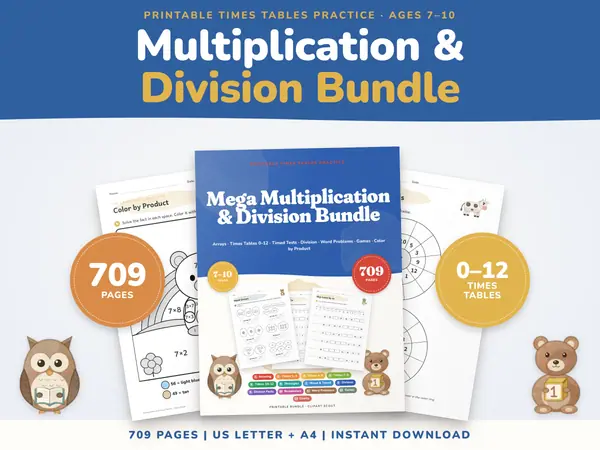
709 pagesUS Letter + A43rd grade & 4th gradeEnglish
See price and buy on EtsyShort answer
The times tables are the multiplication facts from 1 × 1 to 12 × 12. The chart below shows all 144 answers: find one number in the top row and the other in the first column, and the answer is where the row and the column meet. Because 3 × 7 and 7 × 3 give the same answer, there are far fewer facts to learn than it seems.
| × | 1 | 2 | 3 | 4 | 5 | 6 | 7 | 8 | 9 | 10 | 11 | 12 |
|---|---|---|---|---|---|---|---|---|---|---|---|---|
| 1 | 1 | 2 | 3 | 4 | 5 | 6 | 7 | 8 | 9 | 10 | 11 | 12 |
| 2 | 2 | 4 | 6 | 8 | 10 | 12 | 14 | 16 | 18 | 20 | 22 | 24 |
| 3 | 3 | 6 | 9 | 12 | 15 | 18 | 21 | 24 | 27 | 30 | 33 | 36 |
| 4 | 4 | 8 | 12 | 16 | 20 | 24 | 28 | 32 | 36 | 40 | 44 | 48 |
| 5 | 5 | 10 | 15 | 20 | 25 | 30 | 35 | 40 | 45 | 50 | 55 | 60 |
| 6 | 6 | 12 | 18 | 24 | 30 | 36 | 42 | 48 | 54 | 60 | 66 | 72 |
| 7 | 7 | 14 | 21 | 28 | 35 | 42 | 49 | 56 | 63 | 70 | 77 | 84 |
| 8 | 8 | 16 | 24 | 32 | 40 | 48 | 56 | 64 | 72 | 80 | 88 | 96 |
| 9 | 9 | 18 | 27 | 36 | 45 | 54 | 63 | 72 | 81 | 90 | 99 | 108 |
| 10 | 10 | 20 | 30 | 40 | 50 | 60 | 70 | 80 | 90 | 100 | 110 | 120 |
| 11 | 11 | 22 | 33 | 44 | 55 | 66 | 77 | 88 | 99 | 110 | 121 | 132 |
| 12 | 12 | 24 | 36 | 48 | 60 | 72 | 84 | 96 | 108 | 120 | 132 | 144 |
The shaded squares are the square numbers: 1 × 1, 2 × 2, 3 × 3 and so on.
Not sure where to start? How to Teach Multiplication Facts: An Order That Works explains an order to teach the tables in and how to practice.
Choose the right answer. Ten questions each round, taken from the 2 to 12 times tables.
709 pagesUS Letter + A43rd grade & 4th gradeEnglish
See price and buy on Etsy2,289 pagesUS Letter + A4Kindergarten to 3rd gradeEnglish
See price and buy on Etsy1,390 pagesUS Letter + A43rd grade & 4th gradeEnglish
See price and buy on EtsyThey are the multiplication facts for the numbers 1 to 12. Each table lists one number multiplied by 1, 2, 3 and so on up to 12. For example the 3 times table is 3, 6, 9, 12, 15, 18, 21, 24, 27, 30, 33, 36.
Pick one number in the top row and the other in the first column. Follow the column down and the row across. The square where they meet holds the answer. For 6 × 8, the column under 6 and the row beside 8 meet at 48.
A 12 by 12 chart has 144 squares. Since the order of the numbers does not change the answer, each pair appears twice, which leaves 78 different facts. Many of those are in the easy 1, 2, 5, 10 and 11 times tables.
Children usually find the 6, 7, 8 and 12 times tables hardest, because they have the fewest simple patterns. Facts such as 6 × 7 = 42, 7 × 8 = 56 and 8 × 12 = 96 need the most practice.
They are two names for the same thing. People often say "times table" for the facts of one number, such as the 7 times table, and "multiplication chart" for the grid that shows all the tables together.
Teachers and parents are welcome to link to this page. Copy the address or the ready-made link.