How to Teach Multiplication Facts: An Order That Works
By the Clipart Scout team11 min read
Short answer
Start with meaning: equal groups, arrays and skip counting. Then teach the facts from easy to hard: 2s, 10s, 5s, 1s and 0s, then squares, 3s, 4s and 9s, and last the three facts that remain. That order is our practical suggestion, not an official one. The Common Core expects children to know all products of two one-digit numbers from memory by the end of 3rd grade.
Key points
- Teach meaning first: equal groups, arrays and skip counting. Meaning gives a child a way to rebuild a fact they forget.
- Of the 100 facts with factors from 1 to 10, only 55 are different, because 3 x 4 and 4 x 3 are the same fact.
- Once the 1s, 2s, 5s and 10s are known, only 21 different facts remain. In our order, the last three to learn are 6 x 7, 6 x 8 and 7 x 8.
- The Common Core expects all one-digit products from memory by the end of 3rd grade (3.OA.C.7).
- The IES practice guide on struggling students suggests about 10 minutes of fact practice per intervention session. Timed activities should run 1 to 5 minutes and never introduce a concept.
On this page
- How do you teach what multiplication means?
- How many multiplication facts are there to learn?
- What order should you teach multiplication facts in?
- Which strategies help with the hard facts?
- How long should multiplication practice take each day?
- Are timed multiplication tests a good idea?
- What grade should kids know multiplication facts by?
- What do you do once the facts are learned?
- What to do next
You are probably here because your child can say “2, 4, 6, 8” but freezes at 7 x 8. Or the school sent home a times-table sheet and you are not sure where to start.
The answer in short: teach what multiplication means first, then teach the facts from easy to hard, and keep daily practice short. The order below is our own practical suggestion. We looked for an authoritative order for the tables and found none, so treat it as a plan that works well, not as a rule.
This guide gives the meaning steps, a nine-stage order with the number of new facts in each stage, strategies for the hard facts, and a practice routine.
How do you teach what multiplication means?
Multiplication means “this many groups of that many”. Before any facts, a child should be able to show 3 x 4 in three ways and say the same thing about each.
- Equal groups: three plates with four crackers on each. That is 4 + 4 + 4 = 12.
- An array: three rows of four dots in a rectangle. Count the dots: 12.
- Skip counting: count by 4s, three times: 4, 8, 12.
Use real objects first. Buttons, coins and egg cartons all make good arrays. Then draw them. Then write 3 x 4 = 12.
This is also where you show the turn-around rule. Turn the array on its side and you have four rows of three. The total is still 12, so 3 x 4 and 4 x 3 are the same fact. That one idea cuts the work almost in half, as the next section shows.
Second grade already points this way. The Common Core’s Grade 2 standard 2.OA.C.4 has children use addition to find the total in an array of up to 5 rows and 5 columns. If your child can do that, and can skip-count by 5s and 10s, they are ready for facts.
How many multiplication facts are there to learn?
If you multiply the numbers 1 to 10 by each other, there are 100 facts. But because 3 x 4 equals 4 x 3, only 55 of them are different.
Now take away the easy ones. Once a child knows the 1s, 2s, 5s and 10s, only 21 different facts are left. Every one of them is made from 3, 4, 6, 7, 8 and 9:
| Smaller factor | The facts that remain |
|---|---|
| 3 | 3 x 3 = 9, 3 x 4 = 12, 3 x 6 = 18, 3 x 7 = 21, 3 x 8 = 24, 3 x 9 = 27 |
| 4 | 4 x 4 = 16, 4 x 6 = 24, 4 x 7 = 28, 4 x 8 = 32, 4 x 9 = 36 |
| 6 | 6 x 6 = 36, 6 x 7 = 42, 6 x 8 = 48, 6 x 9 = 54 |
| 7 | 7 x 7 = 49, 7 x 8 = 56, 7 x 9 = 63 |
| 8 | 8 x 8 = 64, 8 x 9 = 72 |
| 9 | 9 x 9 = 81 |
That is 6 + 5 + 4 + 3 + 2 + 1 = 21 facts. It is a small, finite job, and it is worth saying out loud to your child. “Twenty-one facts” feels much smaller than “the whole times table”.
What order should you teach multiplication facts in?
We suggest this order: 2s, 10s, 5s, 1s and 0s, then squares, then 3s, 4s and 9s, then the three facts that are left. The idea is to start with facts that children already half-know from counting, and to leave the facts with no pattern until last.
| Stage | What to teach | New different facts | Different facts known so far (of 55) |
|---|---|---|---|
| 1 | 2s (doubles) | 10 | 10 |
| 2 | 10s | 9 | 19 |
| 3 | 5s | 8 | 27 |
| 4 | 1s (and 0s) | 7 | 34 |
| 5 | Squares: 3 x 3, 4 x 4, 6 x 6, 7 x 7, 8 x 8, 9 x 9 | 6 | 40 |
| 6 | 3s | 5 | 45 |
| 7 | 4s | 4 | 49 |
| 8 | 9s | 3 | 52 |
| 9 | 6 x 7, 6 x 8, 7 x 8 | 3 | 55 |
The counts take into account facts already learned in earlier stages. For example, 10 x 2 was counted in stage 1, so stage 2 adds only nine new facts. The 0s do not appear in the count because the count uses factors from 1 to 10, but they take a few minutes: any number times 0 is 0, and any number times 1 is that number.
Why this order?
- 2s, 10s and 5s match counting patterns children already know: by twos, by tens and by fives.
- 1s and 0s have a rule, so there is nothing to memorize.
- Squares are a small group with an easy picture: a square array.
- 3s, 4s and 9s each have a strategy that builds on earlier stages (see below).
- 6 x 7, 6 x 8 and 7 x 8 come last because they have the least pattern. By then there are only three of them.
Move to the next stage when your child answers the current facts quickly without counting on fingers. As a rough guide, give each stage a week or two. Do not wait for perfect before starting the next one, and keep mixing the earlier facts in.
Which strategies help with the hard facts?
Strategies let a child work out a fact they have not memorized yet, and memorized facts then follow from repeated use. The 2009 IES practice guide on struggling students says to teach children in grades 2 to 8 to use the properties of numbers (turn-around, grouping and breaking apart) to work out facts they have not memorized. It also notes evidence that strategy-based teaching beats rote memorizing alone. The examples below are our own.
| Facts | Strategy | Worked example |
|---|---|---|
| 3s | Do the 2s fact, then add one more group | 3 x 7: 2 x 7 = 14, and 14 + 7 = 21 |
| 4s | Double the 2s fact, then double again | 4 x 7: 2 x 7 = 14, and 14 + 14 = 28 |
| 9s | Do 10 groups, then take away one group | 9 x 7: 10 x 7 = 70, and 70 - 7 = 63 |
| 6s | Do the 5s fact, then add one more group | 6 x 8: 5 x 8 = 40, and 40 + 8 = 48 |
| 7 x 8 | Break 8 into 5 and 3 | 7 x 5 = 35, 7 x 3 = 21, and 35 + 21 = 56 |
| Squares | Break one factor apart | 8 x 8: 8 x 5 = 40, 8 x 3 = 24, and 40 + 24 = 64 |
Show each strategy once with an array drawn on paper, so the child sees why it works. For 9 x 7, draw ten rows of 7, then cross out one row. The picture does the explaining.
The same guide suggests presenting facts in families, for example 7 x 8 = 56, 8 x 7 = 56, 56 ÷ 7 = 8 and 56 ÷ 8 = 7. A child who sees the four sentences together learns that multiplication and division are one idea.
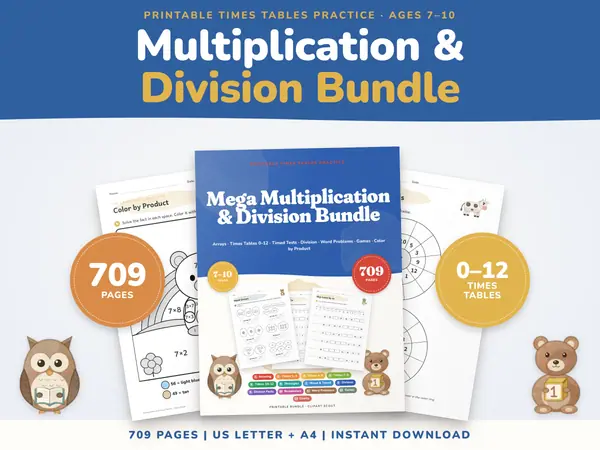
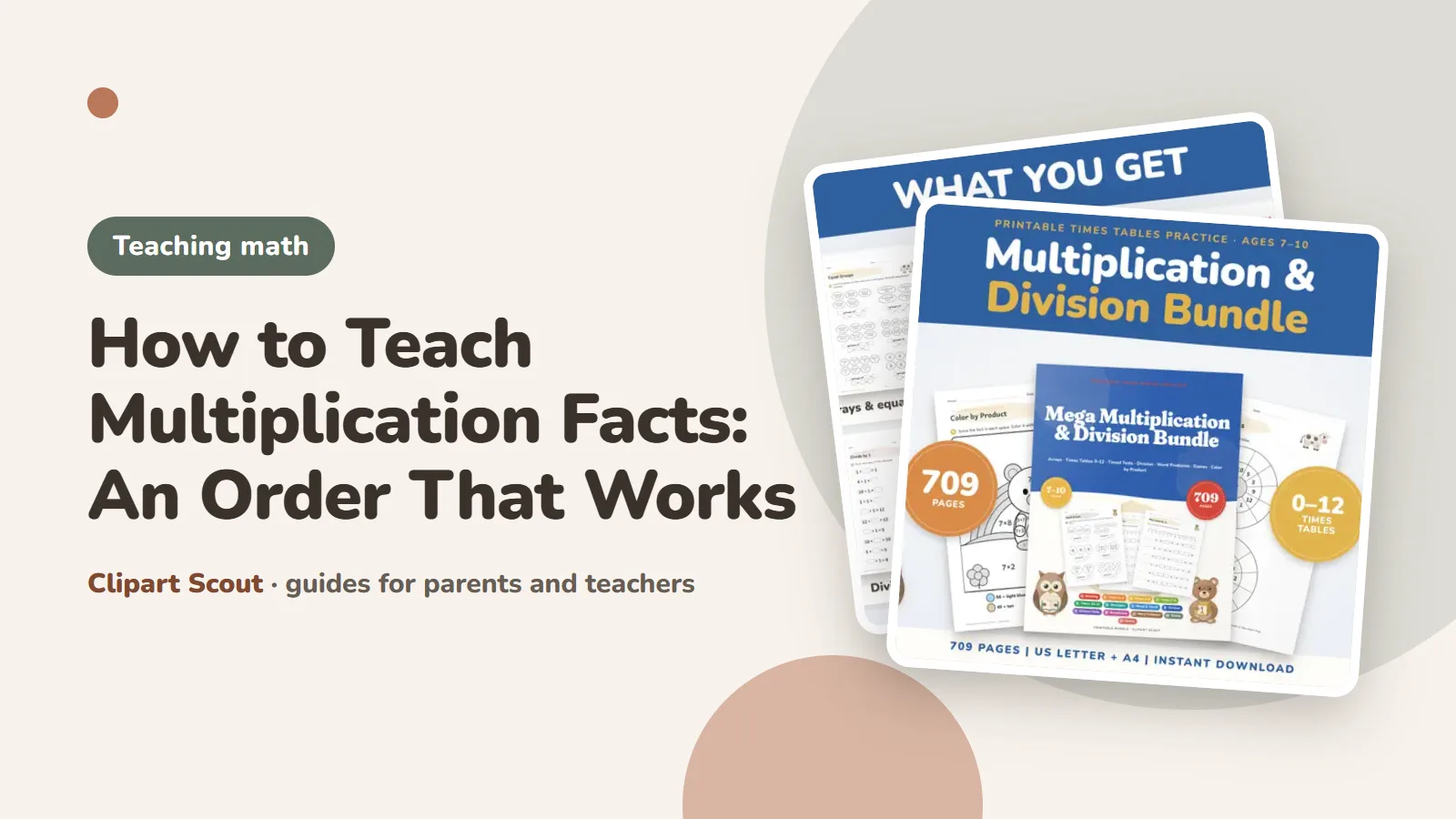
If you want ready-made pages for the meaning steps and the strategy work, the Multiplication Worksheets Bundle has a Meaning of Multiplication section (24 pages) and a Strategies and Properties section (25 pages). The strategy section covers break apart, use a fact you know, doubling and square numbers.
How long should multiplication practice take each day?
The one time figure we can support from a source is this: the 2009 IES guide says interventions should spend about 10 minutes of each session building quick recall of basic facts, and at least 5 minutes if time is short. That advice is written for extra-help sessions with students who are struggling. It is not a rule for every child, and the guide rates the evidence as moderate.
For a child who is not struggling, a short daily session is our suggestion, and five to ten minutes is plenty. A short session that happens every day beats a long one that happens on Sunday.
Here is a simple session shape, based on the guide’s advice to mix one or two new facts with recently learned facts and older ones:
- Warm up with a few facts from an earlier stage, such as the 2s.
- Practice the one or two new facts, using the strategy and the array.
- Mix those with about five facts learned in the last week.
- Finish on a few easy facts so the last thing the child feels is success.
A set of eight cards might hold two new facts (3 x 6 and 3 x 7), three recent ones (3 x 3, 3 x 4 and 5 x 6) and three older ones (2 x 8, 10 x 7 and 5 x 5). Say each answer out loud and name the strategy when the child is stuck.
Tip: Stop while it is still going well. If a child is guessing or getting upset, go back to a stage they know and end there.
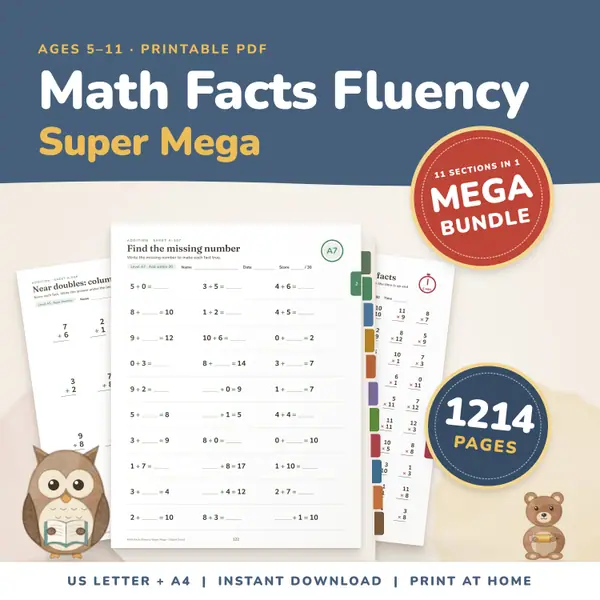
For a full practice library that follows the same tables, the Math Facts Fluency Worksheets have a Multiplication Facts 0 to 12 section, with a page set for every table from 0 to 12. Its 1,214 pages also cover addition, subtraction and division facts, so it suits a child who needs fluency across all four.
Are timed multiplication tests a good idea?
Timed practice can help, but only at the right moment and in small doses. The 2021 IES guide says timed activities should be one part of a session, last 1 to 5 minutes, and be used after children have worked on a concept over many lessons. They should never introduce it. The panel also does not recommend simply handing out timed worksheets or leaving a child alone with a program.
In practice that means:
- Teach the stage first. Use timed work only on facts the child already knows how to find.
- Keep it to one minute at first. Stay at or under five minutes.
- Have the child compete with their own last score, not with a sibling.
- Stay nearby. Look at the misses together, and give the strategy for each one.
If a timed sheet makes your child anxious, drop it for a few weeks and use games and cards instead. The guide asks for timed work as one tool, not as the main one.
What grade should kids know multiplication facts by?
The Common Core expects children to know from memory all products of two one-digit numbers by the end of 3rd grade. The standard is 3.OA.C.7, and it also asks for fluent multiplying and dividing within 100. Our 3rd grade guide puts that in the context of the rest of the year.
The facts carry on into 4th grade, where children multiply a number of up to four digits by a one-digit number and multiply two two-digit numbers. A child with shaky facts will find that work slow. See what a 4th grader should know for the full picture.
States set their own standards, and some have reworded or replaced the Common Core. If you teach in a school or follow a state plan, check your own list of goals. The Common Core text is on the official standards site, and the Grade 3 operations page is an online copy that says it is unofficial.
What do you do once the facts are learned?
Use them. Facts turn into fluency when children meet them inside real problems. Our guide to math word problems by grade shows how multiplication and division stories look in 3rd and 4th grade, and 2-digit addition with regrouping covers the earlier skill that multi-digit multiplication builds on.
For a 3rd grader who needs the whole year in one place, the Third Grade Worksheets Bundle has a 69-page Multiplication section (2s to 10s, strategies, timed drills, color by product and mystery pictures), a division section and 14 sections in all, with answer keys in the back.
What to do next
- Check meaning first: ask your child to show 3 x 4 as groups, as an array and as skip counting.
- Test the 1s, 2s, 5s and 10s. If they are solid, you are 34 facts into the 55.
- Start the order at the first stage that is not quick yet, and give each stage a week or two.
- Practice for five to ten minutes a day, mixing new, recent and older facts, and ending on an easy one.
- When a stage is solid, add a short timed round of one to five minutes. Browse our math worksheets if you want printable pages for any stage.
Sources
- Common Core State Standards for Mathematics and English Language Arts (official documents), National Governors Association Center for Best Practices and Council of Chief State School Officers.
- Grade 3 mathematics: Operations and Algebraic Thinking, standard 3.OA.C.7 (online copy of the Common Core standards), thecorestandards.org, an unofficial copy of the standards.
- Grade 2 mathematics: Operations and Algebraic Thinking, standard 2.OA.C.4 (online copy of the Common Core standards), thecorestandards.org, an unofficial copy of the standards.
- Grade 4 mathematics: Number and Operations in Base Ten, standard 4.NBT.B.5 (online copy of the Common Core standards), thecorestandards.org, an unofficial copy of the standards.
- Assisting Students Struggling with Mathematics: Response to Intervention (RtI) for Elementary and Middle Schools (2009), Institute of Education Sciences, What Works Clearinghouse.
- Assisting Students Struggling with Mathematics: Intervention in the Elementary Grades (2021), Institute of Education Sciences, What Works Clearinghouse.
This guide is general information for parents and teachers. It is not medical, legal or professional advice. Every guide lists its sources at the end. More about our guides is on the About page.