Math Word Problems by Grade: Examples and How to Teach
By the Clipart Scout team11 min read
Short answer
Teach word problems with one routine: read and retell the story, draw or model it, write the number sentence, then check the answer against the story. The Common Core moves from adding and subtracting within 20 in 1st grade to multistep problems with all four operations in 4th grade. Twenty original examples with answers are below, five for each grade.
Key points
- Use the same four steps every time: read and retell, draw or model, write the number sentence, check against the story.
- Word problems grow from within 20 in 1st grade to two-step problems within 100 in 2nd grade, two-step problems with all four operations in 3rd grade and multistep problems in 4th grade.
- Two IES practice guides for struggling students rate teaching word problems deliberately, by their underlying structure, as strong evidence.
- Single keywords can mislead. 'More' can appear in a subtraction story and 'left' can appear in an addition story.
- Retelling the story in your own words is often what a stuck child needs most.
On this page
- Why are word problems so hard for kids?
- How do you teach a child to solve word problems?
- What does the research say about teaching word problems?
- Should kids look for keywords in word problems?
- What word problems are expected in each grade?
- What are some math word problems for 1st grade?
- What are some math word problems for 2nd grade?
- What are some math word problems for 3rd graders?
- What are some math word problems for 4th graders?
- What can you do with these problems?
- What to do next
A child who is quick with 47 + 38 can still stare at a story about apples and not know where to begin. The math did not change. The reading and the deciding did.
The fix is a routine your child uses every time, plus plenty of short problems at the right level. This guide gives the routine, the grade-by-grade expectations, five original problems with answers for each of grades 1 to 4, and what to say about keywords. All the examples are ours, and every answer is worked out below.
Why are word problems so hard for kids?
A word problem asks a child to do four jobs at once: read the story, picture what is happening, decide what to do with the numbers and then calculate. A child who is good at each job alone can still lose the thread when they must do all four together.
That is a practical explanation, not a research finding. It explains why the routine below separates the jobs, so that your child only has to do one at a time.
How do you teach a child to solve word problems?
Use the same four steps every time. They are our own routine, and they fit what the IES practice guides recommend: teach word problems deliberately, use drawings, and check the work.
- Read and retell. Read the problem, then have your child tell the story back in their own words without looking. “Jo has 62 shells. She gave away 27. We want to know how many are left.”
- Draw or model. Draw a bar, a number line or little pictures. Mark what is known and what is not.
- Write the number sentence. Put the numbers and the question into an equation, with a box or a letter for the unknown.
- Check against the story. Does the answer make sense in the story? Say it as a full sentence with the label: “She has 35 shells left.”
Worked example (2nd grade). A farm stand has 47 apples in the morning and gets 38 more in the afternoon. How many apples does it have now?
- Retell: there were 47, then 38 more came. We want the total.
- Draw: one long bar for the total, split into a part of 47 and a part of 38.
- Number sentence: 47 + 38 = ?
- Solve: 7 + 8 = 15, so write 5 and trade a ten. Then 4 + 3 + 1 = 8 tens. The total is 85.
- Check: 85 is more than 47, and close to 50 + 40 = 90. It makes sense: the farm stand has 85 apples.
If your child gets stuck, go back to step 1. A child who cannot retell the story does not yet understand it, and no operation will fix that.
Tip: Hide the numbers. Ask your child to tell you the story with blanks: “A farm stand had some apples, then got some more.” Once the story is clear, bring the numbers back.
What does the research say about teaching word problems?
Two IES practice guides for children who struggle with math, one from 2009 and one from 2021, both recommend teaching word problems on purpose. The 2009 guide rates as strong the advice to teach word problems by their common underlying structures. The 2021 guide rates word problems, and the use of concrete objects and drawings, as strong evidence too. It also recommends the number line. You can read them at the 2009 guide and the 2021 guide.
A third guide, Improving Mathematical Problem Solving in Grades 4 Through 8, covers grades 4 to 8, so it speaks most directly to our 4th grade section. It rates two recommendations as strong: help students monitor and reflect on their problem-solving process, and teach them to use visual representations. It also recommends showing more than one strategy.
All of these are aimed at schools and at students who need extra help. We suggest the routine above as a home version, but it is not a research-tested program.
Should kids look for keywords in word problems?
Keywords can help a little, but they should not be the main method, because one word can point either way. Here are two examples.
“More” in a subtraction story. Tom has 9 marbles. That is 4 more than Ben has. How many marbles does Ben have? The word “more” suggests adding 9 + 4 = 13. But Tom has more, so Ben has fewer: 9 - 4 = 5. Check: 5 + 4 = 9.
“Left” in an addition story. Kai gave away 6 stickers and has 9 left. How many did Kai start with? “Gave away” and “left” suggest subtracting. But the question asks for the start, so you add the 6 given away to the 9 that remain: 9 + 6 = 15. Check: 15 - 6 = 9.
The same trap appears with “altogether”. Maya has 14 stickers altogether. Six are stars and the rest are hearts. How many hearts? The answer is 14 - 6 = 8.
This is practical advice. We did not find a source that settles the keyword question. The better habit is to picture the story: who has what, what changes, and what is unknown.
What word problems are expected in each grade?
The Common Core grows word-problem work year by year, as shown here. Our examples follow these grade levels. States set their own standards, so check your school’s list.
| Grade | What the Common Core expects | Standard |
|---|---|---|
| 1st | Solves addition and subtraction word problems within 20 | 1.OA.A.1 |
| 2nd | Solves one-step and two-step addition and subtraction word problems within 100 | 2.OA.A.1 |
| 3rd | Solves two-step word problems using the four operations, with whole numbers and whole-number answers | 3.OA.D.8 |
| 4th | Solves multistep word problems with the four operations, including making sense of remainders | 4.OA.A.3 |
The standards come from the official Common Core documents. The pages listed in our sources are an online copy that describes itself as unofficial.
What are some math word problems for 1st grade?
First graders work within 20, with pictures and objects. Let them act out the story with counters.
| Problem | Number sentence | Answer |
|---|---|---|
| Mia has 8 stickers. Her friend gives her 6 more. How many stickers does she have now? | 8 + 6 = 14 | 14 stickers |
| There are 15 apples in a bowl. The children eat 7. How many apples are left? | 15 - 7 = 8 | 8 apples |
| Leo has 12 red crayons and 9 blue crayons. How many more red crayons than blue crayons does he have? | 12 - 9 = 3 | 3 more red crayons |
| A pond has 5 ducks, 4 frogs and 6 fish. How many animals are there in all? | 5 + 4 + 6 = 15 | 15 animals |
| 11 birds sit on a fence. Some fly away. Then 6 birds are left. How many flew away? | 11 - 6 = 5 | 5 birds |
The last one has the unknown in the middle of the story. Try it with 11 counters: cover some, leave 6, and count the covered ones.
What are some math word problems for 2nd grade?
Second graders solve one-step and two-step problems within 100. That includes comparing, and finding a missing number as well as a total. Equal groups and arrays are the first step toward multiplication.
| Problem | Number sentence | Answer |
|---|---|---|
| A farm stand has 47 apples in the morning and gets 38 more. How many apples does it have now? | 47 + 38 = 85 | 85 apples |
| Jo has 62 shells. She gives 27 shells to a friend. How many shells does she have left? | 62 - 27 = 35 | 35 shells |
| Sam has 54 cards and Lee has 29 cards. How many more cards does Sam have? | 54 - 29 = 25 | 25 more cards |
| Ana had 45 stickers. She gave 18 to her sister and then got 10 more. How many stickers does she have now? | 45 - 18 = 27, then 27 + 10 = 37 | 37 stickers |
| A garden has 4 rows of 5 tomato plants. How many plants are there? | 5 + 5 + 5 + 5 = 20 | 20 plants |
Both the 85 and the 35 follow the regrouping steps in our guide to 2-digit addition with regrouping. Ana’s problem needs two steps, so write the middle answer down before the final one.
What are some math word problems for 3rd graders?
Third graders add multiplication and division to the mix, plus two-step problems that use any of the four operations. Time and numbers up to 1,000 also appear.
| Problem | Number sentence | Answer |
|---|---|---|
| A box holds 7 pencils. How many pencils are in 6 boxes? | 6 x 7 = 42 | 42 pencils |
| 24 cookies are shared equally among 4 children. How many cookies does each child get? | 24 ÷ 4 = 6 | 6 cookies |
| A library has 348 picture books and 275 chapter books. How many books does it have in all? | 348 + 275 = 623 | 623 books |
| Pria buys 5 packs of 8 cards. She gives 15 cards to a friend. How many cards does she have left? | 5 x 8 = 40, then 40 - 15 = 25 | 25 cards |
| Band practice begins at 3:40 and ends at 4:15. How many minutes long is it? | 3:40 to 4:00 is 20 minutes, and 4:00 to 4:15 is 15 minutes: 20 + 15 = 35 | 35 minutes |
For the multiplication and division facts behind these, see our guide to how to teach multiplication facts. The time problem is easier on a number line, as our guide to how to teach telling time shows. Our 3rd grade guide puts the year in context.
What are some math word problems for 4th graders?
Fourth graders solve multistep problems, work with larger numbers, and must decide what a remainder means.
| Problem | Number sentence | Answer |
|---|---|---|
| A hall has 24 rows of 15 seats. How many seats are there in all? | 24 x 15 = 240 + 120 = 360 | 360 seats |
| 83 students go on a trip. Each van holds 9 students. How many vans are needed? | 83 ÷ 9 = 9 with 2 left over, so 9 vans plus 1 more | 10 vans |
| Mia has 15 beads. Jo has 4 times as many beads as Mia. How many beads does Jo have? | 15 x 4 = 60 | 60 beads |
| Rosa buys 3 books at 12 dollars each. She pays with 50 dollars. How much change does she get? | 3 x 12 = 36, then 50 - 36 = 14 | 14 dollars |
| Dad eats 2/8 of a pizza and Maya eats 3/8 of the same pizza. What fraction of the pizza did they eat? | 2/8 + 3/8 = 5/8 | 5/8 of the pizza |
The van problem is the one to talk about. The math gives 9 with 2 students left over, but those 2 still need a ride, so the answer is 10 vans. The same division can have a different answer in a different story, and that is what making sense of a remainder means.
If a child has trouble with the story rather than the arithmetic, our guide to reading comprehension strategies can help with the reading side.
What can you do with these problems?
Do not hand a child all twenty at once. Give two or three a day, at the grade level or one step below, and have them use the four steps on each one. A child who gets a problem wrong should retell the story first, then redraw it.
Writing problems is a good change of pace. Ask your child to write a story for 8 + 6, then swap stories and solve each other’s.
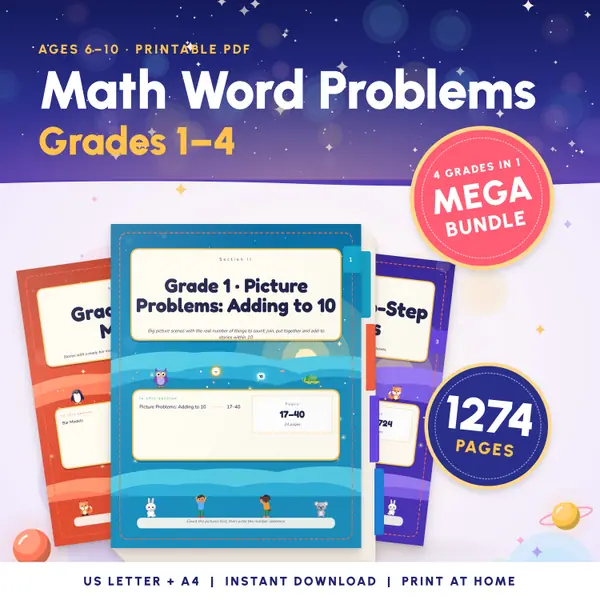
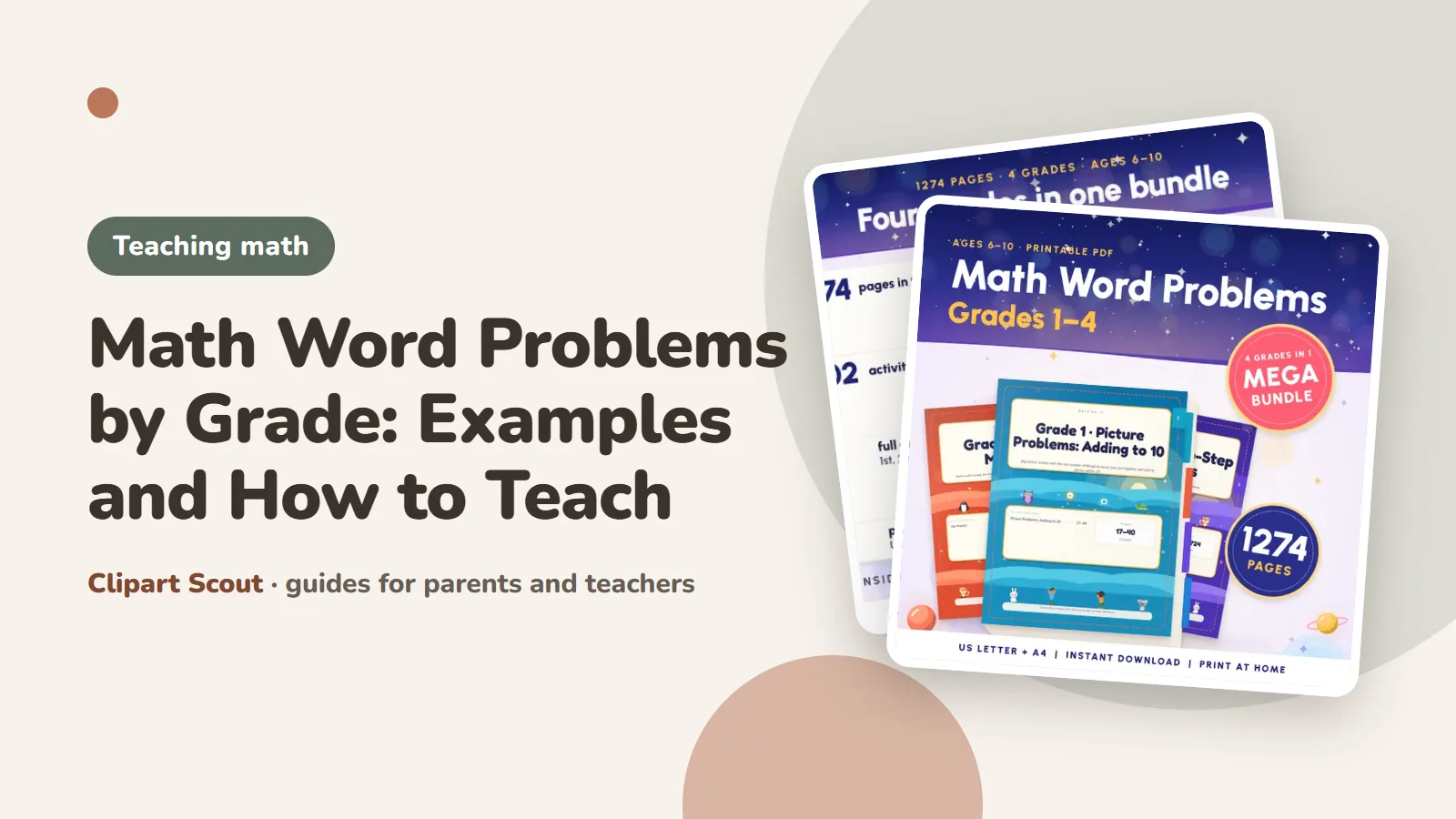
If you would like a set of pages that does this for every grade, the Math Word Problems Grades 1-4 bundle has 1,274 pages, with colored edge tabs by grade and read, draw, solve and check pages in each grade. It has Grade 1 picture problems to 10, Grade 2 two-step problems, Grade 3 multiplication and division stories, and Grade 4 division and remainders.
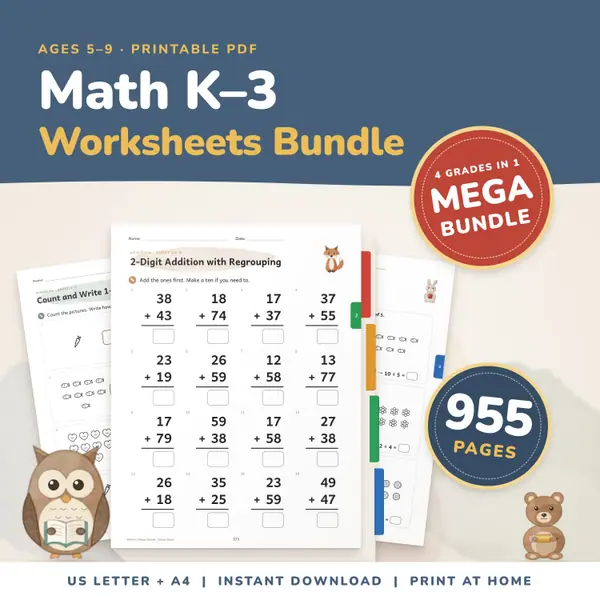
For general math practice across kindergarten to 3rd grade, the Math Worksheets Bundle K-3 has 955 pages, including 1st grade word problems and 3rd grade two-step problems with all four operations.
What to do next
- Choose the grade level of your child, or one step below, and pick two problems from the table.
- Use the four steps out loud: retell, draw, write the number sentence, check.
- If your child is stuck, go back to retelling the story with the numbers hidden.
- Add one problem a day for a week, then swap in a story your child wrote.
- For printable pages, browse our math worksheets.
Sources
- Common Core State Standards for Mathematics and English Language Arts (official documents), National Governors Association Center for Best Practices and Council of Chief State School Officers.
- Grade 1 mathematics: Operations and Algebraic Thinking, standard 1.OA.A.1 (online copy of the Common Core standards), thecorestandards.org, an unofficial copy of the standards.
- Grade 2 mathematics: Operations and Algebraic Thinking, standard 2.OA.A.1 (online copy of the Common Core standards), thecorestandards.org, an unofficial copy of the standards.
- Grade 3 mathematics: Operations and Algebraic Thinking, standard 3.OA.D.8 (online copy of the Common Core standards), thecorestandards.org, an unofficial copy of the standards.
- Grade 4 mathematics: Operations and Algebraic Thinking, standard 4.OA.A.3 (online copy of the Common Core standards), thecorestandards.org, an unofficial copy of the standards.
- Assisting Students Struggling with Mathematics: Response to Intervention (RtI) for Elementary and Middle Schools (2009), Institute of Education Sciences, What Works Clearinghouse.
- Assisting Students Struggling with Mathematics: Intervention in the Elementary Grades (2021), Institute of Education Sciences, What Works Clearinghouse.
- Improving Mathematical Problem Solving in Grades 4 Through 8 (2012, revised 2018), Institute of Education Sciences, What Works Clearinghouse.
This guide is general information for parents and teachers. It is not medical, legal or professional advice. Every guide lists its sources at the end. More about our guides is on the About page.