What Should a 3rd Grader Know by the End of the Year?
By the Clipart Scout team8 min read
Short answer
By the end of 3rd grade, the Common Core standards expect a child to multiply and divide within 100, knowing all products of two one-digit numbers from memory, and to add and subtract within 1,000. Fractions begin, with unit fractions and fractions on a number line. Area and perimeter, time to the minute and two-step word problems are also expected. In reading and language, children decode longer words and use a wider range of grammar.
Key points
- Multiplication and fractions are the two big changes in 3rd grade math.
- By the end of the year a child is expected to know every product of two one-digit numbers from memory, such as 7 x 8.
- 3rd grade fractions use denominators 2, 3, 4, 6 and 8 only.
- Reading shifts to longer words and independent reading, and grammar grows to include complex sentences.
- These are end-of-year goals. Children reach them at different points during the year.
On this page
- What is a 3rd grader expected to learn?
- What math should a 3rd grader know?
- Should a 3rd grader know their multiplication tables?
- What should a 3rd grader know in reading and language?
- What about writing and handwriting in 3rd grade?
- End-of-3rd-grade checklist
- What should a 3rd grader know at the beginning of the year?
- What if your child is behind or ahead?
- What to do next
Third grade is the year math homework starts to look different. Multiplication and division arrive, and fractions stop being pictures of pizza and become numbers with a place on a number line.
The short version: a 3rd grader finishes the year multiplying and dividing within 100, adding and subtracting within 1,000, working with simple fractions and finding area. Reading moves to longer words and more independent reading. The sections below give each goal with a two-minute check, then a checklist to print.
One note first. This guide uses the Common Core standards for Grade 3. States set their own standards, and several have reworded or replaced the Common Core, so your child’s school may list some goals differently. The teacher can give you the school’s own list.
What is a 3rd grader expected to learn?
A 3rd grader is expected to work on four main areas in math, plus longer words, wider grammar and independent reading. The Grade 3 introduction to the math standards names the four math areas: multiplication and division within 100, fractions (especially unit fractions), rectangular arrays and area, and two-dimensional shapes.
| Subject | The main goals for the year |
|---|---|
| Math | Multiplication and division within 100; fractions; area and perimeter; time, volume and mass |
| Reading | Longer words, prefixes and suffixes, reading stories and informational texts independently |
| Language | Plurals, verb tenses, agreement, complex sentences, punctuation in dialogue |
| Writing | Using a keyboard, with adult help, to produce and publish writing |
What math should a 3rd grader know?
By the end of the year a 3rd grader should multiply and divide fluently within 100 and know every product of two one-digit numbers from memory. Fractions are the second big change, and both arrive in the same year, so the middle of the year can feel heavy.
| Skill | What it looks like | Two-minute check |
|---|---|---|
| Multiplication and division | Multiplies and divides within 100. Knows all products of two one-digit numbers from memory | Ask 6 x 7, 9 x 8 and 56 ÷ 7, one after another |
| Word problems | Solves two-step problems with the four operations, with whole-number answers | “A pack has 6 pencils. You buy 4 packs and give away 5. How many are left?” (19) |
| Rounding | Rounds whole numbers to the nearest 10 or 100 | Round 347 to the nearest 10 and the nearest 100 |
| Adding and subtracting | Adds and subtracts fluently within 1,000 | Give 468 + 275 and 703 - 258 on paper |
| Multiples of 10 | Multiplies a one-digit number by a multiple of 10, such as 9 x 80 | Ask 4 x 30 and 9 x 80 |
| Fractions | Understands unit fractions such as 1/4 and fractions made from them such as 3/4. Uses denominators 2, 3, 4, 6 and 8 | Fold a strip of paper into eighths and shade 3 of them |
| Fractions on a number line | Places fractions on a number line | Draw a line from 0 to 1 and mark 1/2 and 3/4 |
| Equal and compared fractions | Recognizes simple equivalent fractions. Compares fractions with the same numerator or the same denominator | Is 1/2 the same as 2/4? Which is bigger, 3/8 or 5/8? |
| Time | Tells and writes time to the nearest minute. Works out intervals in minutes | “Soccer starts at 3:40 and ends at 4:15. How long is it?” (35 minutes) |
| Volume and mass | Measures and estimates liquid volume and mass in grams, kilograms and liters | Compare a full water bottle with a paper clip: which is measured in grams, which in kilograms? |
| Area and perimeter | Finds area by counting unit squares and by multiplying side lengths. Solves perimeter problems | A rectangle is 6 by 3. Find the area and the perimeter (18 and 18) |
| Graphs and shapes | Draws scaled picture graphs and bar graphs. Knows rhombuses, rectangles and squares are quadrilaterals | Graph pets in your family, with each picture standing for 2 |
Multiplication is easier when children see it as equal groups and arrays before they memorize anything. When you are ready to work on the facts themselves, see our guide to how to teach multiplication facts.
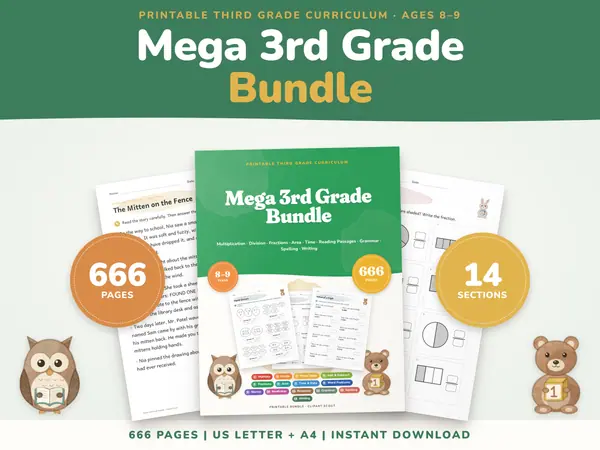
If you want pages for these skills, the Third Grade Worksheets Bundle has a 69-page Multiplication section, a 40-page Fractions section and a 32-page Area, Perimeter & Shapes section, with answer keys at the back.
Should a 3rd grader know their multiplication tables?
By the end of the year, yes: the standard says a 3rd grader knows from memory all products of two one-digit numbers. The standard says “fluently”, so the aim is quick and accurate recall, reached through strategies first and practice second.
The goal is for the end of the year, so the facts do not all have to be there in September. A quick daily check, three or four facts at breakfast, shows which ones need more work.
What should a 3rd grader know in reading and language?
By the end of the year a 3rd grader should decode longer words and read stories, dramas, poems and informational texts independently, at the high end of the grades 2 to 3 range. Grammar also grows well past the 2nd grade list.
| Skill | What it looks like | Two-minute check |
|---|---|---|
| Longer words | Decodes words with several syllables | Read: fantastic, umbrella, wonderful, adventure |
| Prefixes and suffixes | Knows the meaning of the most common prefixes and suffixes | Ask what unfair, replay and kindness mean |
| Plurals and nouns | Forms regular and irregular plurals. Uses abstract nouns | Ask for the plural of box, child and mouse. Name an abstract noun (like courage) |
| Verbs | Uses the simple tenses. Agreement between subject and verb and between a pronoun and the word it stands for | Fix: “The dogs runs fast.” Fix: “Maya lost their hat.” |
| Describing words | Forms and uses comparative and superlative adjectives and adverbs | Fill in: fast, faster, ___ |
| Sentences | Uses coordinating and subordinating conjunctions. Writes simple, compound and complex sentences | Join two short sentences with because or but |
| Punctuation | Capitalizes words in titles. Uses commas in addresses and dialogue, quotation marks and possessives | Write an address and one line of dialogue with the speaker named |
What about writing and handwriting in 3rd grade?
In the standards checked for this guide, the new writing expectation in 3rd grade is using a keyboard, with adult guidance, to produce and publish writing. A 3rd grader is also working on the grammar and punctuation above, which show up whenever they write a paragraph.
Cursive does not appear in the Common Core pages we checked, although some families and schools teach it in 3rd grade. If you are wondering whether to start, read when kids learn cursive.
Quick check: Ask for a six-sentence paragraph about a favorite place. Look for a complete sentence each time, a capital for the name of the place, and a comma or quotation marks if anyone speaks.
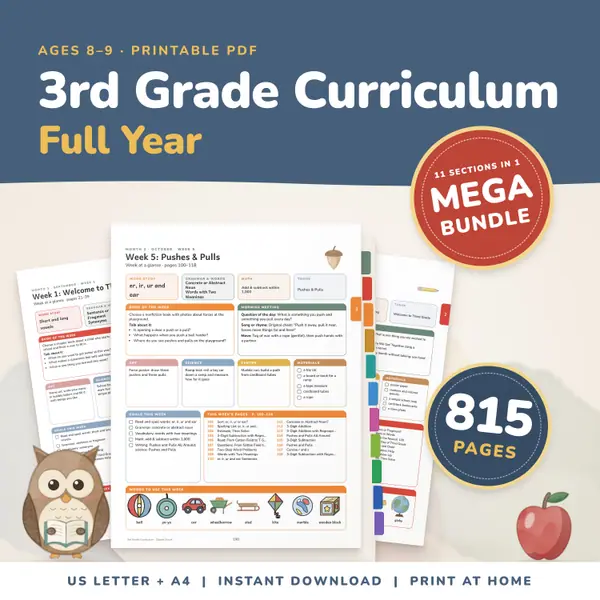
If you teach at home, the 3rd Grade Curriculum Full Year puts these skills in order across the year. Multiplication facts for 2, 5, 10, 3, 4 and 6 come in November, and facts for 7, 8 and 9 in December. It has 815 pages, including 36 reading passages with question pages.
End-of-3rd-grade checklist
Print this page and tick what is solid. Circle the two or three lines that are not there yet.
Math
Reading and language
What should a 3rd grader know at the beginning of the year?
At the start of 3rd grade a child is expected to have the end-of-2nd-grade skills. In math that means knowing all sums of two one-digit numbers from memory, adding and subtracting fluently within 100, working within 1,000 with models and place-value strategies, reading and writing numbers to 1,000, telling time to the nearest five minutes and measuring with a ruler.
In reading it means decoding regular two-syllable words with long vowels and words with common prefixes and suffixes. The full list is in our guide to what a 2nd grader should know. A short review of addition facts in the first weeks makes multiplication much easier.
What if your child is behind or ahead?
These are goals for the end of the year, and children reach them at different points. A child who is still working on the 7s and 8s in March has a clear next step, not a failure.
If the checklist shows gaps, choose the ones the rest of the year leans on: the multiplication facts and fractions on a number line. Ten minutes a day on one skill is easier to keep up than a long weekend session. Talk to the teacher too. They see your child’s work daily and can tell you what matters most right now.
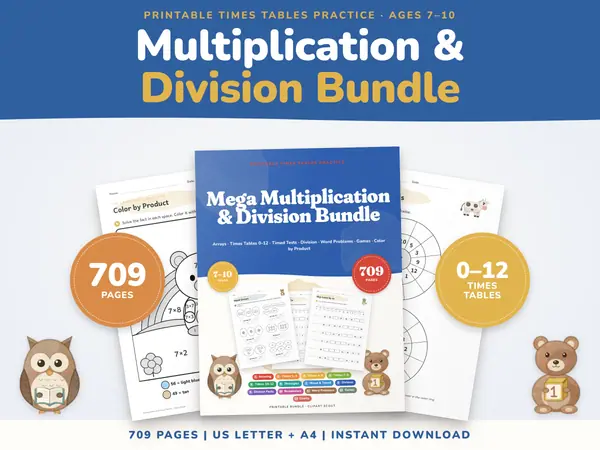
For a child who needs more multiplication and division practice, the Multiplication Worksheets Bundle has 709 pages covering times tables 1 to 12, division facts and word problems. If your child already has most of the list, look ahead to what a 4th grader should know.
What to do next
- Run the multiplication check on three different days, with a few facts each time, and note which ones are slow.
- Print the checklist, tick what is solid and circle two or three things to work on.
- Ask the teacher for the school’s own list of end-of-year goals and compare it with this one.
- Practice one circled skill for ten minutes a day for two weeks, then check it again.
- To pick single topics, browse our 3rd grade worksheets.
Sources
- Common Core State Standards for Mathematics and English Language Arts (official documents), National Governors Association Center for Best Practices and Council of Chief State School Officers.
- Grade 3 mathematics: introduction (online copy of the Common Core standards), thecorestandards.org, an unofficial copy of the standards.
- Grade 3 mathematics: Operations and Algebraic Thinking (online copy of the Common Core standards), thecorestandards.org, an unofficial copy of the standards.
- Grade 3 mathematics: Number and Operations in Base Ten (online copy of the Common Core standards), thecorestandards.org, an unofficial copy of the standards.
- Grade 3 mathematics: Number and Operations, Fractions (online copy of the Common Core standards), thecorestandards.org, an unofficial copy of the standards.
- Grade 3 mathematics: Measurement and Data (online copy of the Common Core standards), thecorestandards.org, an unofficial copy of the standards.
- Grade 3 reading: foundational skills (online copy of the Common Core standards), thecorestandards.org, an unofficial copy of the standards.
- Grade 3 language standards (online copy of the Common Core standards), thecorestandards.org, an unofficial copy of the standards.
- Grade 3 writing standards (online copy of the Common Core standards), thecorestandards.org, an unofficial copy of the standards.
This guide is general information for parents and teachers. It is not medical, legal or professional advice. Every guide lists its sources at the end. More about our guides is on the About page.