What Should a 4th Grader Know by the End of the Year?
By the Clipart Scout team8 min read
Short answer
By the end of 4th grade, the Common Core standards expect a child to add and subtract multi-digit whole numbers with the standard algorithm, multiply up to four-digit numbers by one digit, and divide up to four-digit numbers by one digit. Fraction equivalence, adding and subtracting fractions with like denominators and tenths and hundredths as decimals are also expected. In language, children use more grammar and type at least one page in a sitting.
Key points
- Whole-number work reaches 1,000,000, with multiplication and division of multi-digit numbers.
- Fractions grow: equivalent fractions, adding and subtracting with like denominators, and multiplying a fraction by a whole number.
- Decimals start small, with tenths and hundredths linked to fractions.
- Reading and writing add summarizing, more grammar and typing at least one page in a single sitting.
- These are end-of-year goals. Children reach them at different points during the year.
On this page
- What is a 4th grader expected to learn?
- What math should a 4th grader know?
- Should a 4th grader know long division?
- What do 4th graders learn in reading, writing and grammar?
- End-of-4th-grade checklist
- What should a 4th grader know at the beginning of the year?
- What if your child is behind or ahead?
- What to do next
By 4th grade the math in a backpack has numbers up to a million and fractions with different bottoms. It is easy to lose track of what your child is meant to finish by June.
The short version: a 4th grader finishes the year multiplying and dividing larger whole numbers, working with equivalent fractions and the first decimals, and measuring angles. Reading and writing add summaries, more grammar and typing. The tables below give each goal with a two-minute check, followed by a checklist to print.
One note first. This guide uses the Common Core standards for Grade 4. States set their own standards, and several have reworded or replaced the Common Core, so your child’s school may list some goals differently. The teacher can give you the school’s own list.
What is a 4th grader expected to learn?
A 4th grader is expected to work on three main areas in math, plus reading, grammar and typing. The Grade 4 introduction to the math standards names the three: multi-digit multiplication and division, fraction equivalence with adding, subtracting and multiplying by whole numbers, and analyzing and classifying shapes by their properties.
| Subject | The main goals for the year |
|---|---|
| Math | Multi-digit multiplication and division; fractions; decimals to hundredths; angles and symmetry |
| Reading | Summarizing stories and informational texts; reading in the grades 4 to 5 range |
| Language | Relative pronouns, progressive tenses, modal verbs, commas and quotation marks |
| Writing | Typing at least one page in a single sitting |
What math should a 4th grader know?
By the end of the year a 4th grader should add and subtract numbers up to 1,000,000 with the standard algorithm and multiply and divide multi-digit numbers using place-value strategies. Fractions and decimals take up the other big share of the year.
| Skill | What it looks like | Two-minute check |
|---|---|---|
| Place value | Reads, writes and compares whole numbers up to 1,000,000. Rounds to any place | Round 482,637 to the nearest ten thousand (480,000) |
| Adding and subtracting | Uses the standard algorithm fluently with multi-digit numbers | Give 45,892 + 37,468 and 70,000 - 24,615 |
| Multiplying | Multiplies up to four digits by one digit, and two digits by two digits, using place-value strategies | Ask 3,482 x 6 and 27 x 34, and listen to how they break the numbers apart |
| Dividing | Divides up to four digits by one digit, with whole-number quotients and remainders | Ask 856 ÷ 4 and 7,325 ÷ 6 (1,220 remainder 5) |
| Factors and multiples | For numbers 1 to 100, finds factor pairs, recognizes multiples and tells prime from composite | List the factor pairs of 36. Is 29 prime? Is 51? |
| Multistep problems | Solves multistep word problems with the four operations, including making sense of remainders | “29 students ride in vans that seat 6. How many vans?” (5) |
| Equivalent fractions | Recognizes and makes equivalent fractions. Compares fractions with different numerators and denominators | Write 2/3 as twelfths. Which is bigger, 3/4 or 5/8? |
| Adding fractions | Adds and subtracts fractions and mixed numbers with like denominators | 2 1/5 + 1 3/5 |
| Fractions times whole numbers | Multiplies a fraction by a whole number | 3 x 2/5 (6/5, or 1 1/5) |
| Decimals | Writes fractions with denominators 10 or 100 as decimals. Compares decimals to hundredths | Write 7/10 and 43/100 as decimals. Which is bigger, 0.6 or 0.58? |
| Measurement | Converts a larger unit to a smaller one within a system. Uses area and perimeter formulas for rectangles | 3 feet is how many inches? Find the area and perimeter of a 9 by 4 rectangle |
| Angles | Measures angles in degrees with a protractor and sketches angles of a given size | Draw a 70-degree angle |
| Lines and shapes | Draws points, lines, rays, right, acute and obtuse angles, and parallel and perpendicular lines. Recognizes lines of symmetry | Draw a pair of parallel lines. Fold a heart to show its line of symmetry |
The multi-digit multiplication goal depends on knowing the one-digit facts. If your child hesitates on 7 x 8, spend a week there first. Our guide to how to teach multiplication facts can help.
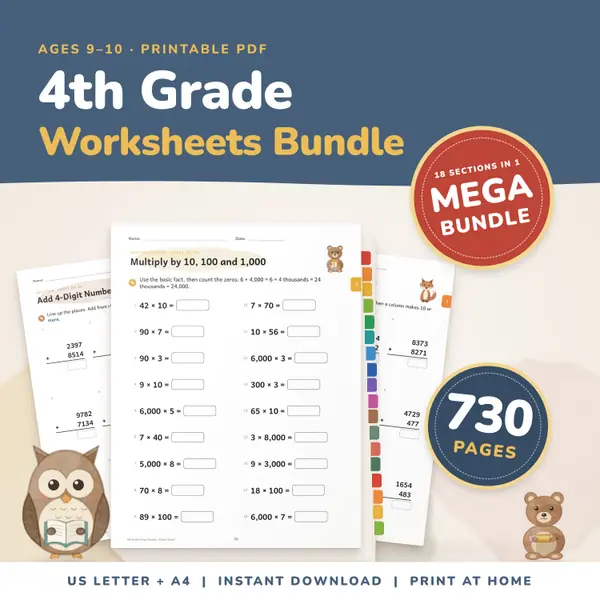
The 4th Grade Worksheets Bundle has a 42-page Multiplication section, a 35-page Long Division section, a 44-page Fractions section and a 21-page Decimals section, with answer keys at the back.
Should a 4th grader know long division?
A 4th grader is expected to divide numbers of up to four digits by a one-digit divisor, finding the quotient and the remainder. The standard says “using strategies” and does not name one written method, so the way your child lays it out may depend on the school.
Division by a two-digit divisor is a 5th grade goal, so one-digit divisors are the whole target this year. The standards also ask children to make sense of a remainder in a word problem: 29 students in vans of 6 need 5 vans, not 4 and a bit.
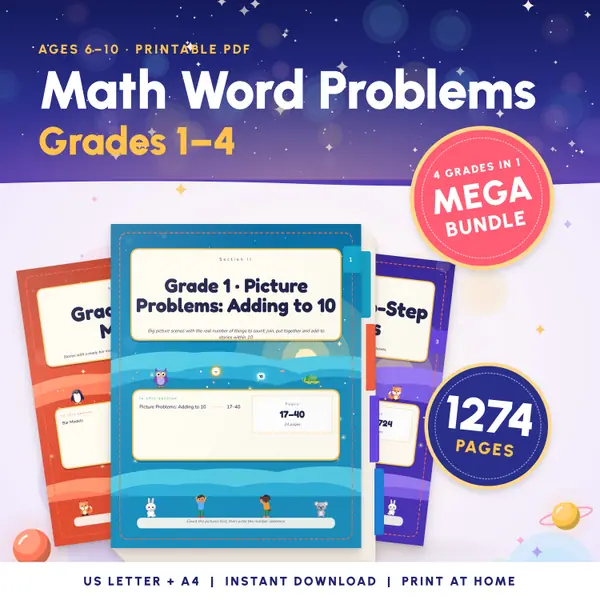
For help with the story-problem side, see our guide to math word problems by grade. The Math Word Problems Grades 1-4 bundle has a 30-page Grade 4 Multi-Step Problems section and a 26-page Division and Remainders section.
What do 4th graders learn in reading, writing and grammar?
A 4th grader is expected to summarize both stories and informational texts and to read in the grades 4 to 5 complexity band, with support on the hardest texts. Grammar gets more detailed, and children type at least one page in a single sitting.
| Skill | What it looks like | Two-minute check |
|---|---|---|
| Summarizing | Summarizes a literary text and an informational text | After a chapter, ask for three sentences: who, what happened, how it ended |
| Reading new words | Uses letter-sound, syllable and word-part knowledge to read unfamiliar long words | Read: unbelievable, transportation, misunderstanding |
| Relative words | Uses relative pronouns and adverbs | Fill in who, which or that: “The girl ___ lives next door” |
| Verb forms | Uses progressive tenses and modal verbs | Change “I walk” to “I was walking”. Use can, should or must in a sentence |
| Word order | Uses the usual order of adjectives and prepositional phrases | Which sounds right: “a red big ball” or “a big red ball”? |
| Complete sentences | Spots and fixes fragments and run-ons | Fix: “Because it was raining.” Fix: “We ran home it was late.” |
| Confused words | Uses words like to, too, two and there and their correctly | Fill in: “___ going to ___ house” |
| Punctuation | Comma before and, but or or in a compound sentence. Commas and quotation marks for speech. Explains simple similes and metaphors | Write one line of dialogue. Ask what “as quiet as a mouse” means |
| Typing | Types at least one page in a single sitting | Time ten minutes of typing a favorite paragraph |
Quick check: Ask for a one-page piece typed on a keyboard, such as a letter to a grandparent. Count the page, then read it together for run-ons and missing quotation marks.
End-of-4th-grade checklist
Print this page and tick what is solid. Circle the two or three lines that are not there yet.
Math
Reading, language and writing
What should a 4th grader know at the beginning of the year?
At the start of 4th grade a child is expected to have the end-of-3rd-grade skills. In math that means knowing all products of two one-digit numbers from memory, adding and subtracting fluently within 1,000, understanding unit fractions and placing fractions on a number line, and finding area and perimeter.
In language it means plurals, verb tenses, agreement and complex sentences. The full list is in our guide to what a 3rd grader should know. A short review of the multiplication facts in September pays off all year.
What if your child is behind or ahead?
These are goals for the end of the year, and children reach them at different points. A child who still needs the multiplication table for 8 x 7 in October has one clear thing to practice, not a verdict.
If the checklist shows gaps, choose the ones the rest of the year leans on: the one-digit multiplication facts and equivalent fractions. Ten minutes a day on one skill is easier to keep up than a long weekend session. Talk to the teacher too. They see your child’s work daily and can tell you what matters most right now.
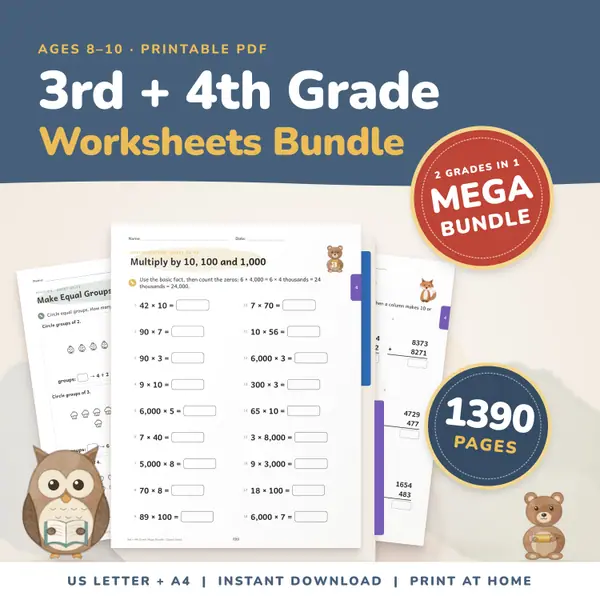
If your child already has most of the list, look ahead to what a 5th grader should know. Families with two children, or one child working across two years, can use the 3rd and 4th Grade Worksheets Bundle, which has 1,390 pages with sections marked by grade.
What to do next
- Run the multiplication and fraction checks over a few days, and note where your child pauses.
- Print the checklist, tick what is solid and circle two or three things to work on.
- Ask the teacher for the school’s own list of end-of-year goals and compare it with this one.
- Practice one circled skill for ten minutes a day for two weeks, then check it again.
- To pick single topics, browse our 4th grade worksheets.
Sources
- Common Core State Standards for Mathematics and English Language Arts (official documents), National Governors Association Center for Best Practices and Council of Chief State School Officers.
- Grade 4 mathematics: introduction (online copy of the Common Core standards), thecorestandards.org, an unofficial copy of the standards.
- Grade 4 mathematics: Operations and Algebraic Thinking (online copy of the Common Core standards), thecorestandards.org, an unofficial copy of the standards.
- Grade 4 mathematics: Number and Operations in Base Ten (online copy of the Common Core standards), thecorestandards.org, an unofficial copy of the standards.
- Grade 4 mathematics: Number and Operations, Fractions (online copy of the Common Core standards), thecorestandards.org, an unofficial copy of the standards.
- Grade 4 mathematics: Measurement and Data (online copy of the Common Core standards), thecorestandards.org, an unofficial copy of the standards.
- Grade 4 mathematics: Geometry (online copy of the Common Core standards), thecorestandards.org, an unofficial copy of the standards.
- Grade 4 reading: foundational skills (online copy of the Common Core standards), thecorestandards.org, an unofficial copy of the standards.
- Grade 4 reading: literature (online copy of the Common Core standards), thecorestandards.org, an unofficial copy of the standards.
- Grade 4 language standards (online copy of the Common Core standards), thecorestandards.org, an unofficial copy of the standards.
- Grade 4 writing standards (online copy of the Common Core standards), thecorestandards.org, an unofficial copy of the standards.
This guide is general information for parents and teachers. It is not medical, legal or professional advice. Every guide lists its sources at the end. More about our guides is on the About page.