What Should a 5th Grader Know by the End of the Year?
By the Clipart Scout team9 min read
Short answer
By the end of 5th grade, the Common Core standards expect a child to multiply multi-digit whole numbers with the standard algorithm, divide up to four-digit numbers by two-digit numbers, and work with decimals to thousandths. Adding, subtracting and multiplying fractions, volume and the coordinate plane are also expected. In reading and language, children quote text accurately, compare texts, use perfect tenses and type at least two pages in a sitting.
Key points
- Math centers on fractions, decimals and volume, with division by two-digit numbers.
- Fractions with unlike denominators are added and subtracted, and fractions are multiplied. Dividing a fraction by a fraction is not required.
- Reading asks children to quote the text exactly and to compare characters, events and the structure of two texts.
- Cursive is not in the Common Core pages checked for this guide. Keyboarding is: at least two pages in a single sitting.
- These are end-of-year goals. Children reach them at different points during the year.
On this page
- What is a 5th grader expected to learn?
- What math should a 5th grader know?
- Is 5th grade math hard?
- What should a 5th grader know in reading and language?
- What do 5th graders learn in writing?
- End-of-5th-grade checklist
- What should a 5th grader know at the beginning of the year?
- What if your child is behind or ahead?
- What to do next
By 5th grade, math homework can include a fraction divided by a whole number, a decimal times a decimal and a box measured in cubes. If you want to know how much of that is expected by June, a plain list helps.
The short version: a 5th grader finishes the year multiplying and dividing larger numbers, working with decimals and fractions in all four operations (with limits on fraction division), and finding volume. In reading, children quote the text and compare texts. The sections below give each goal with a two-minute check and a checklist to print.
One note first. This guide uses the Common Core standards for Grade 5. States set their own standards, and several have reworded or replaced the Common Core, so your child’s school may list some goals differently. The teacher can give you the school’s own list.
What is a 5th grader expected to learn?
A 5th grader is expected to work on three main areas in math, plus reading, grammar and typing. The Grade 5 introduction to the math standards names the three: fractions (adding, subtracting, multiplying and dividing in limited cases), division with two-digit divisors together with decimals to hundredths, and volume.
| Subject | The main goals for the year |
|---|---|
| Math | Fractions and decimals; division with two-digit divisors; volume; the coordinate plane |
| Reading | Quoting the text, comparing characters and texts, finding more than one main idea |
| Language | Perfect tenses, correlative conjunctions, commas, titles of works |
| Writing | Typing at least two pages in a single sitting |
What math should a 5th grader know?
By the end of the year a 5th grader should multiply multi-digit whole numbers with the standard algorithm, divide up to four-digit numbers by two-digit numbers and work with decimals and fractions in several ways. Fractions and decimals take up most of the year.
| Skill | What it looks like | Two-minute check |
|---|---|---|
| Multiplying | Multiplies multi-digit whole numbers fluently with the standard algorithm | Give 3,456 x 27 (93,312) |
| Dividing | Divides up to four-digit numbers by two-digit numbers, using strategies | Give 7,344 ÷ 24 (306) |
| Powers of 10 | Explains the patterns of zeros and the decimal point when multiplying or dividing by powers of 10. Writes powers of 10 with exponents | What is 4.7 x 100? Write 1,000 as a power of 10 |
| Decimal place value | Reads, writes and compares decimals to thousandths. Rounds decimals to any place | Which is bigger, 0.35 or 0.349? Round 6.827 to the nearest hundredth |
| Decimal operations | Adds, subtracts, multiplies and divides decimals to hundredths, using models or drawings and place-value strategies | Give 3.2 x 4 and 7.5 ÷ 5 |
| Adding fractions | Adds and subtracts fractions with unlike denominators, including mixed numbers | Give 2/3 + 3/4 and 3 1/2 - 1 3/4 |
| Multiplying fractions | Multiplies a fraction or a whole number by a fraction | Give 2/3 x 3/5 (2/5) |
| Dividing with fractions | Divides unit fractions by whole numbers and whole numbers by unit fractions | Give 1/4 ÷ 3 and 3 ÷ 1/4 |
| Fractions as division | Understands a fraction as the numerator divided by the denominator | What is 3 ÷ 4 as a fraction? |
| Expressions | Uses and evaluates parentheses, brackets and braces | Give 4 x (6 + 3) - 2 (34) |
| Volume | Measures volume by counting unit cubes. Uses V = l x w x h and V = b x h for boxes with whole-number edges | Find the volume of a box 5 by 4 by 3 (60 cubic units) |
| Units | Converts between different-sized units in one system | How many meters is 350 centimeters? |
| Coordinate plane | Understands the coordinate plane and graphs points in the first quadrant | Plot (3, 2) and (5, 4) and name each point |
| Shapes | Classifies two-dimensional figures in a hierarchy by their properties | Is every square a rectangle? Is every rectangle a square? |
A footnote in the standards says dividing a fraction by a fraction is not required in 5th grade. If your child meets it on a worksheet, it is extra, not a gap.
When a child can do each step but loses points on word problems, the trouble is often choosing the operation. Our guide to math word problems by grade covers word problems at every level.
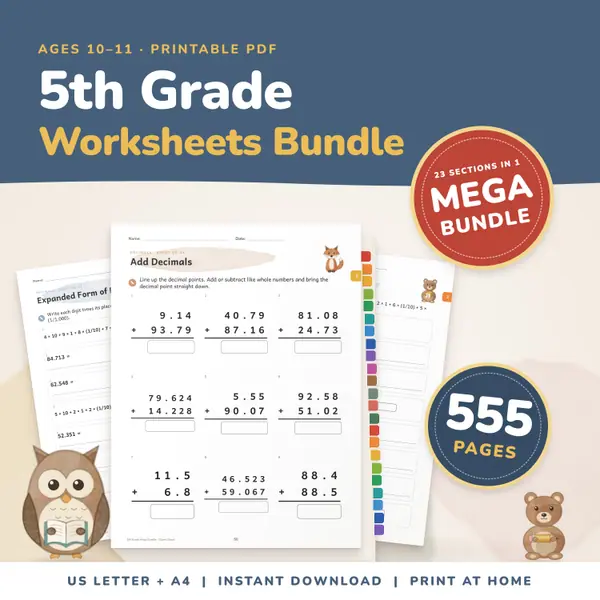
The 5th Grade Worksheets Bundle has a 26-page Long Division: 2-Digit Divisors section, two 24-page fraction sections (adding and subtracting, then multiplying and dividing), a 20-page Multiply & Divide Decimals section and a 15-page Volume section.
Is 5th grade math hard?
It is a large year, because fractions, decimals and volume all arrive together, and each leans on 4th grade work. Whether it feels hard depends on how solid the 4th grade version is.
A useful test is to trace a problem back one year. A child who cannot add 2/3 and 3/4 may not have secure equivalent fractions. A child who slips when multiplying decimals may need the 4th grade work on tenths and hundredths first. Fix the earlier step, then return to the new one.
What should a 5th grader know in reading and language?
By the end of the year a 5th grader should quote accurately from a text to support what they say, compare characters, settings, events and text structures, and read stories, dramas, poems and informational texts independently at the high end of the grades 4 to 5 range.
| Skill | What it looks like | Two-minute check |
|---|---|---|
| Quoting | Quotes accurately from a text when explaining it or drawing an inference | “How do you know she was nervous?” Ask for the exact words |
| Comparing | Compares two or more characters, settings or events. Compares the structure of two informational texts | Compare two characters from the same book on one trait |
| Main ideas | Finds two or more main ideas in a text and summarizes it | After an article, ask for two main ideas and a summary |
| Figurative language | Interprets figurative language, including similes and metaphors, in context | “The classroom was a zoo.” What does the writer mean? |
| Parts of speech | Explains the function of conjunctions, prepositions and interjections. Uses correlative conjunctions | Use either/or and neither/nor in two sentences |
| Verb tenses | Forms the perfect tenses. Corrects shifts in tense | Fix: “She walked to the store and buys milk.” |
| Commas | Uses commas in a series, after an introductory word or phrase, and to set off yes and no and a name in direct address | Write: “Yes, Maya, I can come.” |
| Titles | Shows titles of works with underlining, quotation marks or italics | Write the title of a favorite book and a favorite song |
What do 5th graders learn in writing?
In the standards checked for this guide, the writing expectation named for 5th grade is typing at least two pages in a single sitting. Everything in the language table above shows up whenever a child writes a paragraph, so the best check is a real piece of writing.
Quick check: Ask for a two-page typed report on a topic they know well, in one sitting. Look at how many pages they reach, then read it together for tense shifts, commas and quoted facts.
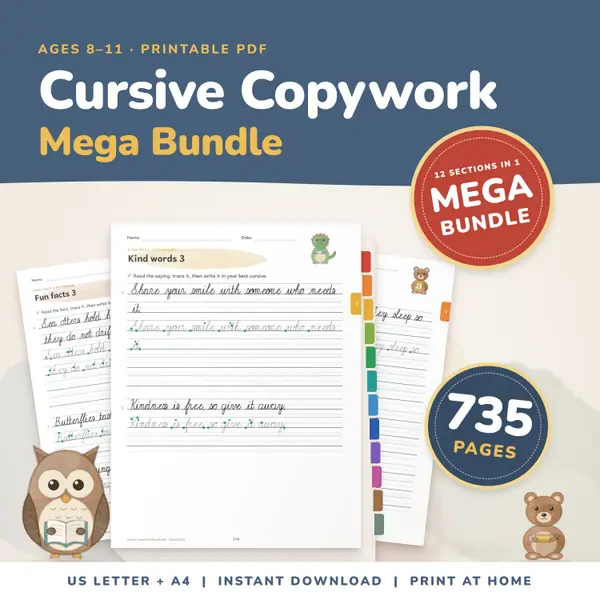
Cursive does not appear in the Common Core pages we checked. If your child is learning it anyway, a little daily copying keeps it going. Our guide to copywork explains the idea. The Cursive Copywork Bundle covers grades 3 to 5, with 735 pages that include a 159-page Fun Fact Copywork section and a 148-page Paragraph Copywork section.
End-of-5th-grade checklist
Print this page and tick what is solid. Circle the two or three lines that are not there yet.
Math
Reading, language and writing
What should a 5th grader know at the beginning of the year?
At the start of 5th grade a child is expected to have the end-of-4th-grade skills. In math that means adding and subtracting multi-digit numbers with the standard algorithm, multiplying up to four digits by one digit, dividing up to four digits by one digit, equivalent fractions, adding fractions with like denominators, writing tenths and hundredths as decimals and measuring angles with a protractor.
In reading and language it means summarizing texts, fixing fragments and run-ons and using commas and quotation marks in dialogue. The full list is in our guide to what a 4th grader should know. A few weeks of review at the start of the year helps.
What if your child is behind or ahead?
These are goals for the end of the year, and children reach them at different points. A child who still checks each fraction step in November has one clear skill to practice, not a problem.
If the checklist shows gaps, choose the ones the rest of the year leans on: equivalent fractions, decimal place value and the multiplication facts. Ten minutes a day on one skill is easier to keep up than a long weekend session. Talk to the teacher too. They see your child’s work daily and can tell you what matters most right now.
After 5th grade comes middle school, so the weeks before it are a good time to firm up any circled lines. If you teach at home, our guide to how many hours a day to homeschool covers how long a school day needs to be.
What to do next
- Run the math checks over a few days, and note where your child pauses or guesses.
- Print the checklist, tick what is solid and circle two or three things to work on.
- Ask the teacher for the school’s own list of end-of-year goals and compare it with this one.
- Practice one circled skill for ten minutes a day for two weeks, then check it again.
- To pick single topics, browse our 5th grade worksheets.
Sources
- Common Core State Standards for Mathematics and English Language Arts (official documents), National Governors Association Center for Best Practices and Council of Chief State School Officers.
- Grade 5 mathematics: introduction (online copy of the Common Core standards), thecorestandards.org, an unofficial copy of the standards.
- Grade 5 mathematics: Operations and Algebraic Thinking (online copy of the Common Core standards), thecorestandards.org, an unofficial copy of the standards.
- Grade 5 mathematics: Number and Operations in Base Ten (online copy of the Common Core standards), thecorestandards.org, an unofficial copy of the standards.
- Grade 5 mathematics: Number and Operations, Fractions (online copy of the Common Core standards), thecorestandards.org, an unofficial copy of the standards.
- Grade 5 mathematics: Measurement and Data (online copy of the Common Core standards), thecorestandards.org, an unofficial copy of the standards.
- Grade 5 mathematics: Geometry (online copy of the Common Core standards), thecorestandards.org, an unofficial copy of the standards.
- Grade 5 reading: literature (online copy of the Common Core standards), thecorestandards.org, an unofficial copy of the standards.
- Grade 5 reading: informational text (online copy of the Common Core standards), thecorestandards.org, an unofficial copy of the standards.
- Grade 5 language standards (online copy of the Common Core standards), thecorestandards.org, an unofficial copy of the standards.
- Grade 5 writing standards (online copy of the Common Core standards), thecorestandards.org, an unofficial copy of the standards.
This guide is general information for parents and teachers. It is not medical, legal or professional advice. Every guide lists its sources at the end. More about our guides is on the About page.