What Is Copywork? How to Use It in Your Homeschool
By the Clipart Scout team6 min read
Short answer
Copywork is the practice of copying a short, well-written passage by hand, letter by letter, from a model. It builds handwriting through repeated, careful writing. A common amount is a few minutes a day: a word or sentence in the early grades, growing to a short paragraph by 4th or 5th grade. The amounts in this guide are our suggestions, not a standard.
Key points
- Copywork means copying a short passage by hand from a model. It is practice for handwriting, spelling and punctuation.
- Five to ten minutes a day is plenty. Stop while the writing is still neat.
- The daily amounts by grade in this guide are our suggestions, not a standard.
- Choose passages worth copying: poems, sayings, facts and good sentences from books you read.
- Dictation is the next step: the child studies a passage, then writes it from your voice.
On this page
Copywork is one of the simplest things you can add to a homeschool day. It takes a few minutes, needs no preparation beyond a good passage, and gives a child steady handwriting practice that feels more like writing than like a drill.
The short version: copywork means copying a short, well-chosen passage by hand from a model. A word or sentence suits the early grades, and a short paragraph suits 4th or 5th grade. This guide covers how much to give by grade, what to copy, how to run a session and how to move on to dictation.
All amounts and routines below are our suggestions. They are not a standard, and you can adjust them to your child.
What is copywork in homeschool?
Copywork is copying a short passage by hand, letter by letter, from a model the child can see. The child looks at the original, writes it, and compares the result. It practices letter shapes, spacing, spelling and punctuation all at once.
Because the child copies rather than composes, there is no pressure to think of what to say. All of the attention goes to the writing itself. That makes it a gentle way to build handwriting for children who find blank pages hard.
How much copywork should a child do each day?
A good daily amount is whatever the child can write neatly in five to ten minutes. Use the table as a starting point and shorten or lengthen it to suit your child. These are our suggestions, and children in the same grade vary a lot.
| Grade | A suggested daily piece | Typical time |
|---|---|---|
| Kindergarten | One letter, or a short word such as “cat”, traced and then copied | 3 to 5 minutes |
| 1st grade | One short sentence | 5 minutes |
| 2nd grade | One or two sentences, such as a saying or a fun fact | 5 to 8 minutes |
| 3rd grade | Two or three sentences, or a short poem verse | 8 to 10 minutes |
| 4th grade | A short paragraph | 10 minutes |
| 5th grade | A paragraph, or a longer poem verse | 10 minutes |
Quality counts more than quantity. If the last line is messier than the first, the piece was too long, so shorten it tomorrow.
For the whole day around it, see our homeschool schedule by grade.
What should children copy?
Choose passages that are worth reading twice and match the child’s level. A passage that is too hard turns copywork into a spelling struggle. A passage that is too easy gets boring.
Good sources include:
- Short poems and verses
- Proverbs and sayings
- True facts about animals, space or the body
- A favorite line from a book you are reading together
- Spelling words for the week, written in a sentence
- A thank-you note or a letter that will actually be sent
Print and cursive both work. If your child is learning cursive, copywork is a natural place to use it, once the letters and joins are comfortable. Our guide to how to teach cursive writing covers that order, and when kids learn cursive covers what schools do.
How do you run a copywork session?
A copywork session takes five to ten minutes, and it works best with the same steps every day. Here is a routine you can follow:
- Set up. Check the seat, the pencil grip and the paper position. Put the model where the child can see it clearly.
- Read it first. The child reads the passage aloud, once or twice. Point out any tricky word or punctuation mark.
- Copy it. The child writes slowly, one word at a time, looking back at the model between words.
- Check together. Ask the child to compare the copy with the original, and to circle their best letter or word. Praise something specific.
- Fix one thing. Choose one small thing to improve tomorrow, such as spacing between words, and leave it at that.
Tip: If your child gets frustrated, cut the piece in half. A short piece written well is better than a long one written badly.
How do you check copywork with a child?
Check it with the child, not for the child. Let your child do the first look, because spotting their own mistakes builds the habit of checking. Then add one comment of your own.
A short list helps. Ask: Does it match the original? Are all the words there? Are capitals and punctuation in place? Are the letters sitting on the line, with even spacing? Choose just one of these to work on each week. A child who is told about six problems at once usually remembers none of them.
When do you move on to dictation?
Move to dictation when copying is easy and accurate. In copywork the child sees the passage while writing. In dictation you read it aloud and the child writes it without a model, so it also practices listening, spelling and remembering.
A gentle bridge is prepared dictation:
- The child studies the passage for a minute or two, looking at spelling and punctuation.
- You cover or take away the model.
- You read the passage aloud, one phrase at a time, and the child writes it.
- The child checks the result against the original and fixes any mistakes.
Start with a single sentence and increase the length slowly. You could keep one day a week for dictation and use the other days for copywork. Our guide to what a 2nd grader should know lists the writing goals that sit around this work.
What does research say about copywork?
No study we checked tests copywork on its own, but research does support teaching handwriting directly. A meta-analysis of K-12 intervention studies by Santangelo and Graham (2016) found that handwriting instruction improved handwriting legibility and fluency, and also the quality, length and fluency of students’ writing.
In a controlled study, first graders with handwriting and writing difficulties who got extra handwriting instruction improved more than their peers in handwriting and in how fluently they composed text. The federal practice guide on elementary writing recommends teaching students to become fluent with handwriting, spelling, sentence construction, typing and word processing, with moderate evidence.
These sources are about handwriting teaching in general. We state them modestly and do not claim any particular result from copywork.
Which printables make copywork easier?
Printed copywork saves you from hunting for passages and writing models. Choose by grade and by print or cursive.
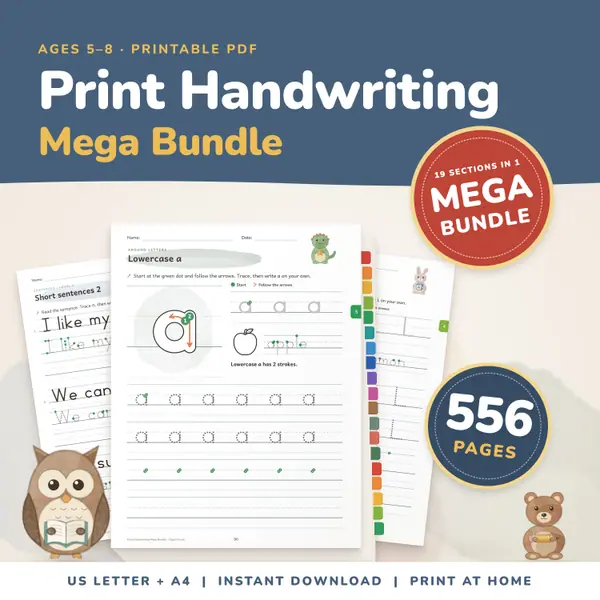
For kindergarten to 2nd grade in print, the Print Handwriting Practice Bundle has 556 pages. Its sections include 120 short original sentences, 60 longer sentences, 72 kindness sayings and 72 true fun facts to read, trace and copy.
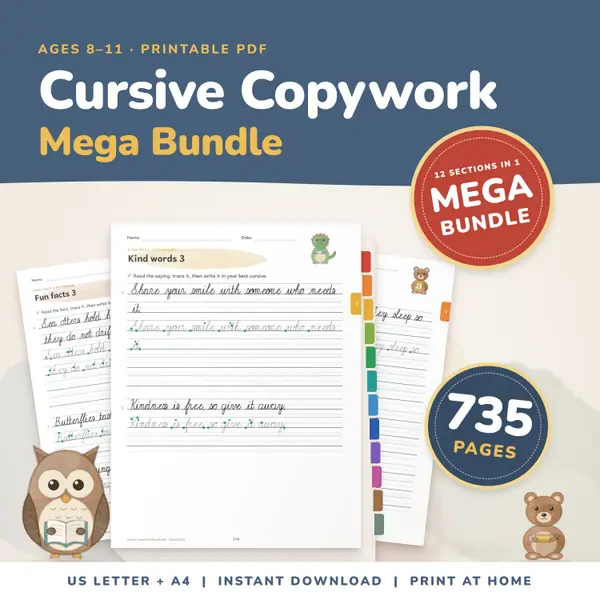
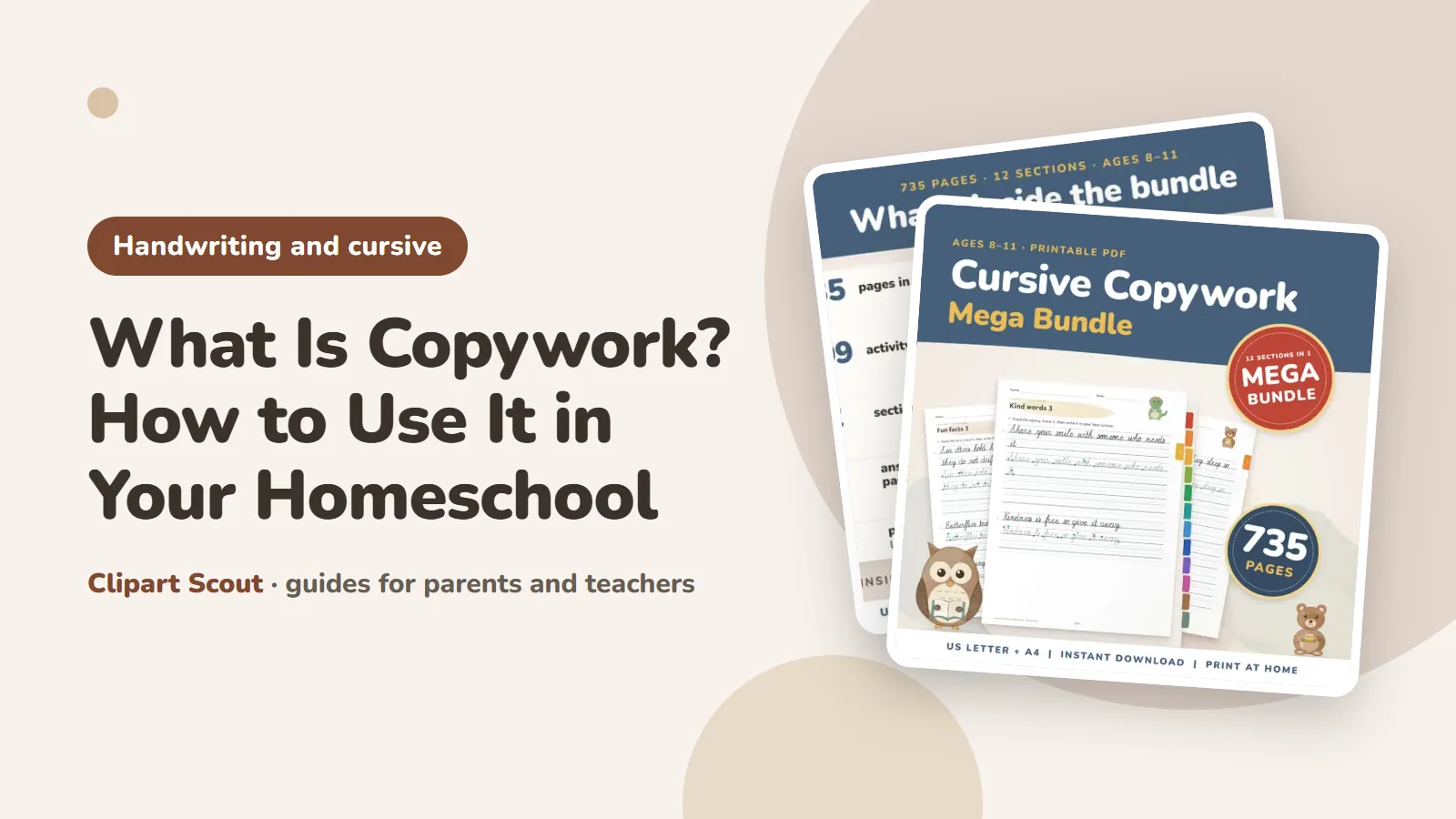
For grades 3 to 5 in cursive, the Cursive Copywork Bundle has 735 pages. It includes 162 true fun facts, 116 kindness sayings, 60 proverbs and 98 original paragraphs to copy, plus a 36-week plan in its Start Here section.
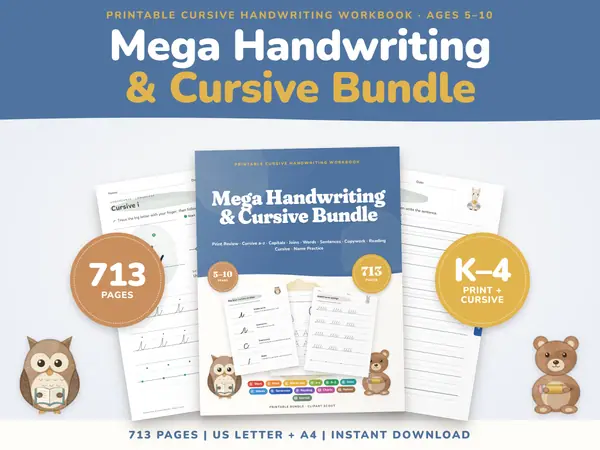
If your child is still learning the cursive letters, the Cursive Handwriting Practice Bundle has 713 pages, including a 119-page Sentences and Copywork section with 20 original poems.
You can see all of these in our handwriting and cursive practice pages.
What to do next
- Pick a first passage that is short, such as a favorite saying or one sentence from a book.
- Choose a daily size from the table and set a timer for five to ten minutes.
- Run one session this week using the steps above, and ask your child which letter they liked best.
- After a few weeks, try one prepared dictation with a single sentence.
- If you would like ready-made passages, browse our handwriting and cursive practice section.
Sources
- A Comprehensive Meta-Analysis of Handwriting Instruction, Santangelo and Graham, Educational Psychology Review (2016), ERIC record EJ1100680.
- Teaching Elementary School Students to Be Effective Writers (practice guide), IES What Works Clearinghouse (June 2012, revised October 2018).
- Controlled study of extra handwriting instruction for first graders with handwriting and writing difficulties, Graham, Harris and Fink, Journal of Educational Psychology 92(4) (2000), ERIC record EJ621003.
This guide is general information for parents and teachers. It is not medical, legal or professional advice. Every guide lists its sources at the end. More about our guides is on the About page.