What Should a 2nd Grader Know by the End of the Year?
By the Clipart Scout team9 min read
Short answer
By the end of 2nd grade, the Common Core standards expect a child to add and subtract within 100 fluently, understand place value to 1,000, tell time to the nearest five minutes and solve problems with coins and dollar bills. In reading, they decode two-syllable words and read grade-level text smoothly enough to understand it. In writing, they produce short opinion, informative and story pieces.
Key points
- Math centers on place value to 1,000 and on adding and subtracting within 100.
- By the end of the year a 2nd grader is expected to know every one-digit addition fact from memory, such as 8 + 7.
- Reading moves from sounding out short words to reading longer words smoothly and understanding the text.
- Multiplication is not expected yet. Skip counting, arrays and odd and even numbers prepare for it.
- These are end-of-year goals. Children reach them at different points during the year.
On this page
- What is a 2nd grader expected to learn?
- What math should a 2nd grader know?
- How well should a 2nd grader read by the end of the year?
- What writing and grammar should a 2nd grader know?
- End-of-2nd-grade checklist
- What should a 2nd grader know at the beginning of the year?
- What if your child is behind or ahead?
- Do 2nd graders learn multiplication?
- What to do next
Second grade is the year children stop learning the basics one at a time and start using them together. If you are trying to work out whether your child is on track, it helps to see the end-of-year goals written in plain words.
The short version: a 2nd grader finishes the year adding and subtracting two-digit numbers, working with numbers up to 1,000, reading longer words smoothly and writing a short piece that has a beginning and an ending. The tables below give each goal, a two-minute way to check it at home, and a checklist you can print.
One note first. This guide uses the Common Core standards for Grade 2. States set their own standards, and several have reworded or replaced the Common Core, so your child’s school may list a few goals differently. The teacher can give you the school’s own list.
What is a 2nd grader expected to learn?
A 2nd grader is expected to work on four main areas in math, plus reading, writing and grammar. The Grade 2 introduction to the math standards names the four math areas, and the language standards add the rest.
| Subject | The main goals for the year |
|---|---|
| Math | Place value to 1,000; fluent adding and subtracting; measuring with standard units; describing shapes |
| Reading | Longer words, common prefixes and suffixes, and reading smoothly enough to understand |
| Writing | Short opinion, informative and story pieces with an introduction and an ending |
| Grammar and punctuation | Irregular plurals and verbs, capitals for holidays and places, apostrophes, commas in letters |
What math should a 2nd grader know?
By the end of the year a 2nd grader should add and subtract within 100 fluently and understand three-digit numbers as hundreds, tens and ones. Most of the year’s math grows from those two ideas.
| Skill | What it looks like | Two-minute check |
|---|---|---|
| Addition and subtraction facts | Knows every sum of two one-digit numbers from memory. Adds and subtracts within 20 in their head | Ask ten facts such as 8 + 7 and 15 - 9. Listen for answers without finger counting |
| Adding and subtracting within 100 | Works out problems such as 47 + 38 and 62 - 27 accurately | Give four written problems and watch how they handle the tens |
| Adding and subtracting within 1,000 | Uses drawings, models or place-value strategies with three-digit numbers | Ask for 325 + 240 with a quick sketch of hundreds, tens and ones |
| Place value | Reads and writes numbers to 1,000 as digits, number words and expanded form. Compares two three-digit numbers with >, = and < | Say “six hundred forty-two”. They write 642 and 600 + 40 + 2 |
| Counting | Counts within 1,000. Skip-counts by 5s, 10s and 100s | Start at 380 and count by 10s to 450 |
| Mental math | Adds or subtracts 10 or 100 in their head for numbers from 100 to 900 | “What is 100 less than 572?” |
| Word problems | Solves one-step and two-step addition and subtraction problems within 100 | “You had 45 stickers, gave away 18, then got 10 more. How many now?” (37) |
| Time | Tells and writes time to the nearest five minutes on analog and digital clocks, with a.m. and p.m. | Show a clock at 4:35 and ask the time |
| Money | Solves problems with dollar bills, quarters, dimes, nickels and pennies | “Two quarters, a dime and three pennies. How much?” (63 cents) |
| Measuring | Measures with rulers, yardsticks or tapes. Estimates in inches, feet, centimeters and meters | Estimate the width of a book, then measure it |
| Shapes and equal shares | Draws triangles, quadrilaterals, pentagons, hexagons and cubes. Splits circles and rectangles into halves, thirds and fourths | Fold a paper rectangle into fourths |
| Graphs | Draws a picture graph and a bar graph for up to four categories | Graph the colors of ten socks |
Two skills cause most of the trouble in this list. One is trading ten ones for a ten when adding and subtracting, which our guide to 2-digit addition with regrouping takes step by step. The other is the clock, covered in how to teach telling time.
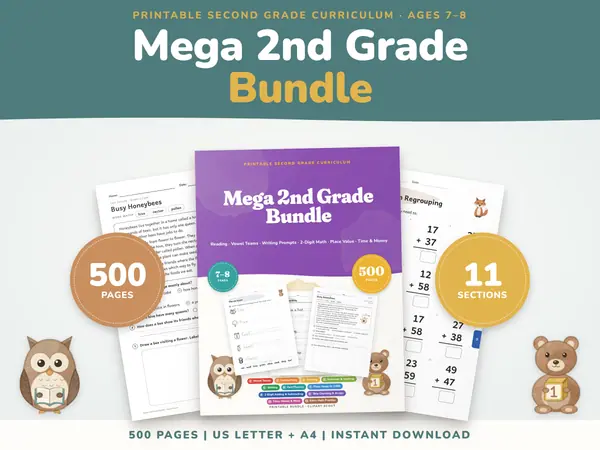
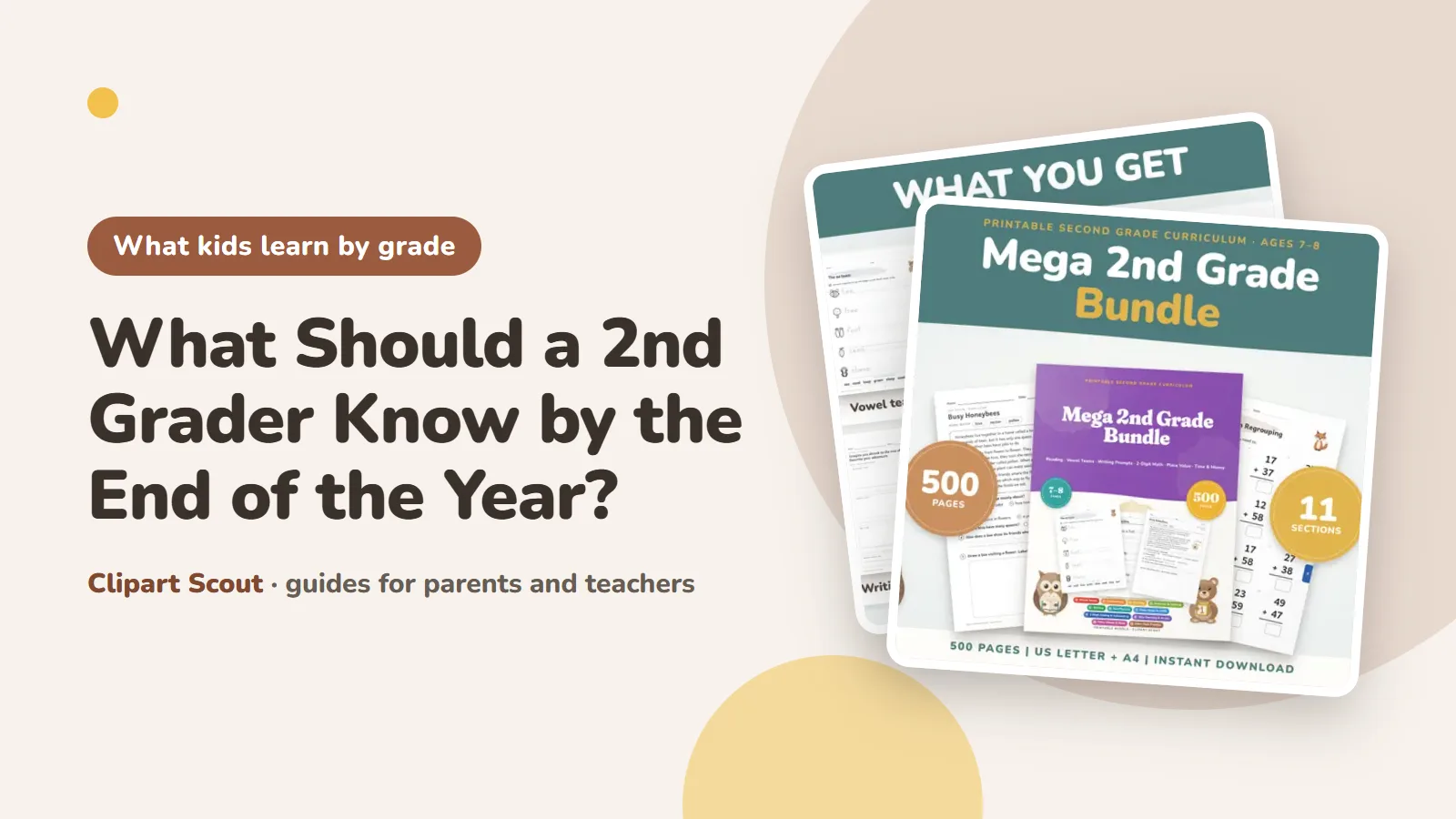
If you want practice pages for these exact skills, the Second Grade Worksheets Bundle has short sections on place value to 1,000, 2-digit adding and subtracting, and time and money, with answer keys in the same order.
How well should a 2nd grader read by the end of the year?
By the end of the year a 2nd grader should read grade-level text accurately and smoothly enough to understand it. The goal named in the standard is understanding, so a child who reads every word correctly but cannot tell you what happened still has work to do.
| Skill | What it looks like | Two-minute check |
|---|---|---|
| Long and short vowels | Tells long from short vowels in regular one-syllable words | Read these pairs aloud: cap and cape, hop and hope, kit and kite |
| Two-syllable words | Reads regular two-syllable words with long vowels | Read: pilot, music, robot, tiger, paper |
| Prefixes and suffixes | Reads words with common beginnings and endings | Read: unhappy, redo, careful, slowly |
| Words that break the rules | Recognizes common irregularly spelled words | Read: could, because, people, enough |
| Fluency | Reads a grade-level page accurately and smoothly enough to follow it | Listen to one page, then ask them to retell it in their own words |
| Range of reading | Reads stories, poems and informational texts in the grades 2 to 3 range, with help on the hardest ones | Offer one story and one fact book in the same week |
If the words come out right but the meaning does not stick, the fix is usually talk, not more worksheets. Our guide to reading comprehension strategies shows what to ask before, during and after a book.
What writing and grammar should a 2nd grader know?
A 2nd grader is expected to write three kinds of short pieces: an opinion, an informative text and a story. Each one should introduce the topic, give reasons, facts or details, and finish with a concluding sentence or a clear ending.
The grammar and punctuation goals for the year are specific:
- Nouns and verbs: collective nouns (a herd, a team), common irregular plurals (feet, children, mice) and the past tense of common irregular verbs (sat, hid, told).
- Pronouns and describing words: reflexive pronouns (myself, ourselves), and choosing between an adjective and an adverb.
- Capital letters: holidays, product names and geographic names.
- Commas: in the greeting and the closing of a letter.
- Apostrophes: in contractions and in common possessives.
Quick check: Ask your child to write a five-sentence letter to a relative about a favorite holiday. One short letter shows you capitals, the comma after the greeting, apostrophes and whether the writing has an ending.
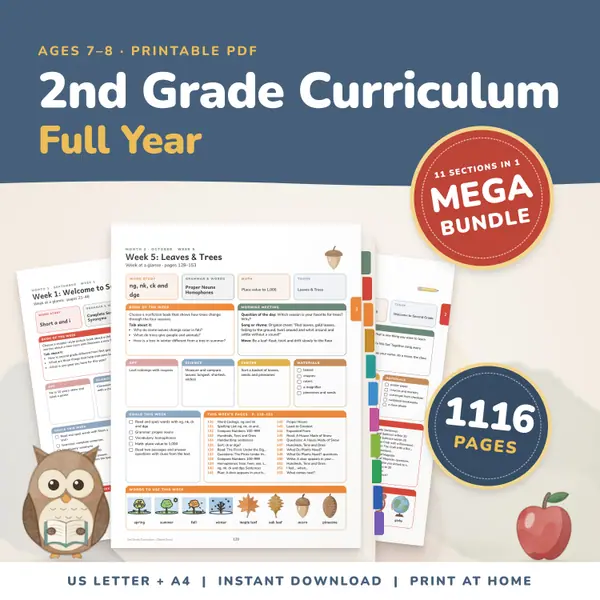
If you teach at home and want the whole year laid out, the 2nd Grade Curriculum Full Year follows the same skills month by month: place value to 1,000 in October, adding with regrouping in December, subtracting with regrouping in January, and money and time in February. It has 1,116 pages, including 72 reading passages with question pages.
End-of-2nd-grade checklist
Print this page and tick what is solid. Circle the two or three lines that are not there yet.
Math
Reading
Writing
What should a 2nd grader know at the beginning of the year?
At the start of 2nd grade a child is expected to have the end-of-1st-grade skills. In math that means adding and subtracting within 20, with fluency within 10, counting and writing numbers to 120, understanding two-digit numbers as tens and ones, and telling time to the hour and half hour.
In reading and writing it means sounding out regularly spelled one-syllable words, reading grade-level text with understanding, printing all upper and lowercase letters, and writing short pieces with an ending.
If some of these are shaky after the summer, start there before the new material. The full list is in our guide to what a 1st grader should know.
What if your child is behind or ahead?
These are goals for the end of the year, and children reach them at different points. A child who cannot regroup in October is not behind. A child who still counts on fingers for 8 + 7 in May has one clear thing to practise.
If the checklist shows gaps, pick the ones that hold up everything else: addition facts and two-digit work in math, long vowels and fluency in reading. Ten to fifteen minutes a day on one skill is easier to keep up than an hour at the weekend. Talk to the teacher too. They see your child’s work every day and can tell you which goals matter most right now.
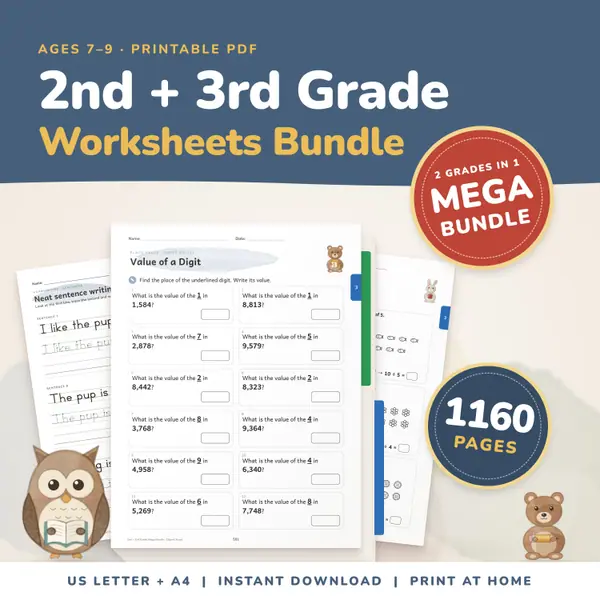
If your child already has most of the list, look ahead. Third grade brings multiplication, division and fractions, described in what a 3rd grader should know. For a child working across both years, the 2nd and 3rd Grade Worksheets Bundle keeps both grades in one file, with sections marked by grade.
Do 2nd graders learn multiplication?
Not formally. In the Common Core standards, multiplying and dividing within 100 belongs to 3rd grade. Second grade lays the ground for it in three ways: skip counting by 5s and 10s, sorting numbers up to 20 into odd and even, and using addition to find the total in an array of up to 5 rows and 5 columns.
If your child enjoys arrays and skip counting, that is the right preparation. When they are ready for the facts themselves, see how to teach multiplication facts.
What to do next
- Run the two-minute checks in the math and reading tables over a few days, not in one sitting.
- Print the checklist, tick what is solid and circle two or three things to work on.
- Ask the teacher for the school’s own list of end-of-year goals and compare it with this one.
- Practise one circled skill for ten to fifteen minutes a day for two weeks, then check it again.
- If you want pages ready to print, browse our 2nd grade worksheets.
Sources
- Common Core State Standards for Mathematics and English Language Arts (official documents), National Governors Association Center for Best Practices and Council of Chief State School Officers.
- Grade 2 mathematics: introduction and standards (online copy of the Common Core standards), thecorestandards.org, an unofficial copy of the standards.
- Grade 2 reading: foundational skills (online copy of the Common Core standards), thecorestandards.org, an unofficial copy of the standards.
- Grade 2 language standards (online copy of the Common Core standards), thecorestandards.org, an unofficial copy of the standards.
- Grade 2 writing standards (online copy of the Common Core standards), thecorestandards.org, an unofficial copy of the standards.
This guide is general information for parents and teachers. It is not medical, legal or professional advice. Every guide lists its sources at the end. More about our guides is on the About page.