2-Digit Addition With Regrouping: How to Teach It
By the Clipart Scout team9 min read
Short answer
Regrouping means trading ten ones for one ten when you add, or one ten for ten ones when you subtract. Teach it with objects first, then drawings, then written columns. In the Common Core, adding and subtracting fluently within 100 is a 2nd grade expectation (2.NBT.B.5). The 1st grade standards stay narrower and use models and drawings.
Key points
- Regrouping is a trade: ten ones for one ten when adding, one ten for ten ones when subtracting.
- Teach in order: objects, adding without regrouping, trading ten ones for a ten, written columns, then subtraction with regrouping as the mirror.
- Common Core expects fluent adding and subtracting within 100 in 2nd grade (2.NBT.B.5).
- Many column mistakes are place-value mistakes: a forgotten ten, or a ten that was traded but never taken away.
- Check every answer by estimating, and check subtraction by adding the answer back.
On this page
- What is regrouping in addition and subtraction?
- What grade do kids learn 2-digit addition with regrouping?
- How should you teach regrouping, step by step?
- How do you add without regrouping first?
- How do you add with regrouping?
- How do you subtract with regrouping?
- Which mistakes are most common, and how do you fix them?
- How do you explain regrouping to a child?
- Regrouping checklist
- What to do next
Two-digit addition is easy until the ones add up to more than nine. Then a child who was doing well suddenly writes 715 for 47 + 38, or gives up.
The skill that fixes it is called regrouping, and you can teach it in small steps at the kitchen table. This guide gives the steps in order, three fully worked examples, a table of common mistakes with a fix for each one, and a short checklist.
What is regrouping in addition and subtraction?
Regrouping means trading between places: ten ones become one ten, or one ten becomes ten ones. In addition you trade up when the ones add to 10 or more. In subtraction you trade down when there are not enough ones to take away.
The value never changes. 15 ones and 1 ten plus 5 ones are the same amount, written differently. That is the idea to keep returning to, because a child who sees it as a trade will not treat it as a magic trick with a small number written above the column.
What grade do kids learn 2-digit addition with regrouping?
By the Common Core, fluent adding and subtracting within 100 is a 2nd grade expectation, and the skill keeps growing from there.
| Grade | What the Common Core expects | Code |
|---|---|---|
| 1st | Understands that the two digits of a two-digit number are tens and ones. Adds a two-digit number and a one-digit number, or a two-digit number and a multiple of 10, using models, drawings and place-value strategies. This is not a fluency expectation | 1.NBT.B.2, 1.NBT.C.4 |
| 2nd | Adds and subtracts fluently within 100. Adds and subtracts within 1,000 using models, drawings and place-value strategies | 2.NBT.B.5, 2.NBT.B.7 |
| 3rd | Adds and subtracts fluently within 1,000 | 3.NBT.A.2 |
| 4th | Adds and subtracts multi-digit whole numbers fluently with the standard algorithm | 4.NBT.B.4 |
A problem like 47 + 38 is two-digit plus two-digit, so it sits in the 2nd grade expectation rather than the 1st. The standards come from the official Common Core documents. The pages we link in the sources are an online copy that describes itself as unofficial. States set their own standards and some differ, so check your school’s list.
For what else belongs in the year, see our guides to what a 2nd grader should know and what a 1st grader should know.
How should you teach regrouping, step by step?
Teach it in five steps, one or two sessions each. The order is our practical suggestion. It uses the advice in the 2021 IES guide for struggling students to teach with a well-chosen set of concrete objects and drawings.
- Tens and ones with objects. Build 47 with four bundles of ten sticks and seven single sticks. Or use dimes and pennies. Ask: how many tens, how many ones?
- Add without regrouping. Start with sums where the ones stay under 10, such as 34 + 25.
- Trade ten ones for a ten. Use objects for a sum where the ones overflow, and make the trade with your hands.
- Write it in columns. Only now move to numbers on paper, matching each written step to the object step.
- Subtract with regrouping. Do the same trade in the other direction.
Do not rush to step 4. A child who can only follow the written steps has a recipe with no meaning behind it, and recipes get misremembered.
How do you add without regrouping first?
Add the ones, then add the tens. When the ones total 9 or less, no trade is needed.
Worked example: 34 + 25
- Ones: 4 + 5 = 9. Write 9 in the ones place.
- Tens: 3 + 2 = 5. Write 5 in the tens place.
- Answer: 59.
Do a handful of these first. They show the column layout and that you work one place at a time, so the later trade is the only new idea.
How do you add with regrouping?
When the ones total 10 or more, trade ten of them for one ten and add that ten to the tens column.
Worked example: 47 + 38
- Ones: 7 + 8 = 15. That is 1 ten and 5 ones.
- Write 5 in the ones place. Put the new ten above the tens column.
- Tens: 4 + 3 + the 1 new ten = 8 tens. Write 8 in the tens place.
- Answer: 85.
- Check: 47 is close to 50 and 38 is close to 40, and 50 + 40 = 90, so 85 is sensible.
Worked example: 56 + 27
- Ones: 6 + 7 = 13. That is 1 ten and 3 ones.
- Write 3 in the ones place and carry the new ten to the tens column.
- Tens: 5 + 2 + 1 = 8 tens. Write 8.
- Answer: 83.
- Check: 56 + 27 is close to 55 + 25 = 80, and 83 is only a little more.
One more case: when the tens overflow too. In 68 + 57, the ones give 8 + 7 = 15, so write 5 and trade one ten. The tens give 6 + 5 + 1 = 12 tens. Twelve tens is 1 hundred and 2 tens, so write 2 in the tens place and 1 in the hundreds place. Answer: 125.
Tip: Have your child say the trade out loud each time: “Fifteen ones is one ten and five ones.” Saying it helps more than writing a small 1 and hoping.
How do you subtract with regrouping?
Subtraction with regrouping is the mirror image: when the ones on top are smaller than the ones below, trade one ten for ten ones.
Worked example: 62 - 27
- Ones: 2 - 7 cannot be done, because 2 is smaller than 7.
- Trade: take one ten from the 6 tens. Now there are 5 tens, and the ones are 2 + 10 = 12 ones.
- Ones: 12 - 7 = 5. Write 5.
- Tens: 5 - 2 = 3. Write 3.
- Answer: 35.
- Check by adding back: 35 + 27 = 62. It matches.
When the ones place is zero: 70 - 38
- Ones: 0 - 8 cannot be done.
- Trade: take one ten from the 7 tens. Now there are 6 tens and 10 ones.
- Ones: 10 - 8 = 2. Tens: 6 - 3 = 3.
- Answer: 32. Check: 32 + 38 = 70.
Because 70 has no ones, a child sometimes feels stuck. The trade works the same way: the ten becomes ten ones.
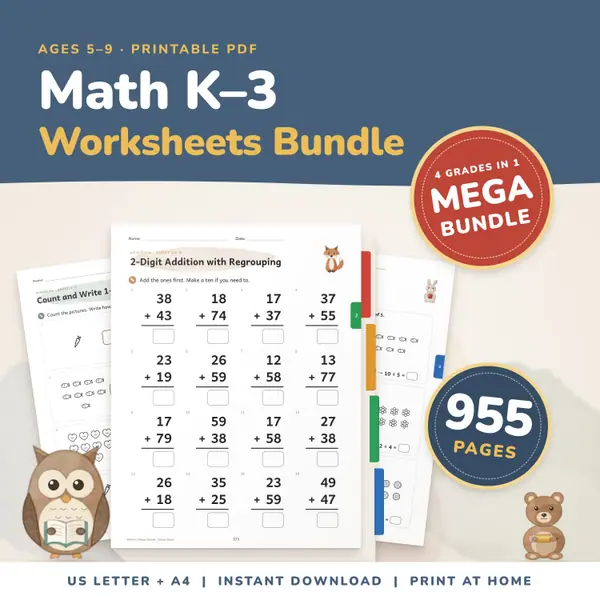
If you would like practice pages for this skill, the Second Grade Worksheets Bundle has a 2-Digit Adding and Subtracting section of 16 pages, with column math both with and without regrouping and answer keys in the same order.
Which mistakes are most common, and how do you fix them?
Many errors are place-value errors, so a good first fix is to go back to the objects or the drawing.
| What the child writes | What went wrong | The fix |
|---|---|---|
| 47 + 38 = 75 | The new ten from 15 was written down but never added to the tens | Say “15 ones is 1 ten and 5 ones” and add the new ten into the tens column |
| 47 + 38 = 715 | Both digits of 15 were written in the ones place | Ask how many ones can fit in the ones place (9 at most) and have them trade ten ones for a ten |
| 62 - 27 = 45 | The smaller digit was taken from the larger in each column, so 7 - 2 = 5 and 6 - 2 = 4 | Ask whether 2 take away 7 can be done, and trade a ten with sticks or dimes |
| 83 - 47 = 46 | The ten was traded, so 13 - 7 = 6, but the tens column was still counted as 8 | After every trade, cross out the old tens digit and write the new one. Here 8 tens becomes 7 tens, so 7 - 4 = 3 and the answer is 36 |
| Wrong answer, no idea why | Digits not lined up, or tens written under ones | Use squared paper or draw a tens and ones chart |
Always have your child check by estimating or by adding back. A child who learns to ask “does that answer make sense?” catches most errors alone.
How do you explain regrouping to a child?
Use one sentence and keep it concrete: “Ten ones make one ten, like ten pennies make a dime.”
Then act it out. Put 15 pennies on the table and ask whether they can all stay in the ones place. Swap ten of them for one dime, and show that there is 1 dime and 5 pennies. The amount is the same, 15 cents, but it now fits the layout.
Is regrouping the same as carrying? In everyday use, yes. Carrying in addition and borrowing in subtraction are older words for the same trades. We use regrouping because it names what actually happens. If your child’s school says carrying, say that at home too and add that it means the same thing.
If you want a whole year of this in order, the 2nd Grade Curriculum Full Year has two-digit adding in November, adding with regrouping in December and subtracting with regrouping in January. It has 1,116 pages. For a child who works across several years, the Math Worksheets Bundle K-3 has 1st grade sections on place value and on addition and subtraction to 20, and a 2nd grade section on 2-digit adding and subtracting.
Regrouping checklist
Print this and tick each line when your child does it without help.
What to do next
- Check step 1: ask your child to show 47 with tens and ones and tell you the number of tens and ones.
- Try 34 + 25 and 47 + 38 on paper and see which step is shaky.
- Spend a few days on that step with objects, then go back to columns.
- Move to subtraction only when addition with regrouping is steady. Use the mistakes table to diagnose any errors.
- Once the skill is solid, use it in stories: see math word problems by grade. Browse our 2nd grade worksheets for practice pages, and when you are ready for the next skill, read how to teach multiplication facts.
Sources
- Common Core State Standards for Mathematics and English Language Arts (official documents), National Governors Association Center for Best Practices and Council of Chief State School Officers.
- Grade 1 mathematics: Number and Operations in Base Ten, standards 1.NBT.B.2 and 1.NBT.C.4 (online copy of the Common Core standards), thecorestandards.org, an unofficial copy of the standards.
- Grade 2 mathematics: Number and Operations in Base Ten, standards 2.NBT.B.5 and 2.NBT.B.7 (online copy of the Common Core standards), thecorestandards.org, an unofficial copy of the standards.
- Grade 3 mathematics: Number and Operations in Base Ten, standard 3.NBT.A.2 (online copy of the Common Core standards), thecorestandards.org, an unofficial copy of the standards.
- Grade 4 mathematics: Number and Operations in Base Ten, standard 4.NBT.B.4 (online copy of the Common Core standards), thecorestandards.org, an unofficial copy of the standards.
- Assisting Students Struggling with Mathematics: Intervention in the Elementary Grades (2021), Institute of Education Sciences, What Works Clearinghouse.
This guide is general information for parents and teachers. It is not medical, legal or professional advice. Every guide lists its sources at the end. More about our guides is on the About page.