How to Teach Telling Time on an Analog Clock, by Grade
By the Clipart Scout team9 min read
Short answer
Teach the hour hand and o'clock first, then half past, then counting by fives around the clock, then quarter past and quarter to, then the minute, then a.m. and p.m., then elapsed time. The Common Core expects hours and half hours in 1st grade, the nearest five minutes in 2nd grade and the nearest minute in 3rd grade. The teaching order is our suggestion.
Key points
- Common Core expects hours and half hours in 1st grade (1.MD.B.3), the nearest five minutes with a.m. and p.m. in 2nd grade (2.MD.C.7) and the nearest minute in 3rd grade (3.MD.A.1).
- Teach in order: o'clock, half past, counting by fives, quarter past and quarter to, to the minute, a.m. and p.m., elapsed time. The order is our suggestion.
- The clock is hard because it has two hands and one set of numbers that means two things: the 3 is both 3 hours and 15 minutes.
- A paper-plate clock and the times of your own daily routine give plenty of practice with no worksheets.
- Elapsed time is easiest on a number line: jump to the next hour, then add the rest.
On this page
- What grade do kids learn to tell time?
- Why is telling time hard for kids?
- How do you teach a child to read an analog clock?
- How do you teach telling time to 5-minute intervals?
- What hands-on ideas help?
- How do you teach a.m. and p.m. and elapsed time?
- When should a child tell time to the minute?
- Telling time checklist
- What to do next
Telling time on a clock with hands is one of those skills that looks simple to an adult and can puzzle a child for a long time. If your child can read a phone screen but not the wall clock, that is normal. The two are different skills.
The answer in short: teach one hand at a time, in a set order, and practice with clocks your child can move. This guide shows what each grade is expected to know, an eight-step teaching order, worked examples and hands-on ideas. The teaching order is our practical suggestion, not an official sequence.
What grade do kids learn to tell time?
The Common Core spreads telling time over grades 1, 2 and 3, getting more exact each year.
| Grade | What children are expected to do | Standard |
|---|---|---|
| 1st | Tell and write time in hours and half-hours, on analog and digital clocks | 1.MD.B.3 |
| 2nd | Tell and write time to the nearest five minutes, on analog and digital clocks, using a.m. and p.m. | 2.MD.C.7 |
| 3rd | Tell and write time to the nearest minute, measure time intervals in minutes, and solve word problems that add and subtract time intervals | 3.MD.A.1 |
The standards come from the official Common Core documents. The pages we list as sources are an online copy that describes itself as unofficial. Not every state uses the Common Core, and some that do have added their own standards, so ask your school for its list.
Each year builds on the last, so a 3rd grader who struggles with elapsed time may need to go back to five-minute times. Our guides to what a 1st grader should know, what a 2nd grader should know and what a 3rd grader should know put time in the context of the full year.
Why is telling time hard for kids?
A clock asks a child to do several things at once. Knowing the pieces helps you teach them one at a time. These are our practical observations, not research findings.
- Two hands: the short hand counts hours and the long hand counts minutes. Children mix them up.
- One set of numbers, two meanings: the 3 stands for 3 hours and also for 15 minutes. Nothing on the dial says so.
- The hour hand moves too: at half past 6 it sits between the 6 and the 7, not on the 6.
- Counting by fives: the minute hand needs skip counting, which the child must know first.
None of this means a child is behind. It means the skill has several parts, and it is easier to teach them one at a time.
How do you teach a child to read an analog clock?
Teach these eight steps in order, spending as long as your child needs on each. The order is a practical one we suggest. Do not move on until the current step is quick.
- The hour hand and the numbers. Show the 12 numbers and the short hand. Ask: “Which number is the short hand closest to?”
- O’clock. The long hand points straight up at the 12. The short hand names the hour. Practice reading 3:00, 7:00 and 11:00.
- Half past. The long hand points straight down at the 6. The short hand sits halfway between two numbers. At 6:30 it is between the 6 and the 7.
- Count by fives around the clock. Each number is five minutes after the one before it. Count 5, 10, 15 and so on around the dial.
- Quarter past and quarter to. Quarter past has the long hand on the 3 (15 minutes). Quarter to has it on the 9 (45 minutes).
- To the minute. Count by fives to the last number the long hand passed, then count on by ones.
- a.m. and p.m. Add morning and afternoon labels to the times.
- Elapsed time. Work out how long something took, or what time it will be after a number of minutes.
Step 4 needs a reference. Here is what the long hand says:
| Long hand on | Minutes past the hour |
|---|---|
| 12 | 0 (o’clock) |
| 1 | 5 |
| 2 | 10 |
| 3 | 15 (quarter past) |
| 4 | 20 |
| 5 | 25 |
| 6 | 30 (half past) |
| 7 | 35 |
| 8 | 40 |
| 9 | 45 (quarter to the next hour) |
| 10 | 50 |
| 11 | 55 |
Once the table makes sense, ask children to say both ways: “ten past five” and “5:10”. Past times are read from the hour just gone, and “to” times are read toward the next hour.
| Time in words | Time as digits | Why |
|---|---|---|
| ten past 5 | 5:10 | the long hand is on the 2, so 10 minutes after 5 |
| quarter past 3 | 3:15 | the long hand is on the 3 |
| half past 6 | 6:30 | the long hand is on the 6 |
| quarter to 9 | 8:45 | 15 minutes before 9 o’clock, so it is still the 8 o’clock hour |
| 20 to 6 | 5:40 | 20 minutes before 6 o’clock |
| 10 to 3 | 2:50 | 10 minutes before 3 o’clock |
“To” times trip up many children, because the digits show the earlier hour. Show it with the hour hand: at 2:50 the short hand is almost at the 3 but has not got there.
How do you teach telling time to 5-minute intervals?
Count by fives around the dial, and then read the long hand first and the short hand second. Counting by fives is a skip-counting skill, so check it away from the clock before you add the dial.
Worked example: the long hand is on the 4 and the short hand is a little past the 8.
- Long hand first: the 4 is 4 x 5 = 20 minutes.
- Short hand: it has passed the 8 and not yet reached the 9, so the hour is 8.
- Time: 8:20.
Worked example: the long hand is on the 8 and the short hand is just before the 5.
- Long hand: the 8 is 8 x 5 = 40 minutes.
- Short hand: it has not reached the 5 yet, so the hour is 4.
- Time: 4:40. In words, that is “20 to 5”.
Have your child say “hour hand, minute hand” for a while: “It is after the 4, so it is 4 o’clock something. The long hand is on the 8, so it is 40 minutes. 4:40.”
To read to the minute, count by fives, then by ones. If the long hand is two small marks past the 7, that is 7 x 5 = 35, then 36, 37. The time is 37 minutes past the hour. This is the 3rd grade skill, and your child can try it once five-minute times feel automatic.
What hands-on ideas help?
Children learn the clock best by moving the hands themselves.
- A paper-plate clock. Write the numbers 1 to 12 around the edge. Cut two hands from card, one short and one long, and attach them in the middle with a brass fastener. Color the hands differently, such as red for hours and blue for minutes. Say a time and have your child set it.
- Daily routine times. Ask your child to set the plate clock to breakfast, the walk to school or dinner time. Real events give the numbers meaning.
- Clock of the day. Put an analog clock in the kitchen. Each day, pick one moment, such as when the bus comes, and write down the time together.
- Swap roles. Set the hands wrong on purpose and ask your child to catch the mistake.
Tip: Keep each session to about ten minutes. Setting five times on the plate clock, then reading five from the wall clock, is plenty.
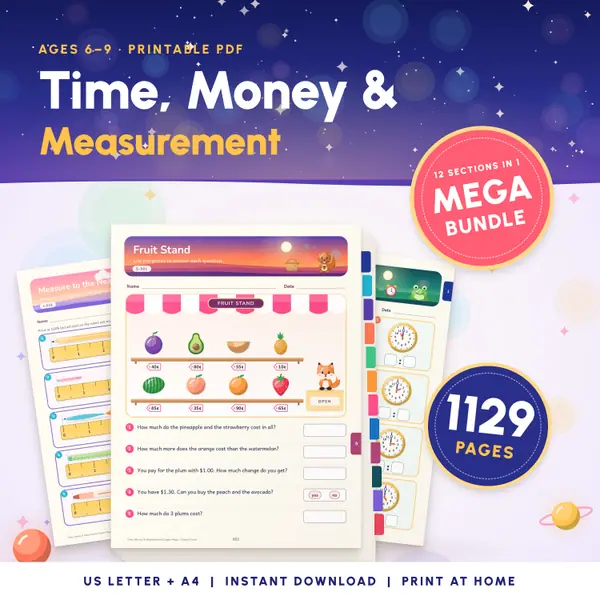
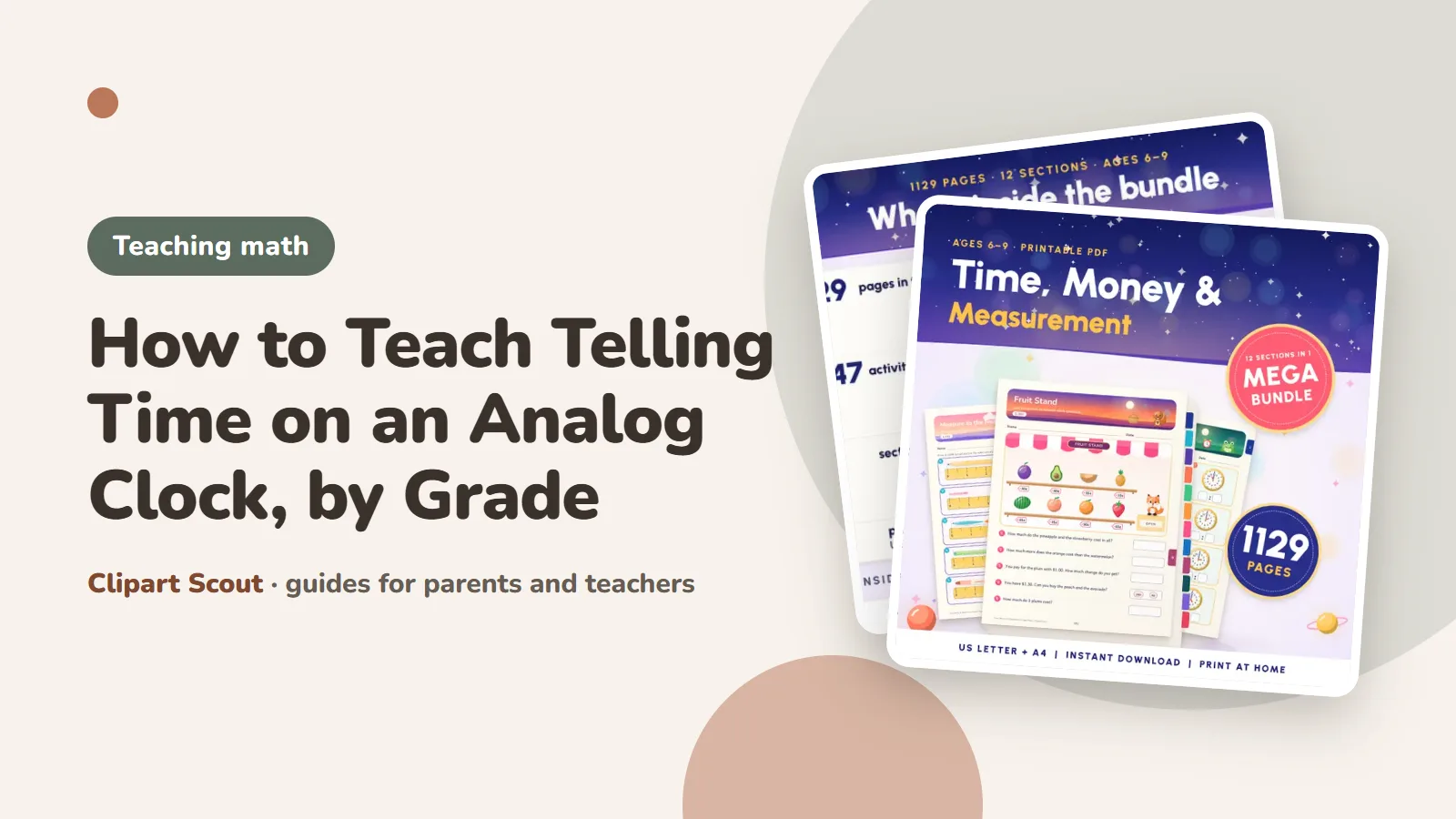
For a full set of pages, the Telling Time Worksheets cover time, money and measurement for grades 1 to 3. The time sections are Hours and Half Hours (78 pages, with two make-your-own clocks), Quarter Hours and Five Minutes (89 pages), Time to the Minute, a.m. and p.m. (68 pages), and Elapsed Time and Schedules (80 pages). It also has sections on coins and money and on measuring length, weight, capacity and temperature.
How do you teach a.m. and p.m. and elapsed time?
Give a.m. and p.m. a daily meaning, then teach elapsed time by jumping to the next hour on a number line. A.m. times are the morning hours, from after midnight until noon. P.m. times are from noon until midnight.
Attach them to your child’s day: breakfast at 7:30 a.m., lunch at 12:00 noon, dinner at 6:00 p.m. Then ask: “Is soccer at 4:00 a.m. or 4:00 p.m.?”
For elapsed time, the 2021 IES guide for struggling students recommends the number line for teaching concepts and procedures. The idea is to jump to the next hour, then add the rest.
Worked example: a movie starts at 6:50 and lasts 45 minutes. What time does it end?
- From 6:50, jump 10 minutes to reach 7:00.
- The movie has 45 - 10 = 35 minutes left.
- From 7:00, add 35 minutes: 7:35.
- The movie ends at 7:35.
Worked example: swim practice starts at 4:10 and ends at 4:55. How long is it?
- From 4:10, jump 40 minutes to reach 4:50.
- Jump 5 more minutes to reach 4:55.
- 40 + 5 = 45 minutes.
Draw a line, mark the start time, and write each jump above it. Have your child say the jumps out loud.
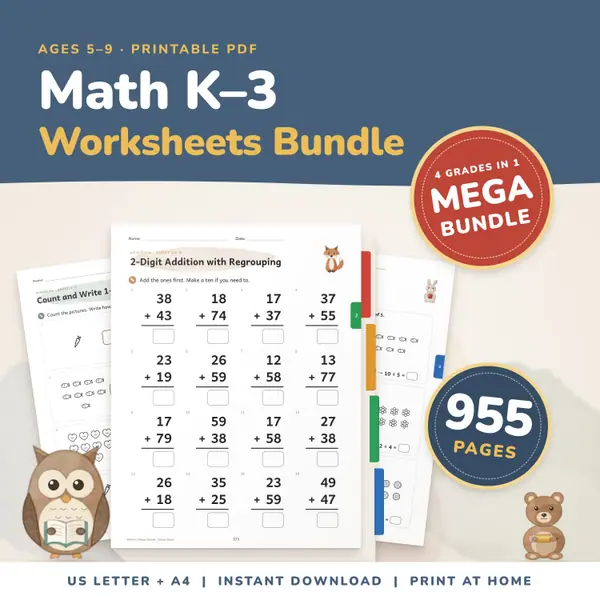
If your child works across several grades, the Math Worksheets Bundle K-3 has a 1st grade Time, Money and Data section (half hours), a 2nd grade Time, Money and More section (clocks) and a 3rd grade Time, Measurement and Data section (time to the minute and elapsed time), all in one file.
When should a child tell time to the minute?
The Common Core places it in 3rd grade. A sensible suggestion is to start when your child reads five-minute times fluently, without counting around from the top each time. Then add the single minutes.
If your child is in 1st or 2nd grade and cannot read single minutes yet, that matches the standards above. Spend the year on hours, halves, quarters and fives instead.
Telling time checklist
What to do next
- Check where your child is: ask for o’clock, half past and five-minute times on a real clock.
- Make a paper-plate clock and set one time for each part of your child’s day.
- Pick the next step in the order and practice it for ten minutes a day.
- Count by fives away from the clock, to get ready for the next step.
- For printable practice, browse our math worksheets. When your child’s facts are ready, how to teach multiplication facts is the next guide.
Sources
- Common Core State Standards for Mathematics and English Language Arts (official documents), National Governors Association Center for Best Practices and Council of Chief State School Officers.
- Grade 1 mathematics: Measurement and Data, standard 1.MD.B.3 (online copy of the Common Core standards), thecorestandards.org, an unofficial copy of the standards.
- Grade 2 mathematics: Measurement and Data, standard 2.MD.C.7 (online copy of the Common Core standards), thecorestandards.org, an unofficial copy of the standards.
- Grade 3 mathematics: Measurement and Data, standard 3.MD.A.1 (online copy of the Common Core standards), thecorestandards.org, an unofficial copy of the standards.
- Assisting Students Struggling with Mathematics: Intervention in the Elementary Grades (2021), Institute of Education Sciences, What Works Clearinghouse.
This guide is general information for parents and teachers. It is not medical, legal or professional advice. Every guide lists its sources at the end. More about our guides is on the About page.