What Should a 1st Grader Know by the End of the Year?
By the Clipart Scout team9 min read
Short answer
By the end of 1st grade, the Common Core standards expect a child to add and subtract within 20, with fluency within 10, count to 120, and understand two-digit numbers as tens and ones. In reading, a child sounds out regularly spelled words, including digraphs and silent e, and reads grade-level text accurately enough to understand it. In writing, a child prints every letter and writes opinion, informative and story pieces.
Key points
- Math centers on adding and subtracting within 20 and on seeing two-digit numbers as tens and ones.
- Children are expected to read words with digraphs, silent e and common vowel teams, not only short words.
- Telling time is limited to the hour and half hour, and measuring means lining up units end to end, not using a ruler.
- Writing grows from single sentences into three kinds of short pieces: opinion, information and story.
- These are end-of-year goals. Children reach them at different points during the year.
On this page
- What is a 1st grader expected to learn?
- What math should a 1st grader know?
- What should a 1st grader know in reading?
- How many sight words should a 1st grader know?
- What writing and punctuation should a 1st grader know?
- End-of-1st-grade checklist
- What should a 1st grader know at the beginning of the year?
- What if your child is behind or ahead?
- What to do next
First grade has more on its list than many parents expect: tens and ones, time, word endings, silent e and three kinds of writing. Knowing the list makes it easier to see which parts are going well at home.
The short version: a 1st grader finishes the year adding and subtracting within 20, counting past 100, reading words with silent e and vowel teams, and writing a few connected sentences. Below you will find each goal with a two-minute check, then a checklist to print.
One note first. This guide uses the Common Core standards for Grade 1. States set their own standards, and several have reworded or replaced the Common Core, so your child’s school may list some goals differently. The teacher can give you the school’s own list.
What is a 1st grader expected to learn?
A 1st grader is expected to work on four big ideas in math, plus phonics, reading fluency, writing and punctuation. The Grade 1 introduction to the math standards names the four math areas: addition and subtraction strategies within 20, place value with tens and ones, measuring length by repeating equal units, and reasoning about shapes and their parts.
| Subject | The main goals for the year |
|---|---|
| Math | Adding and subtracting within 20, tens and ones, time to the half hour, equal shares |
| Reading | Digraphs, silent e, vowel teams, two-syllable words, reading smoothly enough to understand |
| Writing | Opinion, informative and story pieces; printing every letter |
| Punctuation and spelling | Capitals for names and dates, end marks, commas in dates and lists |
What math should a 1st grader know?
By the end of the year a 1st grader should add and subtract within 20 and know the sums within 10 well. They should also understand that a number like 47 means 4 tens and 7 ones. Everything else in the year’s math leans on those two ideas.
| Skill | What it looks like | Two-minute check |
|---|---|---|
| Adding and subtracting | Adds and subtracts within 20, with fluency within 10. Solves word problems within 20 | Ask 8 + 5 and 14 - 6. Then: “There are 9 ducks and 6 swim away. How many are left?” |
| The equal sign | Knows = means “the same as” and can say whether an equation is true or false | Write 7 = 3 + 4 and 5 = 8 - 2 and ask which is true |
| Counting | Counts to 120 from any number below 120. Reads and writes those numbers | Start at 107 and count to 120 |
| Tens and ones | Sees the two digits of a number as tens and ones | Write 63 and ask how many tens and how many ones |
| Comparing | Compares two two-digit numbers with >, = and < | Write 58 and 85 and ask which is bigger and why |
| Adding within 100 | Adds a two-digit number and a one-digit number, or a two-digit number and a multiple of 10, with models or drawings | Draw tens as sticks and ones as dots to solve 34 + 20 |
| Mental ten more, ten less | Finds 10 more or 10 less than a two-digit number in their head. Subtracts multiples of 10 from multiples of 10 | “What is 10 more than 42?” and “What is 80 - 30?” |
| Measuring length | Lays copies of a shorter object end to end to measure a longer one. Puts three objects in order by length | Measure a book using paper clips, with no gaps and no overlaps |
| Time | Tells and writes time to the hour and half hour, on analog and digital clocks | Show 4:00 and 4:30 and ask for each |
| Data | Organizes and reads simple data with up to three categories | Sort a handful of toys into three groups and count each |
| Equal shares | Splits circles and rectangles into two or four equal shares and uses halves, fourths and quarters | Fold a paper circle into fourths and name each part |
Two points surprise parents. Adding within 100 is not a fluency goal this year, so a child who still draws tens and ones is on track. And rulers belong to the next grade: 1st grade measuring is about lining up units end to end.
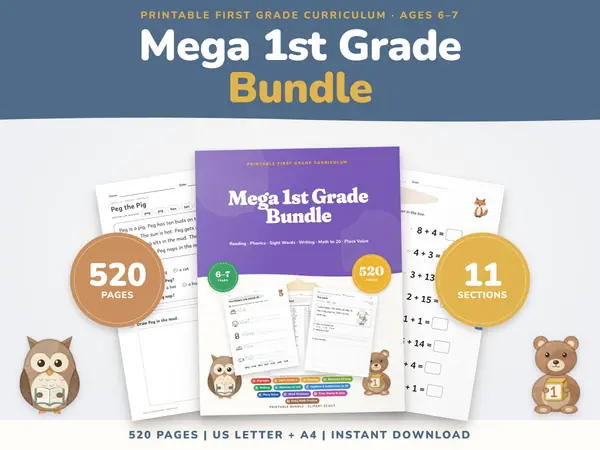
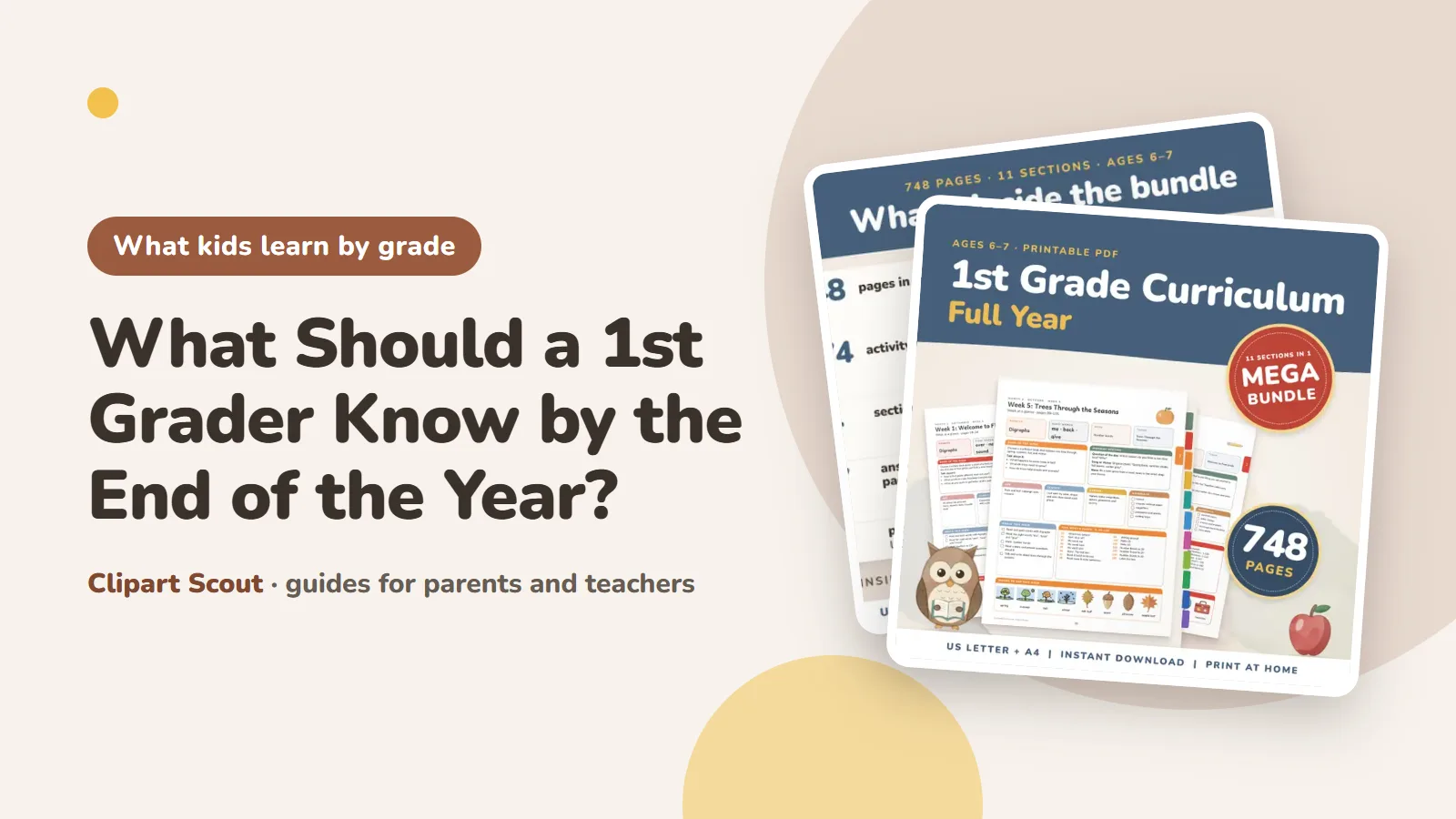
If you want to practice time, our guide to how to teach telling time starts with the hour and half hour. For ready-made pages, the First Grade Worksheets Bundle has a 40-page Addition & Subtraction to 20 section, a 12-page Place Value section on tens and ones, and a 27-page Time, Money & Data section.
What should a 1st grader know in reading?
By the end of the year a 1st grader should read grade-level text with enough accuracy and fluency to understand it. They should also sound out regularly spelled one-syllable words and know what a silent e or a vowel team does to the sound of a word.
| Skill | What it looks like | Two-minute check |
|---|---|---|
| Regular one-syllable words | Decodes regularly spelled words | Read: stop, plan, drum, best |
| Digraphs | Knows the sounds for pairs such as sh, ch, th, wh and ck | Read: ship, chin, thick, whip, duck |
| Long vowels | Knows that a final e and common vowel teams signal long vowel sounds | Read: cake, bike, rain, feet, boat |
| Longer words | Breaks two-syllable words into syllables. Reads words with endings | Read: napkin, rabbit, jumped, running |
| Tricky words | Reads grade-appropriate words that are not spelled the way they sound | Read: said, was, they, one |
| Fluency | Reads aloud with accuracy, a suitable rate and expression | Listen to a short page, then ask what the main character learned |
The last row connects to a goal beyond phonics. A 1st grader is also expected to retell a story with key details and say what lesson or message it carries.
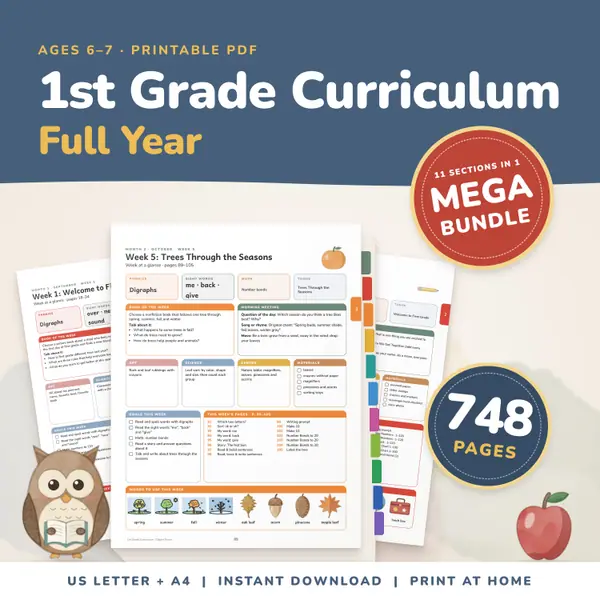
The Curriculum Full Year for 1st grade builds this month by month, with phonics focuses such as digraphs in September, silent e in December and vowel teams from January. It includes 40 first grade stories with questions.
How many sight words should a 1st grader know?
The standards give no number. They ask a 1st grader to read grade-appropriate words that do not follow the usual spelling patterns, and no list is named. Our 1st grade materials practice the second 100 Fry words, which come after the first 100 used in kindergarten. Our guide to sight words by grade explains how the lists work and how to practice them in short sessions.
What writing and punctuation should a 1st grader know?
A 1st grader is expected to print all the upper and lowercase letters and to write three kinds of short pieces. An opinion piece names a topic, gives an opinion and a reason, and ends. An informative piece names a topic, gives some facts and ends. A story tells two or more events in order, with details and time words.
The language goals are specific:
- Capitals: dates and the names of people.
- End marks: a period, question mark or exclamation point on each sentence.
- Commas: in dates and between single words in a list.
- Spelling: words with common patterns and frequent irregular words spelled correctly. New words spelled by their sounds.
Quick check: Ask your child to write three sentences about their favorite animal: what it is, one fact and why they like it. Look for capitals, end marks and a clear last sentence.
End-of-1st-grade checklist
Print this page and tick what is solid. Circle the two or three lines that are not there yet.
Math
Reading
Writing
What should a 1st grader know at the beginning of the year?
At the start of 1st grade a child is expected to have the end-of-kindergarten skills. In math that means counting to 100, writing numbers to 20, adding and subtracting within 10 with objects or drawings, and finding the number that makes 10.
In reading and writing it means naming all the letters, knowing the common sounds, reading some words by sight, printing many letters and writing a short piece by mixing drawing, dictating and writing. The full list is in our guide to what a kindergartener should know. If some of it is shaky after summer, start there.
What if your child is behind or ahead?
These are goals for the end of the year, and children reach them at different points. A child who cannot read words with silent e in October is not behind. A child who still counts every dot to add 8 + 5 in May has one clear thing to practice.
If the checklist shows gaps, choose the ones that hold up the rest: sums within 10, tens and ones, and the sounds in digraphs and silent e. Ten minutes a day on one skill is easier to keep up than a long weekend session. Talk to the teacher too. They see your child’s work daily and can tell you what matters most right now.
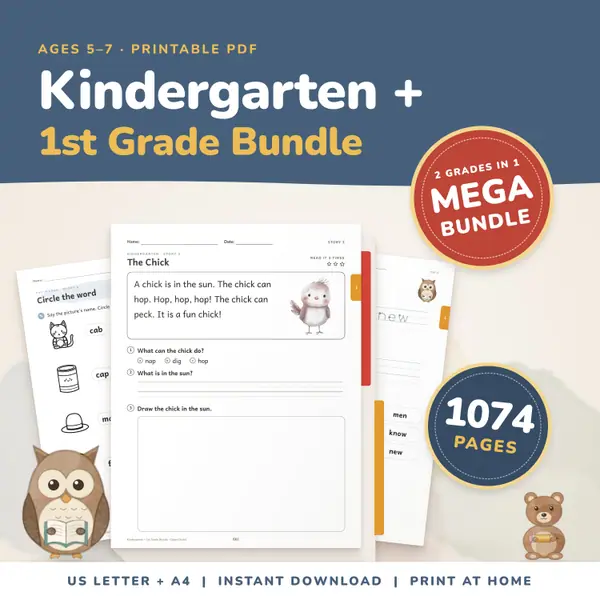
If your child already has most of the list, look ahead to what a 2nd grader should know. For a child working across two years, the Kindergarten and 1st Grade Worksheets Bundle has 1,074 pages with sections marked by grade.
What to do next
- Run the two-minute checks over a few days, one skill at a time.
- Print the checklist, tick what is solid and circle two or three things to work on.
- Ask the teacher for the school’s own list of end-of-year goals and compare it with this one.
- Practice one circled skill for ten minutes a day for two weeks, then check it again.
- To pick single topics, browse our 1st grade worksheets.
Sources
- Common Core State Standards for Mathematics and English Language Arts (official documents), National Governors Association Center for Best Practices and Council of Chief State School Officers.
- Grade 1 mathematics: introduction (online copy of the Common Core standards), thecorestandards.org, an unofficial copy of the standards.
- Grade 1 mathematics: Operations and Algebraic Thinking (online copy of the Common Core standards), thecorestandards.org, an unofficial copy of the standards.
- Grade 1 mathematics: Number and Operations in Base Ten (online copy of the Common Core standards), thecorestandards.org, an unofficial copy of the standards.
- Grade 1 mathematics: Measurement and Data (online copy of the Common Core standards), thecorestandards.org, an unofficial copy of the standards.
- Grade 1 mathematics: Geometry (online copy of the Common Core standards), thecorestandards.org, an unofficial copy of the standards.
- Grade 1 reading: foundational skills (online copy of the Common Core standards), thecorestandards.org, an unofficial copy of the standards.
- Grade 1 language standards (online copy of the Common Core standards), thecorestandards.org, an unofficial copy of the standards.
- Grade 1 writing standards (online copy of the Common Core standards), thecorestandards.org, an unofficial copy of the standards.
This guide is general information for parents and teachers. It is not medical, legal or professional advice. Every guide lists its sources at the end. More about our guides is on the About page.