What Should a Kindergartener Know by the End of the Year?
By the Clipart Scout team8 min read
Short answer
By the end of kindergarten, the Common Core standards expect a child to count to 100 by ones and tens, write numbers from 0 to 20, and add and subtract within 10 with objects or drawings. In reading, a child names all the letters, knows the common sounds and reads some words by sight. In writing, a child prints many letters and tells about an event using drawing, dictating and writing.
Key points
- Number work comes first in kindergarten math: counting to 100, writing numbers to 20, and adding and subtracting within 10.
- Children are expected to name every upper and lowercase letter and give the usual sound for each consonant.
- Writing starts with drawing and telling. Spelling simple words by their sounds is the goal, not perfect spelling.
- Reading means short words and simple books by the end of the year, with a few words known by sight.
- These are end-of-year goals. Five-year-olds reach them at very different speeds.
On this page
- What is a kindergartener expected to learn?
- What math should a kindergartener know?
- What should a kindergartener know in reading?
- What should a kindergartener know in writing and language?
- End-of-kindergarten checklist
- What about the beginning of the year?
- What if your child is behind or ahead?
- What to do next
Kindergarten is the year a child goes from recognizing letters and counting objects to sounding out short words and writing numbers. If you are not sure what that should look like by spring, a plain list helps.
The short version: a kindergartener finishes the year counting to 100, adding and subtracting small numbers with objects, naming every letter with its sound, and telling about something in a drawing and a few written words. The tables below give each goal and a two-minute check you can do at the kitchen table, followed by a checklist to print.
One note first. This guide uses the Common Core standards for kindergarten. States set their own standards, and several have reworded or replaced the Common Core, so your child’s school may list some goals differently. The teacher can give you the school’s own list.
What is a kindergartener expected to learn?
A kindergartener is expected to learn number sense, shapes, letters and sounds, early reading and early writing. The kindergarten introduction to the math standards names two big math areas: representing and comparing whole numbers, starting with sets of objects, and describing shapes and space. It also says more learning time should go to number than to any other topic.
| Subject | The main goals for the year |
|---|---|
| Math | Counting to 100, writing numbers to 20, comparing groups, adding and subtracting within 10, naming shapes |
| Reading | Letter names and sounds, rhymes and syllables, a few words known by sight, simple texts |
| Writing | Printing letters, spelling simple words by sound, drawing, dictating and writing to tell or explain |
What math should a kindergartener know?
By the end of the year a kindergartener should count to 100, write numbers from 0 to 20 and add and subtract within 10 using objects or drawings. Counting real things is the heart of the year, so most checks below use snacks, buttons or fingers.
| Skill | What it looks like | Two-minute check |
|---|---|---|
| Counting | Counts to 100 by ones and by tens. Counts forward from a number other than 1 | Count by tens to 100. Then ask them to count on from 47 |
| Writing numbers | Writes the numbers 0 to 20 | Say five numbers in a mixed order and watch them write each one |
| Counting objects | Counts up to 20 objects in a line, array or circle, and up to 10 when scattered. Counts out a number you ask for | Line up 15 buttons and ask how many. Then say “give me 8” |
| Comparing | Says which of two groups has more, fewer or the same, for groups up to ten. Compares two written numbers from 1 to 10 | Make two piles of raisins and ask which has fewer |
| Adding and subtracting | Adds and subtracts within 10 with objects or drawings, including simple word problems. Does it fluently within 5 | “You have 4 crackers and eat 1. How many are left?” Let them use fingers |
| Making 10 | For any number from 1 to 9, finds the number that makes 10 | Hold up 6 fingers and ask how many more make 10 |
| Teen numbers | Sees 11 to 19 as ten ones and some more ones, such as 18 = 10 + 8 | Show 14 blocks and ask them to group ten and count the rest |
| Shapes | Names squares, triangles, circles, rectangles and hexagons however big or turned. Tells flat shapes from solid shapes such as cubes, cones, cylinders and spheres | Turn a triangle upside down and ask its name. Point to a ball and a circle and ask which is solid |
| Measuring and sorting | Compares things by length or weight. Sorts objects into groups and counts each group | Sort a handful of coins and buttons, then count each pile |
The teen numbers are worth a little extra time, because the words “fourteen” and “sixteen” do not show the ten and the ones. Building each one from blocks, as ten and some more, makes the idea visible.
If you want ready-made practice for these skills, the Kindergarten Worksheets Bundle has a 32-page Math to 20 section and a 32-page Adding & Subtracting section within 10, with answer keys at the back.
What should a kindergartener know in reading?
By the end of the year a kindergartener should name all the upper and lowercase letters and know the usual sounds they make. The goal is not fluent reading of long books. It is a child who can sound out and recognize short words and follow a very simple text.
| Skill | What it looks like | Two-minute check |
|---|---|---|
| Letters | Recognizes and names every upper and lowercase letter | Point to ten mixed letters on a page and ask for the names |
| Consonant sounds | Gives the main sound, or a common one, for each consonant | Ask for the sound of b, m, s, t and r |
| Vowels | Links the long and short sounds to the common spellings of a, e, i, o and u | Ask for the short sound of each vowel, then the long one |
| Sound awareness | Recognizes and makes rhymes. Counts and splits syllables. Picks out the first, middle and last sound in simple words | Say “cat” and ask for the first, middle and last sound |
| Words by sight | Reads common words such as the, of, to, you, she, my, is, are, do and does | Write six of these words on cards and shuffle them |
| Simple texts | Reads emergent-reader texts with purpose and understanding. With prompting, retells a familiar story | Read a short book together, then ask what happened first |
For a child who is still unsure of the sound side, the Kindergarten Worksheets Bundle has a 39-page Beginning Sounds section and a 65-page CVC Words section. Our guide to sight words by grade explains how sight word lists work, and the bundle’s 114-page Sight Words section covers the first 100 Fry words.
What should a kindergartener know in writing and language?
A kindergartener should print many upper and lowercase letters and use drawing, dictating and writing together to share an opinion, give information or tell about an event. The standards treat a picture and a dictated sentence as real writing at this age.
The language goals are small and concrete:
- Capitals: the first word of a sentence and the word I.
- End marks: recognizes and names the punctuation at the end of a sentence.
- Spelling by sound: writes a letter for most consonant and short-vowel sounds, and spells simple words the way they sound.
Quick check: Ask your child to draw their favorite part of the day and write or dictate one sentence about it. Look for a capital at the start, letters that match the sounds, and a mark at the end.
End-of-kindergarten checklist
Print this page and tick what is solid. Circle the two or three lines that are not there yet.
Math
Reading
Writing
What about the beginning of the year?
This guide covers the end of the year, so a child’s starting point depends on what they did before school. For a list of the skills that come before kindergarten, see our kindergarten readiness checklist. If you are teaching at home, how to homeschool kindergarten covers planning the year.
What if your child is behind or ahead?
These are goals for the end of the year, and five- and six-year-olds reach them at different speeds. A child who cannot write all of the numbers to 20 in October is not behind. A child who still mixes up b and d in April has one clear thing to practice.
If the checklist shows gaps, pick the ones that hold up everything else: counting objects one by one and the sounds of the letters. Ten minutes a day, stopped while it is still going well, works better than a long session. Talk to the teacher as well. They see your child’s work all week and can tell you which goals matter most right now.
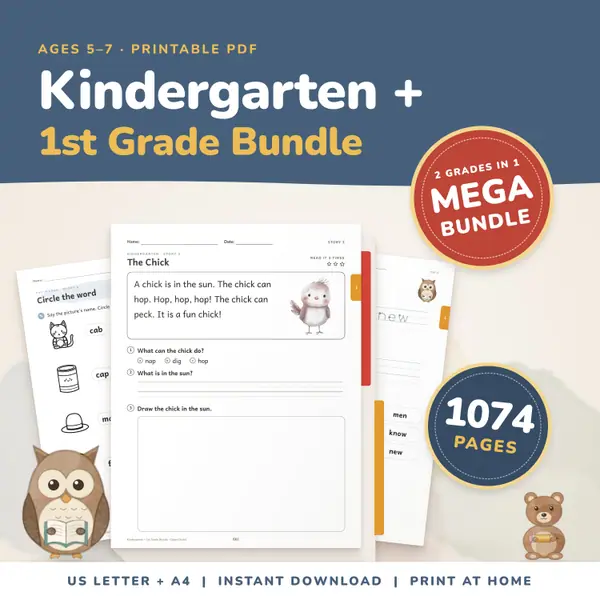
If your child already has most of the list, look ahead to our guide on what a 1st grader should know. For a child working across both years, the Kindergarten and 1st Grade Worksheets Bundle keeps them in one file, with sections marked by grade.
What to do next
- Run the two-minute checks over a few days, not in one sitting. Keep it playful and use real objects.
- Print the checklist, tick what is solid and circle two or three things to work on.
- Ask the teacher for the school’s own list of end-of-year goals and compare it with this one.
- Practice one circled skill for ten minutes a day for two weeks, then check it again.
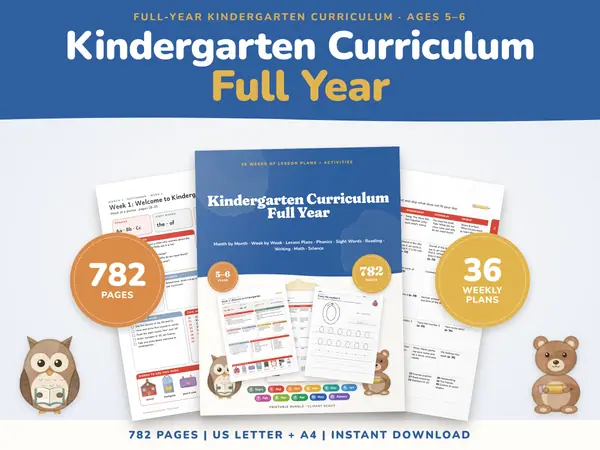
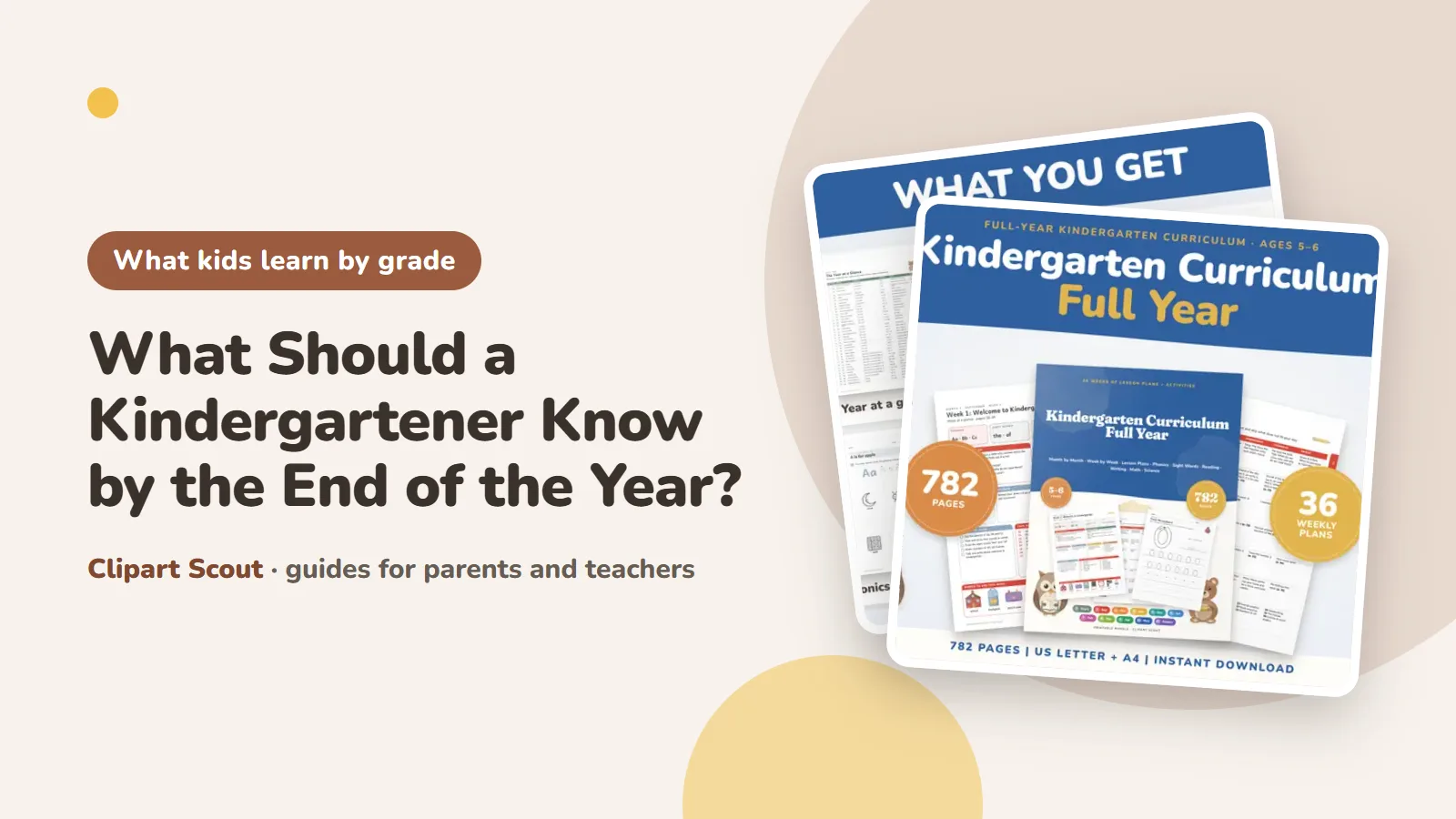
- If you want a full year planned for you, the Kindergarten Curriculum Full Year has 782 pages in 11 sections, including a ready-for-first-grade checklist in its Assessments & Records section.
Browse all of our kindergarten worksheets if you would rather pick single topics.
Sources
- Common Core State Standards for Mathematics and English Language Arts (official documents), National Governors Association Center for Best Practices and Council of Chief State School Officers.
- Kindergarten mathematics: introduction (online copy of the Common Core standards), thecorestandards.org, an unofficial copy of the standards.
- Kindergarten mathematics: Counting and Cardinality (online copy of the Common Core standards), thecorestandards.org, an unofficial copy of the standards.
- Kindergarten mathematics: Operations and Algebraic Thinking (online copy of the Common Core standards), thecorestandards.org, an unofficial copy of the standards.
- Kindergarten mathematics: Number and Operations in Base Ten (online copy of the Common Core standards), thecorestandards.org, an unofficial copy of the standards.
- Kindergarten mathematics: Geometry (online copy of the Common Core standards), thecorestandards.org, an unofficial copy of the standards.
- Kindergarten reading: foundational skills (online copy of the Common Core standards), thecorestandards.org, an unofficial copy of the standards.
- Kindergarten language standards (online copy of the Common Core standards), thecorestandards.org, an unofficial copy of the standards.
- Kindergarten writing standards (online copy of the Common Core standards), thecorestandards.org, an unofficial copy of the standards.
This guide is general information for parents and teachers. It is not medical, legal or professional advice. Every guide lists its sources at the end. More about our guides is on the About page.