How to Homeschool Kindergarten: What to Teach and When
By the Clipart Scout team7 min read
Short answer
In homeschool kindergarten you teach letters and sounds, early reading, counting and adding within 10, shapes and simple writing. The Common Core standards expect a child to finish kindergarten counting to 100 by ones and tens, knowing the sounds of the consonants and the five vowels, and reading common words by sight. Keep lessons short: Illinois's 2020 remote-learning guidance suggested 30 to 90 minutes a day.
Key points
- Kindergarten focus is number and early reading: counting to 100, adding within 10, letter sounds and common sight words.
- Our four-quarter outline is a suggestion built on the Common Core kindergarten standards. Your state may use different standards.
- Lessons should be short. Illinois's spring 2020 guidance suggested 3 to 5 minutes of sustained attention at a time for kindergarten.
- Whether kindergarten is required depends on your state's rules, so ask your state education department.
- You need three things for a year: a reading and phonics path, a math path and books to read together.
On this page
- What do you teach in homeschool kindergarten?
- How do you plan a kindergarten year in four quarters?
- What does a homeschool kindergarten day look like?
- How long should a homeschool kindergarten day be?
- What curriculum do you need for homeschool kindergarten?
- Is kindergarten required?
- What if your child is not ready for a skill yet?
- What to do next
Kindergarten at home is the easiest year to get wrong by doing too much. The skills are small, the lessons are short, and most of the work is talking, counting, reading together and playing with letters and numbers.
The short answer: teach early reading and number, in short lessons, a little each day. The Common Core standards for kindergarten put the most weight on counting and number in math, and on letters, sounds and common words in reading. This guide turns that into a four-quarter outline and an example day.
Two cautions first. States set their own standards, and several have reworded or replaced the Common Core, so this article says what the Common Core expects, not what your state requires. And the year outline is our suggestion, not a rule.
What do you teach in homeschool kindergarten?
In kindergarten you teach number, early reading, simple writing and a little about shapes and the world. The Grade K introduction names two critical areas in math: representing and comparing whole numbers, and describing shapes and space. It says more learning time should go to number than to any other topic.
| Area | What the Common Core expects by the end of kindergarten |
|---|---|
| Counting | Counts to 100 by ones and by tens. Counts forward from any number. Writes numbers from 0 to 20 |
| Comparing | Says which of two groups has more, fewer or the same, for groups of up to ten objects |
| Adding and subtracting | Adds and subtracts within 10 using objects or drawings. Adds and subtracts fluently within 5. Builds the numbers 11 to 19 as ten and some ones |
| Shapes | Names shapes whatever their size or direction. Tells flat shapes from solid ones |
| Letters and sounds | Names all upper and lowercase letters. Gives the primary sound, or many of the most frequent sounds, for each consonant. Links long and short sounds to the five major vowels |
| Words and reading | Reads common high-frequency words by sight, such as the, of, to, you and my. Picks out the first, middle and last sound in simple three-sound words. Reads emergent-reader texts with purpose and understanding |
| Writing | Prints many upper and lowercase letters. Capitalizes the first word of a sentence and the word I. Spells simple words by sound. Uses drawing, dictating and writing to give an opinion, share information or tell about an event |
For the full list with a printable checklist, see our guide to what a kindergartener should know.
How do you plan a kindergarten year in four quarters?
A simple way to plan the year is in four quarters, each with one reading goal and one math goal. This outline is our suggestion. It follows the order of the Common Core kindergarten skills, and a child may move faster or slower.
| Quarter | Reading and writing | Math |
|---|---|---|
| 1 | Letter names and the sounds of the consonants. Rhymes. Printing letters, starting with the first name | Counting objects to 10, then 20. Comparing groups. Naming shapes |
| 2 | Short vowel sounds. Blending simple three-letter words. First sight words | Writing numbers 0 to 20. Adding and subtracting within 5 with objects |
| 3 | Reading simple CVC words and short sentences. Capital letter and end punctuation | Adding and subtracting within 10. Numbers 11 to 19 as ten and some ones |
| 4 | Short emergent-reader books. Retelling a familiar story. A short piece using pictures and words | Counting to 100 by ones and tens. Finding the number that makes 10. Comparing length and weight |
For phonics order, the IES practice guide on foundational reading skills suggests teaching single-letter consonants and short vowel sounds first, then blends and two-letter digraphs, then long vowels with silent e. For kindergarten, the first stages are the ones to focus on. The same guide recommends that every child read connected text every day.
Our CVC words list gives the three-letter words to start with, and our guide to how to teach a child to read shows the steps.
What does a homeschool kindergarten day look like?
A kindergarten day is a few short lessons with breaks. Here is one example, which is our suggestion:
- Read-aloud and songs (15 minutes): a picture book, and a rhyme or counting song.
- Phonics (15 minutes): three tiny activities, such as a letter-sound game, a few sight words and reading one short word.
- Math (15 minutes): counting objects, comparing groups, one number-writing page.
- Handwriting or drawing (10 minutes): print a few letters or draw and label a picture.
- Outdoor time and play: as long as you can.
That is 40 minutes of lessons. For the same day with clock times, and for other grades, see our guide to how many hours a day to homeschool.
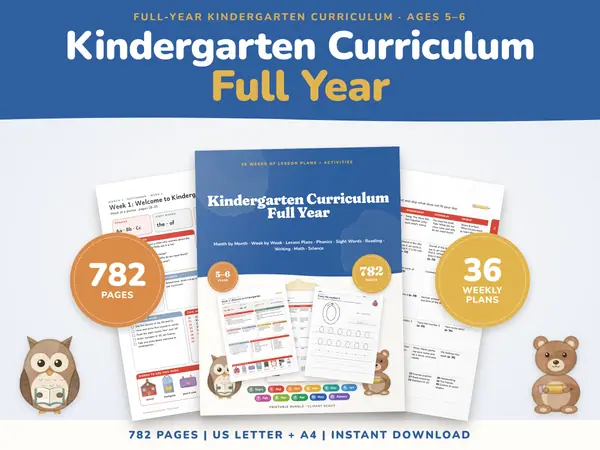
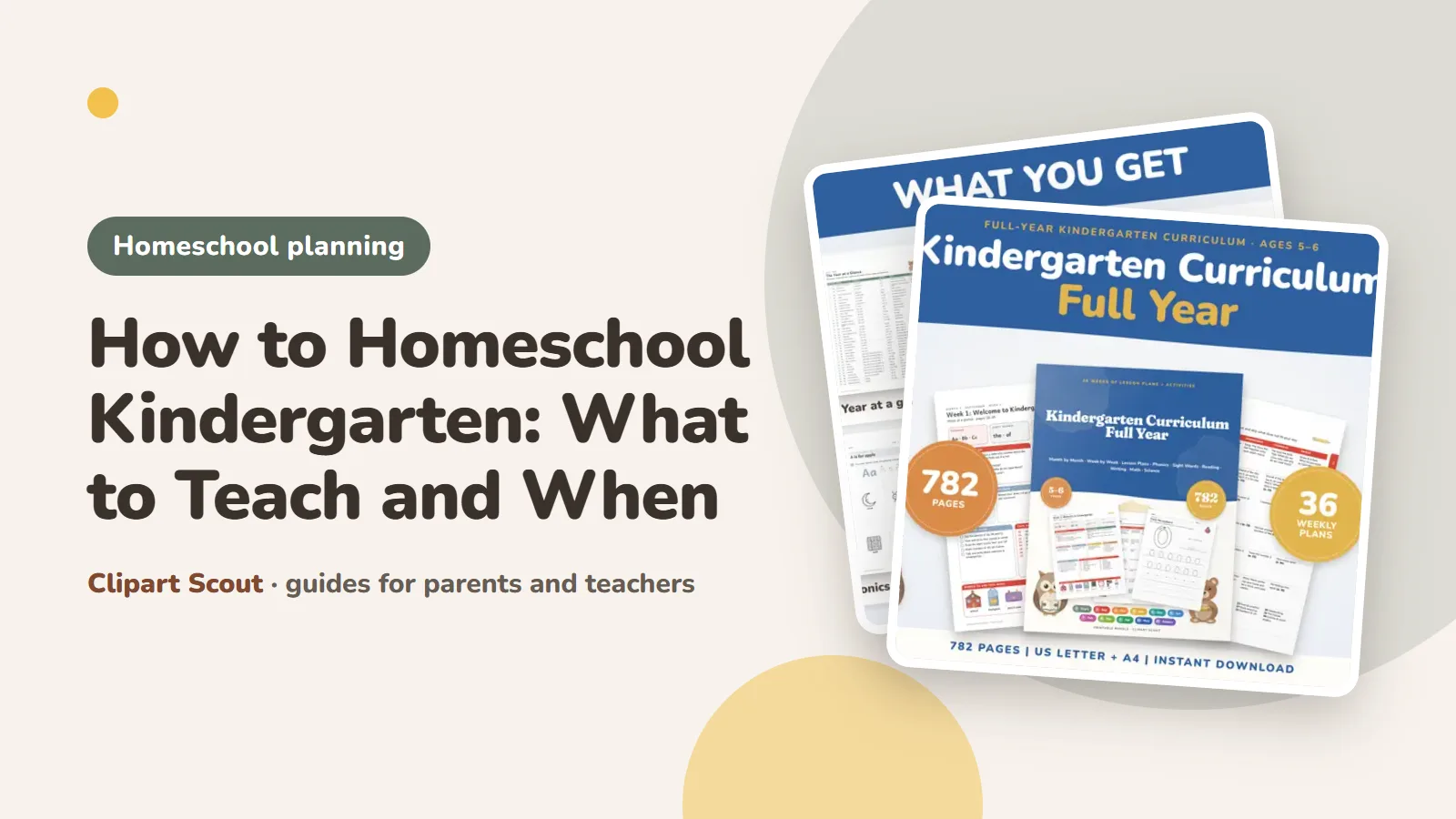
If you want the year already planned, the Kindergarten Curriculum Full Year has 782 pages in 11 sections. Each of nine monthly sections from September to May has a week at a glance and a daily lesson plan for each of four weeks, and there are skills checklists for 4 quarters in the Assessments & Records section.
How long should a homeschool kindergarten day be?
A kindergarten day of lessons is short, and no official body sets a number for homeschools. As a reference only, Illinois’s spring 2020 remote-learning guidance for public schools suggested 30 to 90 minutes a day for kindergarten, and Kansas set a maximum of 45 minutes. Neither is law, and neither was written for homeschools.
Illinois also suggested 3 to 5 minutes of sustained attention at a time for kindergarten. Plan many tiny activities instead of one long task. Both tables are explained in the hours guide linked above.
What curriculum do you need for homeschool kindergarten?
You need three things: a reading and phonics path, a math path and books to read together. A full-year curriculum covers the first two. A worksheet bundle also works, if you are happy to plan the order yourself.
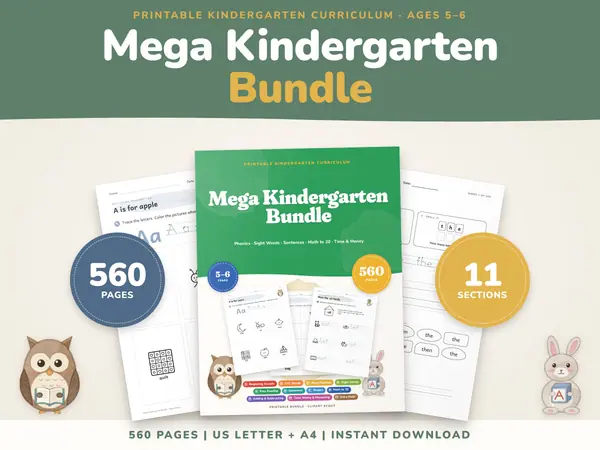
If you prefer workbook pages without a monthly plan, the Kindergarten Worksheets Bundle has 560 pages in 11 sections: Beginning Sounds, CVC Words, Word Families, Sight Words (Fry 1–100), Easy Reading, Sentences, Shapes, Math to 20, Adding & Subtracting, Time, Money & Measuring, and Review & Extra Math.
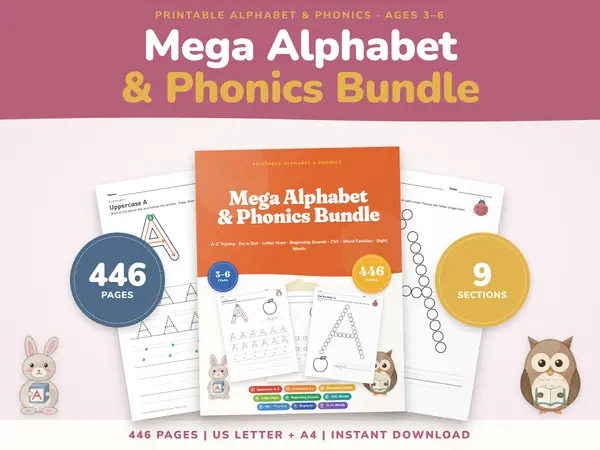
If your child is younger or still working on letters, the Alphabet Worksheets and Phonics Bundle is made for ages 3 to 6. It has 446 pages, starting with tracing uppercase and lowercase letters and moving to beginning sounds, CVC words and the first 50 Fry sight words.
You can browse everything for this age in our kindergarten worksheets.
Is kindergarten required?
It depends on your state. Whether kindergarten is required, and whether a homeschooling family has to follow any rule for a five-year-old, depends on your state’s compulsory school age and on how your state treats homeschoolers. We give no ages here, because they differ and change.
Ask your state education department. HSLDA’s state pages are a handy map, but HSLDA is a membership advocacy organization, and the statute itself is the final word. This is general information, not legal advice.
What if your child is not ready for a skill yet?
Skip it for now and come back in a month. Children reach kindergarten goals at different times, and the standards describe end-of-year goals, not midyear tests.
If a skill is still stuck after a few weeks of short, cheerful practice, change the approach: go back one step, use objects or games, or try a different time of day.
What to do next
- Look up your state education department’s home education page and check the rules for your child’s age.
- Copy the four-quarter outline onto one page and change it to suit your child.
- Start with the reading and math blocks of the example day, 15 minutes each, and add the rest over a few weeks.
- Check what your child already knows with our kindergartener checklist.
- Choose a curriculum or worksheet bundle, and print the first month only.
Sources
- Grade K introduction, Mathematics Standards (online copy of the Common Core standards), thecorestandards.org, an unofficial copy of the standards.
- Counting and Cardinality, Grade K, thecorestandards.org, an unofficial copy of the standards.
- Operations and Algebraic Thinking, Grade K, thecorestandards.org, an unofficial copy of the standards.
- Reading: Foundational Skills, Kindergarten, thecorestandards.org, an unofficial copy of the standards.
- Language standards, Kindergarten, thecorestandards.org, an unofficial copy of the standards.
- Writing standards, Kindergarten, thecorestandards.org, an unofficial copy of the standards.
- Foundational Skills to Support Reading for Understanding in Kindergarten Through 3rd Grade, Institute of Education Sciences, What Works Clearinghouse (practice guide, July 2016).
- Continuous Learning Task Force Guidance (recommended maximum student commitment each day, printed page 13), Kansas State Department of Education.
- Remote Learning Recommendations During COVID-19 Emergency, 27 March 2020 (table of suggested minimum and maximum times of engagement, page 17), Illinois State Board of Education.
- Remote Learning - ISBE Guidelines (page reproducing the Illinois table, 10 April 2020), Jefferson Elementary School, Illinois school district 170.
- Homeschool Laws By State, HSLDA (Home School Legal Defense Association), a membership advocacy organization.
This guide is general information for parents and teachers. It is not medical, legal or professional advice. Every guide lists its sources at the end. More about our guides is on the About page.