CVC Words List: 200+ Words by Vowel, and How to Teach Them
By the Clipart Scout team9 min read
Short answer
A CVC word is a three-letter word made of a consonant, a vowel and a consonant, with a short vowel sound, such as cat, pen, pig, dog and sun. Start with a few letter sounds, then have your child say each sound slowly and blend them into the word. The list below gives 215 CVC words, grouped by vowel and word family.
Key points
- CVC stands for consonant, vowel, consonant. The vowel makes its short sound, as in fan.
- The IES practice guide teaches single consonants and short vowels first, so CVC words are the natural first words to blend.
- Word families such as -at and -an let a child change only the first letter to read a whole group of words.
- Five minutes a day, with a small number of words, is easier to keep up than one long session.
- After CVC words come consonant blends and digraphs, then long vowels with silent e, then vowel teams.
On this page
If your child is learning to read, you will soon hear the term CVC words. These are the first short words most children blend from sounds, and they are easy to build a daily routine around.
A CVC word has three letters: a consonant, a vowel, then a consonant, with the vowel making its short sound. Cat, pen, pig, dog and sun are all CVC words. Below you will find 215 of them grouped by vowel and word family, a step-by-step way to teach blending, a five-minute daily routine and what to teach next.
What is a CVC word?
A CVC word is a word made of a consonant, a vowel and a consonant, where the vowel says its short sound. The IES practice guide on early reading, Foundational Skills to Support Reading for Understanding in Kindergarten Through 3rd Grade, uses the word “fan” as its example.
The letters describe the pattern of sounds, not the spelling. That is why car, saw and day are not CVC words even though each has three letters. The r, w and y change the vowel sound, so a child cannot simply blend the three letters one by one. Every word in the lists below has a short vowel and a plain consonant at each end.
| Short vowel | The sound | Example word |
|---|---|---|
| a | the a in apple | cat |
| e | the e in egg | pen |
| i | the i in igloo | pig |
| o | the o in octopus | dog |
| u | the u in umbrella | sun |
CVC words list by short vowel
The tables group each word by word family, which is the ending the words share, such as -at or -ig. Children can read a whole family by changing only the first letter. The lists are ours, written to use common, child-friendly words. They are not a published or standard list, so feel free to skip any word your child will not know.
Seven words end in x: tax, wax, fix, mix, six, box and fox. The x stands for two sounds, k and s. Many lists count these as CVC words, but teach them after the others if your child stumbles.
CVC words with short a (56 words)
| Word family | Words |
|---|---|
| -at | bat, cat, hat, mat, pat, rat, sat, vat |
| -an | ban, can, fan, man, pan, ran, tan, van |
| -ap | cap, gap, lap, map, nap, rap, sap, tap, yap, zap |
| -ad | bad, dad, had, lad, mad, pad, sad |
| -ag | bag, nag, rag, sag, tag, wag |
| -am | dam, ham, jam, ram, yam |
| -ab | cab, dab, gab, jab, lab, nab, tab |
| -ax | tax, wax |
| Other | gas, pal, yak |
CVC words with short e (35 words)
| Word family | Words |
|---|---|
| -et | bet, get, jet, let, met, net, pet, set, vet, wet, yet |
| -en | den, hen, men, pen, ten, yen |
| -ed | bed, fed, led, red, wed |
| -eg | beg, keg, leg, peg |
| -em | gem, hem |
| Other | gel, pep, ref, rev, web, yep, yes |
CVC words with short i (48 words)
| Word family | Words |
|---|---|
| -ig | big, dig, fig, gig, jig, pig, rig, wig |
| -in | bin, fin, kin, pin, tin, win |
| -ip | dip, hip, lip, nip, pip, rip, sip, tip, yip, zip |
| -it | bit, fit, hit, kit, lit, pit, sit, wit |
| -id | bid, did, hid, kid, lid, rid |
| -im | dim, him, rim |
| -ib | bib, fib, nib, rib |
| -ix | fix, mix, six |
CVC words with short o (37 words)
| Word family | Words |
|---|---|
| -ot | cot, dot, got, hot, jot, lot, not, pot, rot, tot |
| -op | cop, hop, mop, pop, top |
| -og | bog, cog, dog, fog, hog, jog, log |
| -ob | cob, job, mob, rob, sob |
| -od | cod, nod, pod, rod, sod |
| -ox | box, fox |
| Other | doc, mom, wok |
CVC words with short u (39 words)
| Word family | Words |
|---|---|
| -ug | bug, dug, hug, jug, lug, mug, pug, rug, tug |
| -un | bun, fun, nun, pun, run, sun |
| -ut | but, cut, hut, jut, nut, rut |
| -ub | cub, dub, hub, nub, rub, sub, tub |
| -um | gum, hum, sum, yum |
| -up | cup, pup |
| -ud | bud, cud, dud, mud |
| Other | bus |
That makes 215 words in all. Short e, short o and short u have fewer common three-letter words than short a and short i, so those tables are shorter and a few of their words (rev, nub, dub) are less familiar. Skip any you do not want.
How do you teach a child to read CVC words?
Teach CVC reading by giving your child a few letter sounds, then showing how to say the sounds slowly and blend them into a word. The IES practice guide recommends teaching single-letter consonants and short vowel sounds first, and its example first group of letters is s, m, d, p and a. It also says to have children blend the sounds of a word. These steps are our suggested way to do that.
- Pick four or five letters. Start with sounds your child already knows, for example s, m, d, p and a. Add one new letter at a time.
- Say the sounds, not the letter names. Point to each letter and make its sound: “mmm, aaa, ppp”.
- Blend slowly, then fast. Slide a finger under the letters while you say the sounds slowly, then say the whole word at normal speed: “map”.
- Let your child do it. Say the first word together, then let them point and blend the next one by themselves.
- Change one letter. Swap the first letter of map for c and ask for the new word. This shows that each sound matters and builds the habit of reading every letter.
- Check the meaning. Ask “what is a map?” or have them point to a picture. Reading is about meaning, so a child who blends nonsense should be shown the real word.
- Build and write. Spell the word with letter tiles, letters on cards or play dough. Spelling it by sound is good practice for the same skill.
Tip: If your child cannot blend a word, do not move on to a harder one. Say the sounds together once, say the word, and try a different word from the same family.
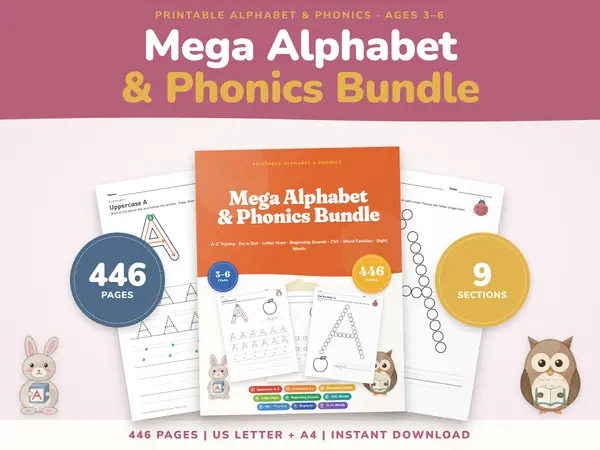
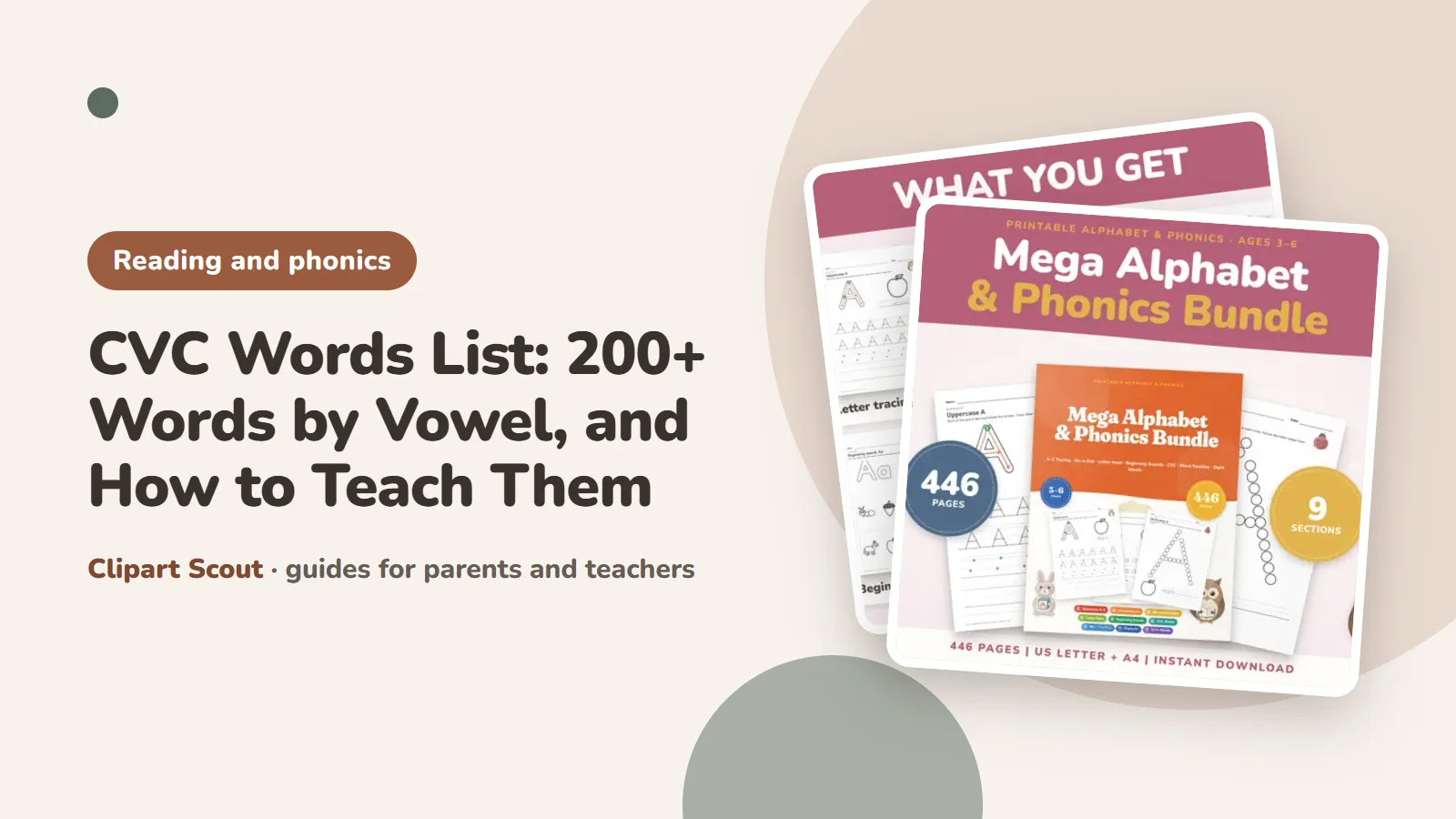
If you want ready-made pages for this step, the Alphabet Worksheets and Phonics Bundle has a CVC Words section of 65 pages for blending and reading short-vowel words, followed by a Word Families section of 79 pages.
A five-minute daily CVC routine
A short, steady routine works better than one long session, so keep the whole thing to about five minutes and stop while it is still going well. This is our suggestion, not a research-based schedule.
| Minute | What to do | Example |
|---|---|---|
| 1 | Review the letter sounds you have taught | Flash the five letters; your child makes each sound |
| 2 | Blend four or five words from one word family | cat, hat, mat, rat |
| 3 | Change the first letter and read the new word | cat to bat to sat |
| 4 | Read a few mixed words from the list above | pin, hop, mud |
| 5 | Build or write two words | Spell “dig” with letter cards or trace it in play dough |
Use words from one vowel at a time. When your child reads one family smoothly, add another family with the same vowel. Mix in a second vowel only when the first feels comfortable.
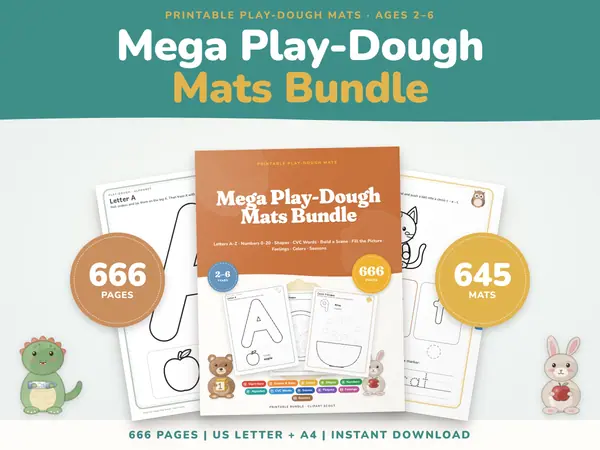
Some children prefer to learn with their hands. The Play Dough Mats Bundle has a CVC Word Building section of 61 pages: 5 short-vowel mats and 56 CVC words, where your child rolls the letters, pushes a ball for each sound and then traces the word.
When should a child read CVC words?
A child can start blending CVC words once they know a few letter sounds and can hear the separate sounds in a spoken word. There is no single right age, and children differ a lot.
Two Common Core goals sit around this skill. The Kindergarten foundational skills standards ask children to pick out the first, middle and last sound in simple three-sound words, and to give the primary sound for each consonant. The Grade 1 standards ask children to decode regularly spelled one-syllable words. States set their own standards, so your child’s school may word these goals differently. Our guide to what a kindergartener should know lists the Kindergarten expectations in plain words.
If your child is much older than these goals and still finds three-letter words hard, or you are worried about their reading, talk to their teacher.
What comes after CVC words?
After CVC words, the next step is words with consonant blends and digraphs. The IES practice guide lays out this order for letter-sound teaching: single consonants and short vowels first, then consonant blends (such as fl, sm and st) and common two-letter digraphs (such as sh, th and ch), then long vowels with silent e, and finally two-letter vowel teams (such as ea and ou).
Word building follows the same path. The guide moves from simple CVC words to CVC words with a silent e, then to words with two consonants at the start or end. The guide also says to teach each sound in a blend and have children blend them, but to teach a digraph as one unit because it makes a single sound. This is one expert panel’s recommended order, so published phonics programs vary in the details.
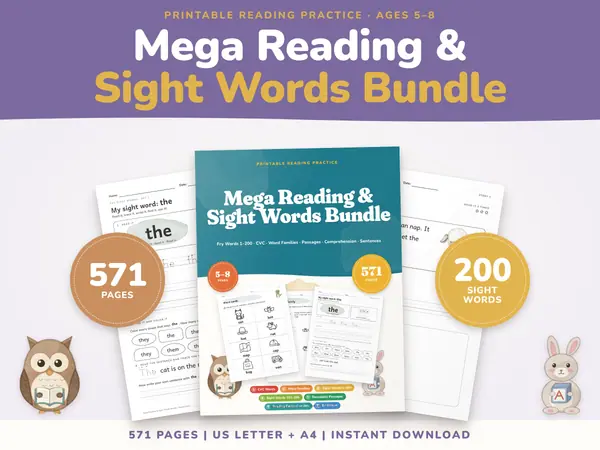
Sight words can run alongside CVC practice, because many common words do not follow the sounding-out rules. Our guide to sight words by grade explains which lists to use. The Sight Words and Reading Bundle includes a 65-page CVC Words section and a 79-page Word Families section, then adds 114 pages of the first 100 Fry words and 12 pages of decodable passages to read aloud.
For the whole sequence from sounds to understanding, see how to teach a child to read step by step.
What to do next
- Teach four or five letter sounds, such as s, m, d, p and a, and check that your child can say each one.
- Pick one word family, such as -at, and blend the words aloud together, then let your child try alone.
- Spend five minutes a day on the routine above and add a new family only when the last one is smooth.
- If you are also teaching one letter at a time, see our letter of the week guide for a weekly plan.
- For ready-to-print pages, browse our reading and phonics worksheets.
Sources
- Common Core State Standards for Mathematics and English Language Arts (official documents), National Governors Association Center for Best Practices and Council of Chief State School Officers.
- Foundational Skills to Support Reading for Understanding in Kindergarten Through 3rd Grade, What Works Clearinghouse, Institute of Education Sciences (IES), U.S. Department of Education.
- Kindergarten reading: foundational skills (online copy of the Common Core standards), thecorestandards.org, an unofficial copy of the standards.
- Grade 1 reading: foundational skills (online copy of the Common Core standards), thecorestandards.org, an unofficial copy of the standards.
This guide is general information for parents and teachers. It is not medical, legal or professional advice. Every guide lists its sources at the end. More about our guides is on the About page.