Letter of the Week: How It Works, Plus a Sample Week
By the Clipart Scout team9 min read
Short answer
Letter of the week means giving one letter five days of short, hands-on attention before moving to the next. A sample week takes 10 to 20 minutes a day. No research we found tests the method or says which letter order is best, so the order and the activities here are our suggestions. At one letter a week it takes 26 weeks to reach Z, so keep reviewing earlier letters.
Key points
- Letter of the week gives one letter five short days: meet it, hunt for it, make it, write it, review it.
- We found no research that tests letter of the week or ranks letter orders, so alphabetical or name letters first are both fine.
- Head Start works toward naming 18 upper-case and 15 lower-case letters by age 5, not all 26 in both cases.
- One letter a week takes 26 weeks to reach Z, so build review into every week.
- Keep hunts and crafts to large items. Small pieces are a choking hazard for children under 3.
On this page
You have decided to teach the alphabet at home and you want a plan that fits into a busy morning. Letter of the week is one of the simplest: pick a letter, give it five short days, then move on.
This guide explains the method, gives a Monday to Friday sample week of 10 to 20 minutes a day, and lists one easy idea for every letter from A to Z. Everything about the method and the order of the letters is our suggestion. We found no research that tests letter of the week or says which order is best, so we do not claim any.
What is letter of the week?
Letter of the week is a way of teaching the alphabet by giving one letter a full week of attention. Each day you meet the same letter in a different way: its name, its sound, its shape and the objects that start with it.
Why spend the time on letters at all? The National Early Literacy Panel reviewed early literacy studies and found that alphabet knowledge, meaning the names and sounds of printed letters, was one of six early skills with medium to large predictive relationships with later literacy. The panel looked at correlations. That is not the same as showing that teaching letters causes better reading later.
The next table shows what the official sources say about letters by age. Each row names its own source, because the lists measure different things.
| Source | Age | What it says |
|---|---|---|
| Head Start framework | 36 to 48 months | Shows awareness of letters, such as recognizing letters from one’s name |
| Head Start framework | 48 to 60 months | Recognizes and names at least half of the letters, including those in their own name |
| Head Start framework | By 60 months | Names 18 upper-case and 15 lower-case letters and knows the sounds of several letters |
| CDC milestones | 5 years | Names some letters when you point to them (75 percent or more of children) |
The CDC has no letter item on its lists before age 5. The Head Start framework says it is not a checklist and must never be used to conclude a child has failed, so use these lines as a picture of the direction, not as a test. If you are worried about your child’s development, the CDC’s advice is to talk with your child’s doctor.
What does a sample week look like?
A letter week can fit into 10 to 20 minutes a day. The plan below is our suggestion. Swap days around freely.
| Day | What you do | Minutes |
|---|---|---|
| Monday | Meet the letter. Say its name and its sound. Show the capital and the lowercase letter on one card. Find the letter on a page of a favorite book. | 10 |
| Tuesday | Hunt. Walk around the house and gather large objects that start with the sound. Put them in a basket and say each name. | 15 |
| Wednesday | Make it. Roll play dough into a snake and shape the letter, or paint it big with a brush. | 15 |
| Thursday | Move and write. Draw the letter in the air, then with a crayon on a big sheet, then on a tracing page. | 15 to 20 |
| Friday | Review. Look at the cards from earlier weeks, sing the sounds, read a picture book and spot the letters. | 10 to 15 |
The CDC’s 5-year list says most children of that age pay attention for 5 to 10 minutes during activities such as story time or crafts (screen time does not count). For younger children, shorter sessions are our suggestion. Stop while it is still going well.
Safety: Choose large objects for the hunt. Small pieces are a choking hazard for children under 3 and for any child who still puts things in the mouth, so keep them out of reach and stay with your child. If you add cutting, supervise scissors closely.
Before week one, a short checklist helps:
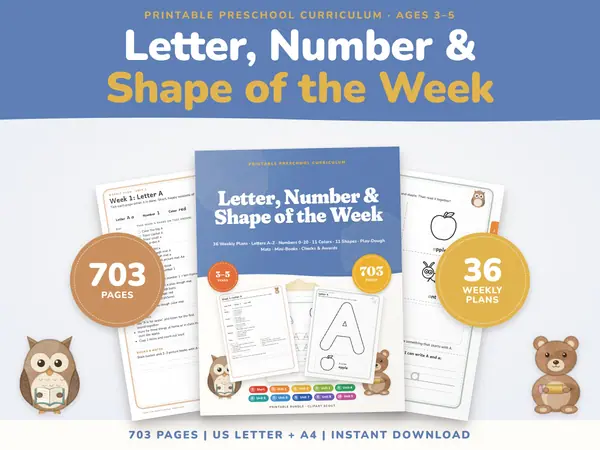
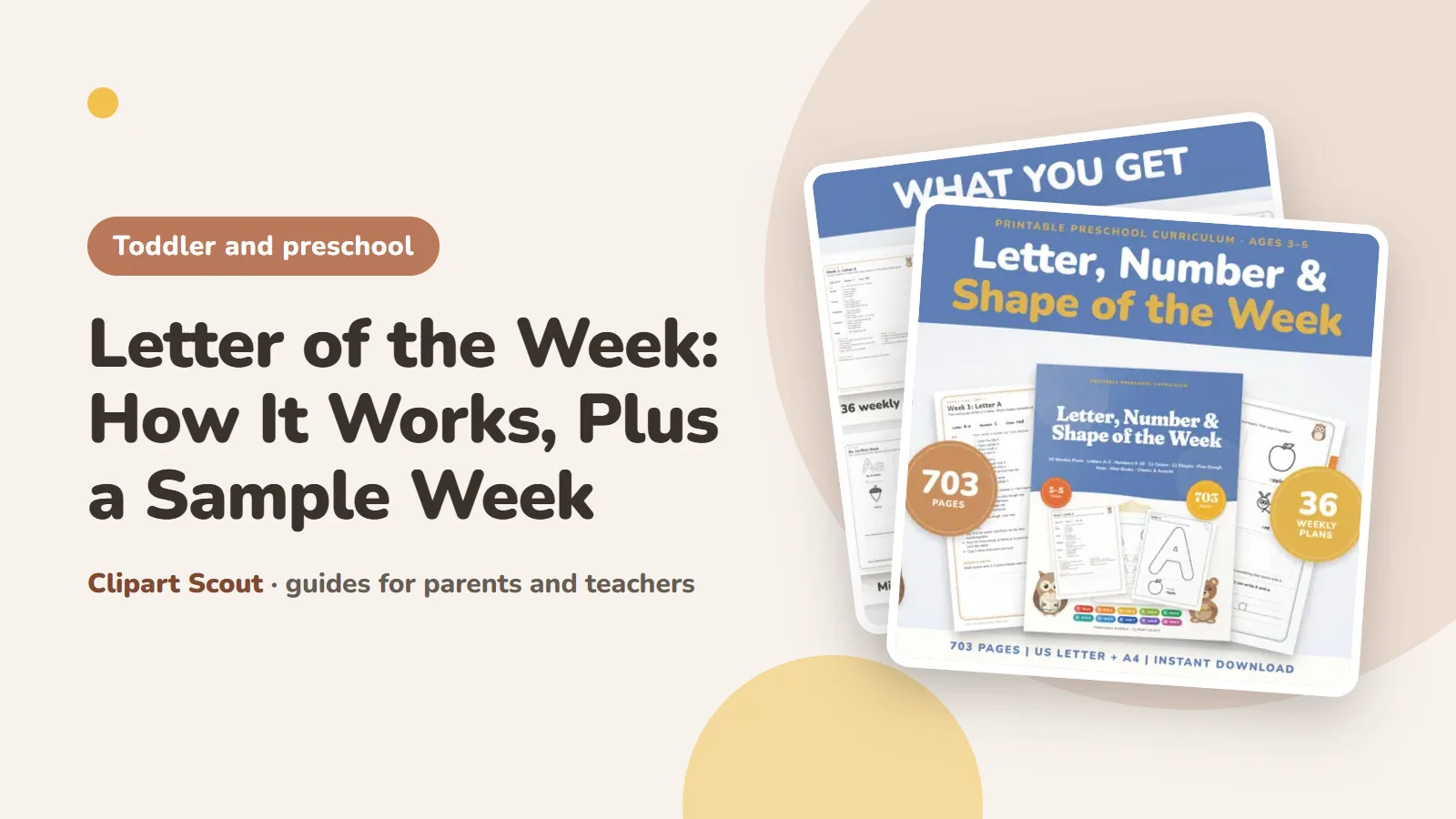
If you would rather have the weeks planned for you, the Letter of the Week Preschool Curriculum lays out a 36-week year. Each letter week has a plan page, letter coloring, tracing, do-a-dot pages, three play-dough mats and a mini-book.
What order should you teach the letters in?
We found no source that names a best order, so this is our suggestion: use the order that is easiest for you to keep going.
- Alphabetical: the simplest, and easy to explain to anyone who helps you.
- Name letters first: some families start with the letters in the child’s name. The Head Start framework mentions recognizing letters from one’s name at 36 to 48 months, which is why this is a natural place to begin.
- Capitals or lowercase first: we found no research on this either. A simple option is to show both on the same card.
Whatever you choose, follow the same pattern every week: name, sound, shape. Our guide to how to teach a child to read shows where letters fit before blending words, and our guide to how to teach a child to write their name uses the letters your child already knows.
What can you do for each letter from A to Z?
Here is one easy idea for every letter. Each one uses an object to find, a simple craft or a movement. They are our suggestions, so adapt them to what you have at home.
| Letter | Idea for the week |
|---|---|
| A | Find an apple and trace a big A next to it |
| B | Bounce a large ball and say “b, b, ball” with each bounce |
| C | Make a cat face on a paper plate with crayons |
| D | Dab dots along a big D with a dot marker |
| E | Draw a big E, then find an empty egg carton and write E on each lid |
| F | Make fish from folded paper and tuck an F inside each |
| G | Walk like a goat, then draw a green G |
| H | Hop like a frog, then trace an H with a finger |
| I | Draw an igloo and an I with chalk outside |
| J | Make a jam sandwich together and write J on the plate |
| K | Fold a paper kite and put a big K on it |
| L | Lie down in the shape of an L and say “l, l, leaf” |
| M | Roll play dough into two humps to make an M |
| N | Build a paper nest and name the things that go in it |
| O | Hunt for round things: an orange, a hoop, a ball |
| P | Paint a big P with a brush and a few dabs of paint |
| Q | Make a quilt square from colored paper |
| R | Draw a rainbow with a big R underneath |
| S | Trace a snake path, then wiggle like a snake |
| T | Stack large blocks into a tower with a T on top |
| U | Draw an umbrella and decorate it with an upside-down U |
| V | Make a V with two crayons and name the things in a vase |
| W | Wave a scarf and draw wavy W lines |
| X | Make an X with tape on the floor and stand on it |
| Y | Trace a yellow Y and sing a song with yo-yo motions |
| Z | Zigzag a crayon across a page, then trace a Z |
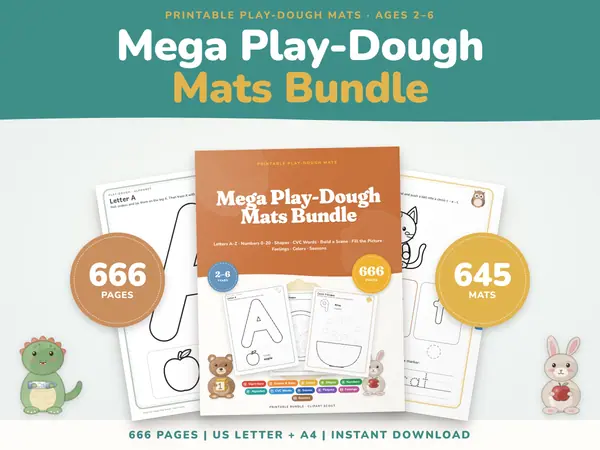
Safety again: where an idea mentions pieces or paper shapes, keep them large, stay with your child, and supervise any scissors. For the play-dough weeks, the Play Dough Mats Bundle has an Alphabet A to Z section of 78 pages, with capital and small letter mats plus a picture mat for every letter.
How long does letter of the week take, and what is the catch?
At one letter a week, you reach Z after 26 weeks. That is simple arithmetic, and it is also the catch. A letter you taught in week 3 is easy to lose by week 20 unless you go back to it.
Researchers who study letter teaching recommend repeated review of letters over time. A 2013 article by Jones, Clark and Reutzel describes alphabet instruction built on flexible, distributed cycles of review, along with learning the name, the sound, how to spot the letter in text and how to write it. We know of no research that proves letter of the week itself works or fails, so treat it as a routine, not a promise of results.
Here are ways to build in review:
- Keep every finished letter card in a box and pull out three on Fridays.
- Add a review week after every three or four letters. Our curriculum does this in its 36-week year.
- Play letter hunts in a picture book, using the letters you have already covered.
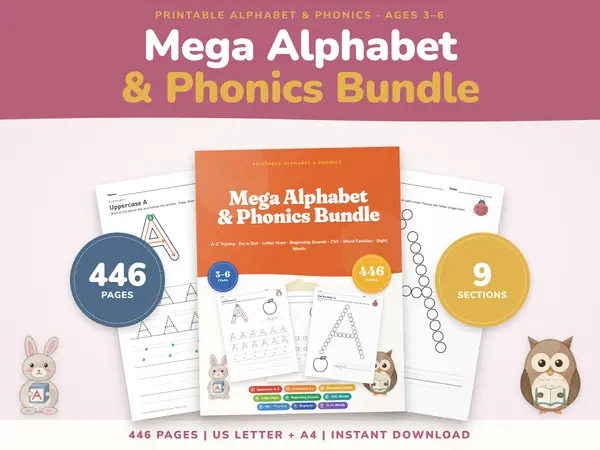
For practice pages, the Alphabet Worksheets and Phonics Bundle has Uppercase A to Z (26 pages), Lowercase a to z (26 pages) and Letter Hunt (26 pages) among its 446 pages.
What age is letter of the week for?
No source sets an age for the method. The sources above show that awareness of letters begins before age 4 in Head Start’s framework, and that the CDC’s first letter item is at 5 years. Our own curriculum is made for ages 3 to 5.
A younger child may only enjoy hearing the sound and playing with play dough. That is fine. A child who already knows most of the letters can use the week to practice sounds and writing. Our guide to preschool at home puts letters next to the other things worth doing in a preschool day, and our list of CVC words is the natural next step once letter sounds are solid.
What to do next
- Choose your order: alphabetical, or the letters in your child’s name first.
- Pick a time of day for 10 to 15 minutes and write the Monday to Friday plan on a card.
- Start with one letter and keep the hunt objects large.
- Put a review day in every week and a review week every three or four letters.
- Browse our preschool printables when you want ready-made pages.
Sources
- Developing Early Literacy: Report of the National Early Literacy Panel (Executive Summary), National Institute for Literacy, via ERIC.
- Head Start Early Learning Outcomes Framework: Ages Birth to Five, Office of Head Start.
- Important Milestones: Your Child By Age 5, Centers for Disease Control and Prevention.
- Enhancing Alphabet Knowledge Instruction: Research Implications and Practical Strategies for Early Childhood Educators (abstract), Jones, Clark and Reutzel, Early Childhood Education Journal, 2013.
This guide is general information for parents and teachers. It is not medical, legal or professional advice. Every guide lists its sources at the end. More about our guides is on the About page.