Preschool at Home: A Simple Plan for Ages 3 and 4
By the Clipart Scout team6 min read
Short answer
Preschool at home can be simple: short play-based blocks of language, early math, hands-on work, self-care and free play, with books every day. No official source gives a number of hours for a 3- or 4-year-old, so the schedule in this guide is our suggestion. Use the CDC's milestone lists and Head Start's goals as guides for choosing activities, not as tests.
Key points
- No official source we read gives hours of school for a 3- or 4-year-old at home, so every schedule here is our suggestion. Keep blocks short.
- In the states shown in a 2020 federal table, the lowest compulsory school age was 5. Check your own state's rules.
- The CDC says most 5-year-olds pay attention for 5 to 10 minutes during activities such as story time or crafts, which supports short blocks.
- The American Academy of Pediatrics describes play as the main focus of high-quality early childhood education and encourages shared reading.
- Use CDC lists and Head Start goals to choose activities. Head Start says its framework is not a curriculum, assessment or checklist.
On this page
Preschool at home does not need to look like school. For a 3- or 4-year-old, a good day is mostly play, books, songs and small jobs around the house, with a little hands-on learning mixed in. If you are building a plan, a loose rhythm is easier to keep than a tight timetable.
No official source we read gives a number of hours for a 3- or 4-year-old at home. So the weekly rhythm and the example morning below are our suggestions. We tie the activities to the CDC’s milestone lists, which describe what most children (75 percent or more) can do by an age, and to Head Start’s goals for preschoolers. Neither is a test.
Do you have to do preschool at home?
No. Preschool is not compulsory in the states shown in the 2020 federal table from the National Center for Education Statistics. The lowest compulsory school age shown there is 5. States change their rules, so check your own state or district.
Many families still choose to set aside some time for learning at home. If you do, aim for something calm and repeatable. The CDC’s page on routines says that children feel safe and secure because they know what to expect, and it adds that it is up to you to decide which routines work best for your family.
What should a weekly rhythm look like?
A weekly rhythm is a repeating pattern of themes, not a timetable. This table is our suggestion, so move the days around freely.
| Day | Main focus | Example |
|---|---|---|
| Monday | Language and stories | Read a picture book twice. Ask “What happens next?” |
| Tuesday | Early math | Count stairs, sort socks, play a simple counting game |
| Wednesday | Hands-on art and fine motor | Play dough, drawing, stringing large beads |
| Thursday | Letters and sounds | Sing the alphabet song, look for the first letter of your child’s name |
| Friday | Movement, helping and play | Hop, kick a ball, bake or help with chores |
On every day, add a book, a song and some free play.
Routines can hold the week together. The CDC’s page on routines gives “Brush, book, bed” as a bedtime example. It also suggests mealtime routines such as washing hands and setting the table, with jobs that are safe and fit your child’s skills. A change is easier to introduce when your child is calm. You can use the same idea for your learning time: same place, same first song, same last tidy-up.
The American Academy of Pediatrics encourages shared reading from birth and continuing at least through kindergarten. It gives no number of minutes or books.
What does a 60 to 90 minute morning look like?
A 60 to 90 minute morning is about six to eight short blocks, with free play between them. This is our suggestion. The CDC’s 5-year list says most children (75 percent or more) pay attention for 5 to 10 minutes during activities such as story time or arts and crafts, and screen time does not count. That is one reason to keep each block short.
| Time | Block | Idea |
|---|---|---|
| 0 to 10 min | Welcome and song | Say the day, sing a song, talk about the weather |
| 10 to 20 min | Story | Read one picture book and talk about the pictures |
| 20 to 30 min | Hands-on | Play dough, stringing, drawing a circle or a person |
| 30 to 40 min | Move | Dance, hop, kick a ball outside |
| 40 to 55 min | Snack and helping | Wash hands, set the table, pour water with supervision |
| 55 to 70 min | Letters or numbers | A short game, such as finding the first letter of a name |
| 70 to 90 min | Free play | Blocks, dress-up, a pretend store |
If your child loses interest, stop and come back later. You can also halve the plan. A 20-minute morning with a story, an activity and some play is still a morning of learning.
What supplies do you need?
You need very little. Most of this list is already in your house.
- Picture books from your library
- Crayons, paper and washable paint
- Play dough
- Large beads or macaroni and a string, for supervised stringing
- Child-safe scissors, for older preschoolers, with supervision
- A box of blocks and some empty containers
- A basket of dress-up clothes
Safety note: The U.S. Consumer Product Safety Commission says small parts present a choking hazard for children under 3. Keep beads, cut-out pieces and other small items away from any child who still puts things in the mouth, and stay with your child. The American Academy of Pediatrics advises close supervision when children use tools such as scissors.
What should you cover across the year?
Across a year, cover five areas: language, early math, fine motor, self-care and play. The CDC’s lists for ages 3, 4 and 5 and Head Start’s goals can guide your choices.
| Area | What the sources mention | Idea at home (our suggestion) |
|---|---|---|
| Language | CDC 3 years: conversation, asks “who,” “what,” “where,” “why.” CDC 4 years: sentences of four or more words, tells about their day | Talk at meals and read daily |
| Early math | CDC 5 years: counts to 10, names some numbers 1 to 5. Head Start by 60 months: counts to at least 20 | Count stairs and snacks |
| Fine motor | CDC 3 years: strings large beads. CDC 4 years: holds a crayon between fingers and thumb | Play dough, drawing, stringing |
| Self-care | CDC 3 years: uses a fork. CDC 4 years: unbuttons some buttons; serves food or pours water with supervision | Let your child help dress and serve |
| Play | CDC 4 years: pretends to be something else during play | Dress-up and make-believe |
Head Start says its framework is not to be used as a curriculum, assessment or checklist, so treat the table as a way to choose activities. Our guides to what a 3-year-old can do and what a 4-year-old can do explain each CDC list in detail, and our fine motor activities by age gives hand-skill ideas.
If you plan to teach letters, there is no official source on the order or on methods such as “letter of the week”. We explain the options in our guide to letter of the week, and a simple suggestion is to keep returning to letters you have already met.
Do you need a curriculum?
No, but a plan can save you from deciding what to do each morning. If you want one, we offer three that are different in size. Skip or repeat anything in any of them.
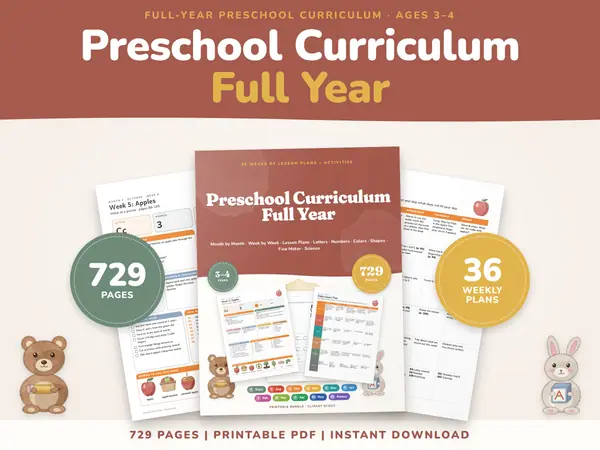
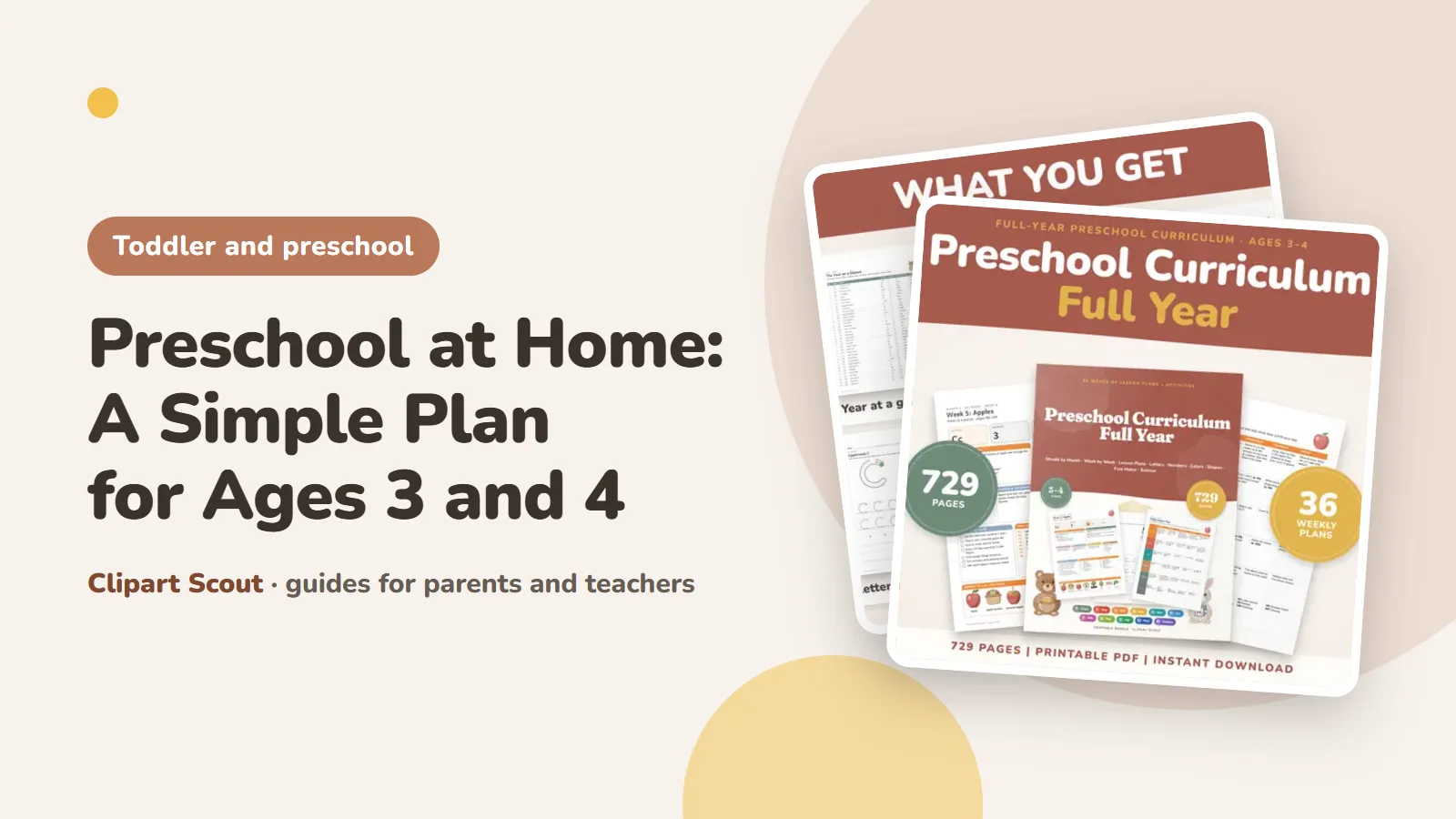
The Preschool Curriculum Full Year has 729 pages for ages 3 to 4, running from September to May with four weeks a month, each with a week at a glance and a daily lesson plan. It also has half-day and full-day schedules, a circle time routine and 36 songs and rhymes.
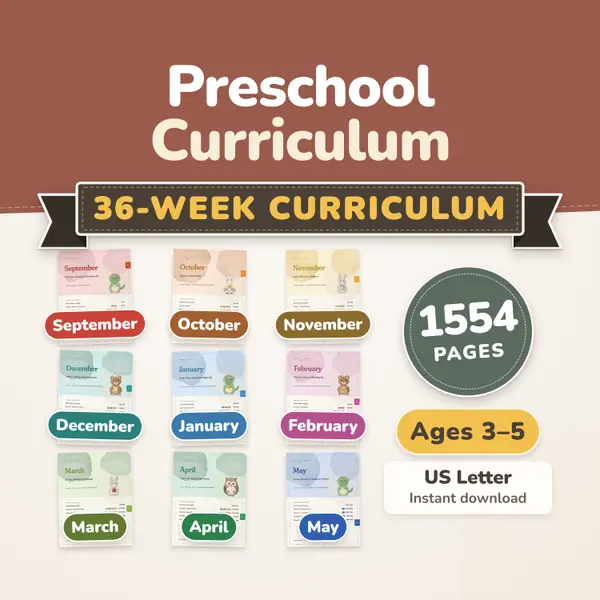
The larger Preschool Curriculum Full Year has 1,554 pages for ages 3 to 5. Its core pages make a calm 20 to 40 minute day, and the other pages are extensions for centers, quiet time or a second session. It also has quarterly skills checks and a portfolio section.
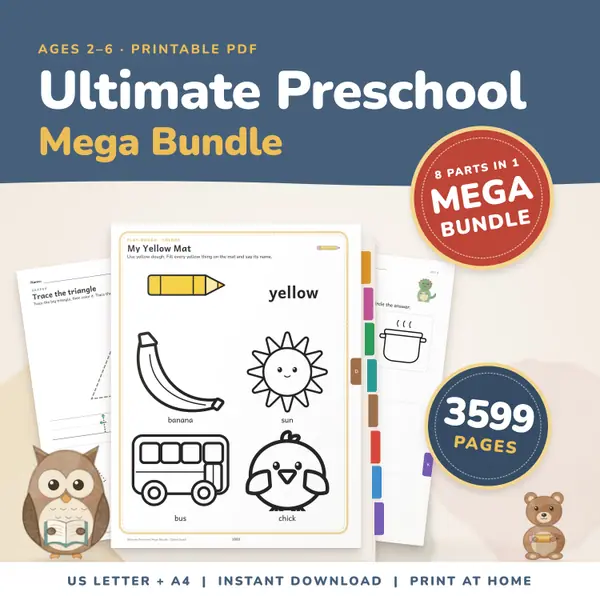
If you have more than one child, the Ultimate Preschool Mega Bundle has 3,599 pages for ages 2 to 6, so siblings can each use their own part.
What to do next
- Choose one or two days from the weekly rhythm and try the example morning for a week.
- Gather the supplies from the list above, mostly from your own home.
- Keep blocks short. If your child loses interest, stop and come back later.
- If you have a concern about your child’s development, the CDC’s advice is to talk with your child’s doctor and ask about developmental screening.
- Browse our preschool printables if you want pages ready to print.
Sources
- The Power of Play: How Fun and Games Help Children Thrive, American Academy of Pediatrics (healthychildren.org).
- Beyond Literacy: Shared Reading Starting at Birth Offers Lifelong Benefits, American Academy of Pediatrics (healthychildren.org).
- Tips for Relying on Routines and Rules, Centers for Disease Control and Prevention (CDC).
- Important Milestones: Your Child By Five Years, Centers for Disease Control and Prevention (CDC).
- Important Milestones: Your Child By Four Years, Centers for Disease Control and Prevention (CDC).
- Head Start Early Learning Outcomes Framework: Ages Birth to Five, Office of Head Start, U.S. Department of Health and Human Services.
- Table 1.3. Types of state and district requirements for kindergarten entrance and attendance, by state: 2020, National Center for Education Statistics (NCES).
- Small Parts for Toys and Children's Products, U.S. Consumer Product Safety Commission (CPSC).
This guide is general information for parents and teachers. It is not medical, legal or professional advice. Every guide lists its sources at the end. More about our guides is on the About page.