Busy Book Ideas by Age, and How to Make One That Lasts
By the Clipart Scout team6 min read
Short answer
A busy book is a binder or folder of hands-on pages, often with loose pieces that stick on with hook-and-loop dots, used for quiet time. No official source tests or recommends busy books, so every idea here is our suggestion. The main safety point is that small pieces are a choking hazard for children under 3 and for any child who still mouths objects.
Key points
- A busy book is a quiet-time binder of hands-on pages. No official source tests or recommends busy books, so every page idea here is our suggestion.
- Small pieces are a choking hazard for children under 3, says the US Consumer Product Safety Commission. Loose busy book pieces can be small parts.
- Tie page ideas to skills the CDC lists, such as matching a color at 30 months, stringing large beads at 3 and counting to 10 at 5.
- Keep loose pieces in a pocket or zip pouch, and rotate a few pages at a time so the book stays interesting.
On this page
A busy book can buy you ten quiet minutes in a waiting room or on a car trip. The hard part is knowing which pages to put in and how to keep the pieces from vanishing under the sofa.
This guide gives page ideas by age, step-by-step instructions for making a busy book that lasts, and the safety points that matter most. An honest note first: no government, AAP or research source tests or recommends busy books. Every idea here is our suggestion, not a proven method.
What is a busy book?
A busy book is a binder, folder or set of rings holding hands-on pages. Each page usually practices one simple thing: matching colors, sorting shapes, counting, or putting pieces in order. Pieces often stick on with hook-and-loop dots, so the child can move them around and start again.
A busy book is a screen-free activity, and that is all this article claims for it. We do not say it improves any skill or replaces any other kind of play.
What are busy book page ideas by age?
Page ideas work best when they match something your child can already do. The skills below come from the CDC milestone lists, which show what 75 percent or more of children can do by an age. The ideas themselves are our suggestions.
| Age band | Page ideas | A skill from the CDC lists |
|---|---|---|
| 1 to 2 | A large picture page to point to and name with you. A page with one big pull-tab or flap. No loose pieces. | Not covered by the sources we used |
| 2 to 3 | Match one color with a crayon row. Turn pages one at a time. A 2-piece picture puzzle. | Knows at least one color and turns book pages one at a time (30 months) |
| 3 to 4 | Color baskets, shape houses and simple patterns. A page with large beads to string. | Strings large beads or macaroni (3 years) |
| 4 to 5 | A button-and-unbutton page, a number-and-dot match, a letter match. | Unbuttons some buttons (4 years); counts to 10 and names some numbers 1 to 5 and some letters (5 years) |
Here are a few more page ideas, again our suggestions, that use only large pieces and things you can draw or print yourself:
- Color baskets: a basket outline for each color, with large pictures to match.
- Shadow match: a picture on one side and its black outline on the other.
- Big and small: two rows of the same picture in two sizes to line up.
- Pattern strip: a row such as red, blue, red, blue, with space for the next card.
- Feelings faces: a page of faces to point to and name with you.
Notice that counting and letters appear in the CDC lists only at age 5. A busy book for a 2-year-old does not need them, and that is a good reason to start with colors and matching.
For a 1-year-old, the sources we used do not cover the age, and our printables are made for ages 2 to 4. If you make something for a child under 2, keep to pages with no loose pieces and stay with them.
Our guide to what a 2-year-old knows and can do lists what the CDC puts at 2 years and 30 months, which helps when you choose first pages. For more hand-skill play, see our fine motor activities by age.
How do you make a busy book that lasts?
These steps are our suggestion:
- Print the pages on paper or card stock.
- Laminate them or slide each one into a clear sleeve, so wipes and spills do not ruin the page.
- Cut out the pieces. This is an adult job.
- Stick hook-and-loop dots on the page and the matching pieces. Press hard and check that nothing peels.
- Bind the pages into a binder or onto rings.
- Store the loose pieces in a zip pouch or a piece pocket at the back.
A cover and spine label make the binder easy to find on a shelf. Rotating a few pages at a time keeps interest high: put four to six pages in the binder, keep the others in a box, and swap them every week or two.
A short checklist before you hand it over:
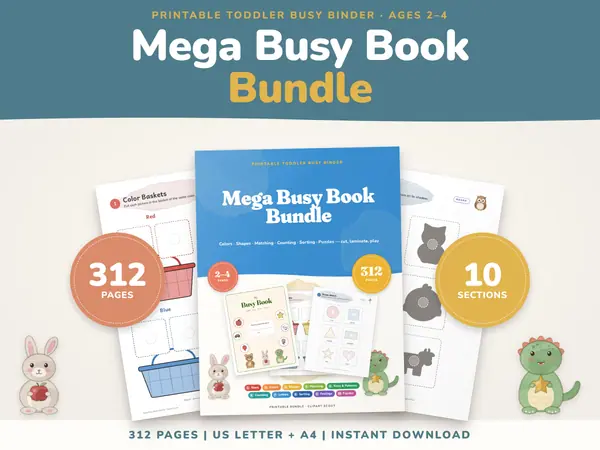
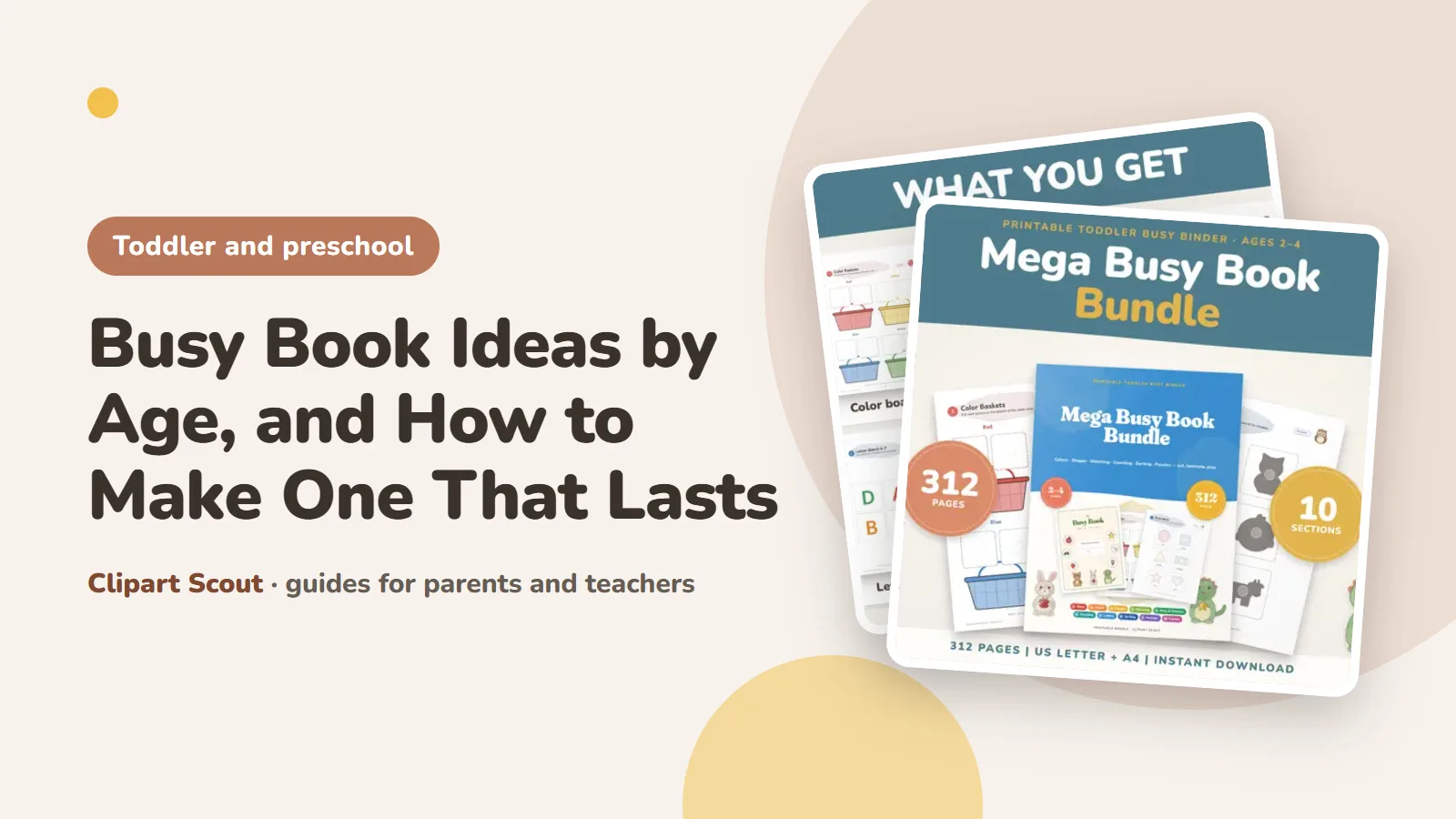
The Toddler Busy Book Bundle has an 8-page Getting Started section with a binder cover, spine labels for 1, 1.5 and 2 inch binders, piece storage labels, a hook-and-loop dot guide with dot counts for each section, and a piece pocket. It is 312 pages and made for ages 2 to 4.
What safety rules apply to busy books?
Small pieces are the main concern. The US Consumer Product Safety Commission says its small parts rule covers children’s products intended for use by children under 3, because small parts present a choking, aspiration or ingestion hazard. A small part is anything that fits entirely into its small parts cylinder, which approximates the throat of a child under three.
CPSC does not mention busy books, so this is our application of its definition. Cut-out cards, hook-and-loop dots that peel off, clips, rings, pom-poms and buttons can all be small parts.
Safety: For a child under 3, or any child who still puts things in the mouth, use only large pieces that cannot come loose, keep small things out of reach and stay with your child. Being made of paper does not make a piece safe to mouth, and we do not call any printable or homemade book safe for under-threes.
Scissors need the same care. Cut the pieces yourself, away from small children, and put the scissors away.
How many pages do you need, and how do you store them?
We suggest four to six pages in the binder at a time. A small number keeps the book easy to carry, and swapping pages brings back the interest.
For storing, use one pouch per section, labeled by theme, such as colors, shapes or counting. Keep the pouches in a box with the extra pages, so the book can be reset in two minutes. Put the pieces back after each play, and count them to be sure.
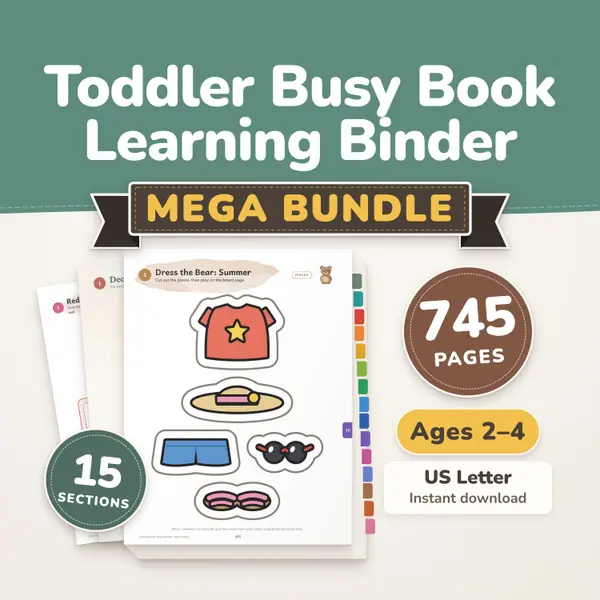
If you want a much bigger collection, the Toddler Busy Book 745 Pages has a 7-page Set Up Your Binder section and a sample week plan, and is also made for ages 2 to 4.
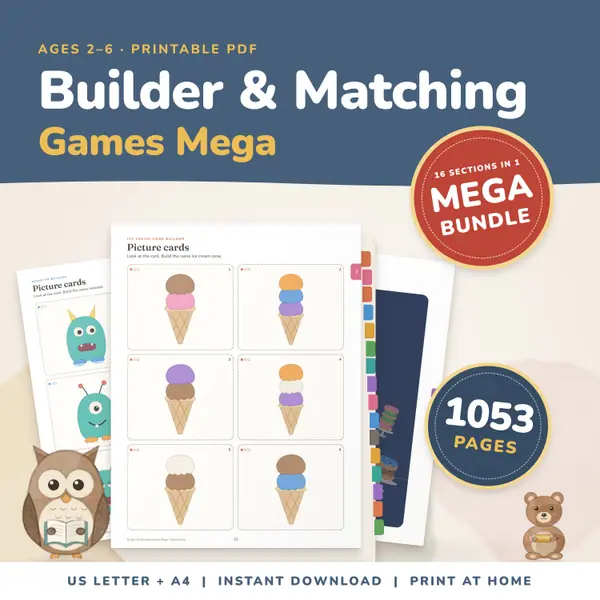
For older children who like building and matching, the Builder Games for Toddlers Printable Mega Bundle has 3 levels of cards in its builder games, among its 1,053 pages.
Our guide to preschool at home fits a busy book into a longer day, and the shop has busy books and learning binders and toddler printables if you would rather print than draw your own.
What to do next
- Pick two or three pages that match something your child can already do.
- Print, laminate and cut them, then add the hook-and-loop dots yourself.
- Check that every loose piece is large and every dot is firm before the first use.
- Sit with your child for the first few sessions and count the pieces back.
- Swap one or two pages every week or two, and keep the rest in a box.
Sources
- Small Parts for Toys and Children's Products, US Consumer Product Safety Commission.
- Important Milestones: Your Child By 30 Months, Centers for Disease Control and Prevention.
- Important Milestones: Your Child By Age 5 Years, Centers for Disease Control and Prevention.
This guide is general information for parents and teachers. It is not medical, legal or professional advice. Every guide lists its sources at the end. More about our guides is on the About page.