Fine Motor Activities by Age: Toddlers to Kindergarten
By the Clipart Scout team7 min read
Short answer
Fine motor skills are the small-muscle movements of the hands and fingers, such as scooping, stringing, buttoning, drawing and cutting. The CDC lists hand skills from age 2 to 5, the AAP describes what children typically do, and Head Start names goals for age 5. Ages differ widely, so the activities here are our suggestions, listed by age band with household items.
Key points
- Head Start describes fine motor skills as increasing control, strength and coordination of the small muscles.
- CDC hand items run from holding a lid at 2 years to stringing large beads at 3, holding a crayon with fingers and thumb at 4, and buttoning some buttons at 5.
- For pencil grasp, the sources give a range from about 3 to 5, with the CDC placing a fingers-and-thumb hold at 4 years.
- Every activity here is our suggestion. Keep pieces large for children under 3 and for any child who still mouths objects.
- If you are worried about your child's hand skills, the CDC's advice is to talk with your child's doctor.
On this page
You may be looking for something to do with a restless two-year-old, or wondering whether your four-year-old’s hands are ready for pencils. Either way, the answer is practical: small, regular, hands-on play, matched to what your child can already do.
This guide sets out what the CDC, the American Academy of Pediatrics (AAP) and Head Start say about hands at each age, then gives six simple activities for each age band using things from home. The activities are our suggestions. Children differ a lot, and the ages below are not deadlines.
What are fine motor skills?
Fine motor skills are the small movements of the hands and fingers. The Head Start framework describes the goal as a child showing increasing control, strength and coordination of small muscles. It links this to hand-eye tasks such as drawing simple shapes, cutting paper with scissors and stringing beads.
In daily life that means picking up a spoon, turning a page, unscrewing a lid, fastening a button and, later, holding a pencil. None of these needs a special product. They need time, safe things to handle and an adult close by.
What can hands do at each age?
The table below names the source for every line, because the three kinds of source measure different things. The CDC lists what 75 percent or more of children can do by an age. The AAP describes what children typically do. Head Start names goals that preschool programs work toward.
| Age band | What the sources say | Source |
|---|---|---|
| 1 to 2 | Not covered by the sources we used. The activities below are our suggestions only. | None |
| 2 to 3 | Holds something in one hand while using the other, such as taking a lid off a container; tries switches, knobs and buttons on a toy; eats with a spoon; at 30 months, twists things like doorknobs and lids and turns book pages one at a time | CDC, 2 years and 30 months |
| 2 to 3 | Handles small objects with ease, builds a tower of 6 blocks and unzips a zipper | AAP, 2-year-olds |
| 3 to 4 | Strings large beads or macaroni, uses a fork, draws a circle when shown how | CDC, 3 years |
| 3 to 4 | Copies a circle, traces a square, unbuttons clothes and holds a crayon with thumb on one side and fingers on the other | AAP, preschooler hand skills |
| 4 to 5 | Holds a crayon or pencil between fingers and thumb (not a fist), unbuttons some buttons, pours water with adult supervision | CDC, 4 years |
| 4 to 5 | Cuts with safety scissors and pastes, traces and copies patterns such as stars or diamonds | AAP, preschooler hand skills |
| 5 to 6 | Buttons some buttons and writes some letters in the name (CDC, 5 years); by 60 months, uses a pincer grip and cuts along a line (Head Start) | CDC and Head Start |
The AAP page on 2-year-olds adds a note on handedness: by 24 months a child may show a clear preference for the right or left hand, but many children do not show it for several years. So there is no need to pick a hand for your child.
What are six activities for each age?
Every idea below uses household items. They are our suggestions, so adjust them to your child and drop any that feel too hard.
Safety: Small pieces are a choking hazard for children under 3 and for any child who still puts things in the mouth. For those children, use only large items that cannot come loose, keep small things out of reach and stay with your child. Scissors always need close supervision.
Ages 1 to 2
- Take large soft scarves in and out of an empty tissue box or a basket.
- Turn the pages of a sturdy board book with you.
- Stack large plastic cups or big blocks.
- Scoop with a big spoon from one bowl to another, using water or dry oats while you sit beside them.
- Pat and squeeze play dough with you next to them, and put it away if it goes toward the mouth.
- Scribble with a chunky crayon on a big sheet of paper.
Ages 2 to 3
- Take lids on and off plastic containers.
- Unscrew a bottle top that has a big, easy thread.
- Poke fingers into play dough, then pinch off pieces.
- Pour water from one cup to another outside or over a tray.
- Peel big stickers and stick them onto paper.
- Unzip a pencil case or a bag.
Ages 3 to 4
- String large beads or pasta tubes on a shoelace, with you watching closely.
- Roll play dough snakes and make a circle.
- Tear paper and glue the pieces onto a picture.
- Snip paper strips with child-safe scissors while you supervise.
- Practice with a fork on soft food or play dough.
- Unbutton and button a big-button shirt.
Ages 4 to 5
- Cut along a thick line with safety scissors, with you nearby.
- Trace or copy a circle, square, star or diamond.
- Pour water into a cup with adult supervision.
- Make a pattern with large pegs or large lacing cards.
- Draw a person and add more body parts each time.
- Hold a paper steady with one hand and draw with the other.
Ages 5 to 6
- Cut out simple shapes and paste them onto a picture.
- Button, unbutton and zip a jacket without help.
- Write the letters of their name, a few at a time.
- String smaller beads on a pipe cleaner at a table, with an adult present.
- Complete a jigsaw puzzle of 12 to 24 pieces.
- Copy a simple word from a card.
Our guide to scissor skills by age takes the cutting steps slowly, and our guide to how to teach a child to write their name shows where pencil work leads.
When should a child hold a pencil correctly?
There is no single date, so the honest answer is a range of about 3 to 5. The AAP says a 3-year-old can hold a crayon like an adult, with thumb on one side and fingers on the other. The CDC’s 4-year list says most children can hold a crayon or pencil between fingers and thumb, not a fist. Head Start works toward a pincer grip for writing, drawing and painting by 60 months.
We did not find a sourced list of grasp stages with ages, so we do not give one. Draw big, draw often and let the grip settle. If you are worried about your child’s hand skills, the CDC says to talk with your child’s doctor, share your concerns and ask about developmental screening.
How can you practice at home without a lot of fuss?
Short and regular beats long and rare. Pick one or two activities from the lists and keep them in a basket where your child can reach them. Rotate the contents every few days so they stay interesting.
A starting checklist:
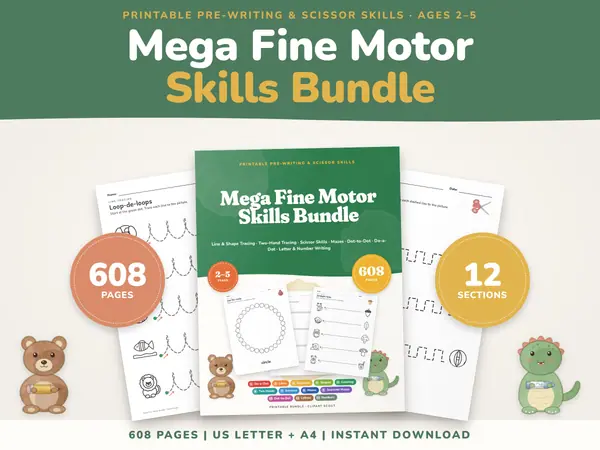
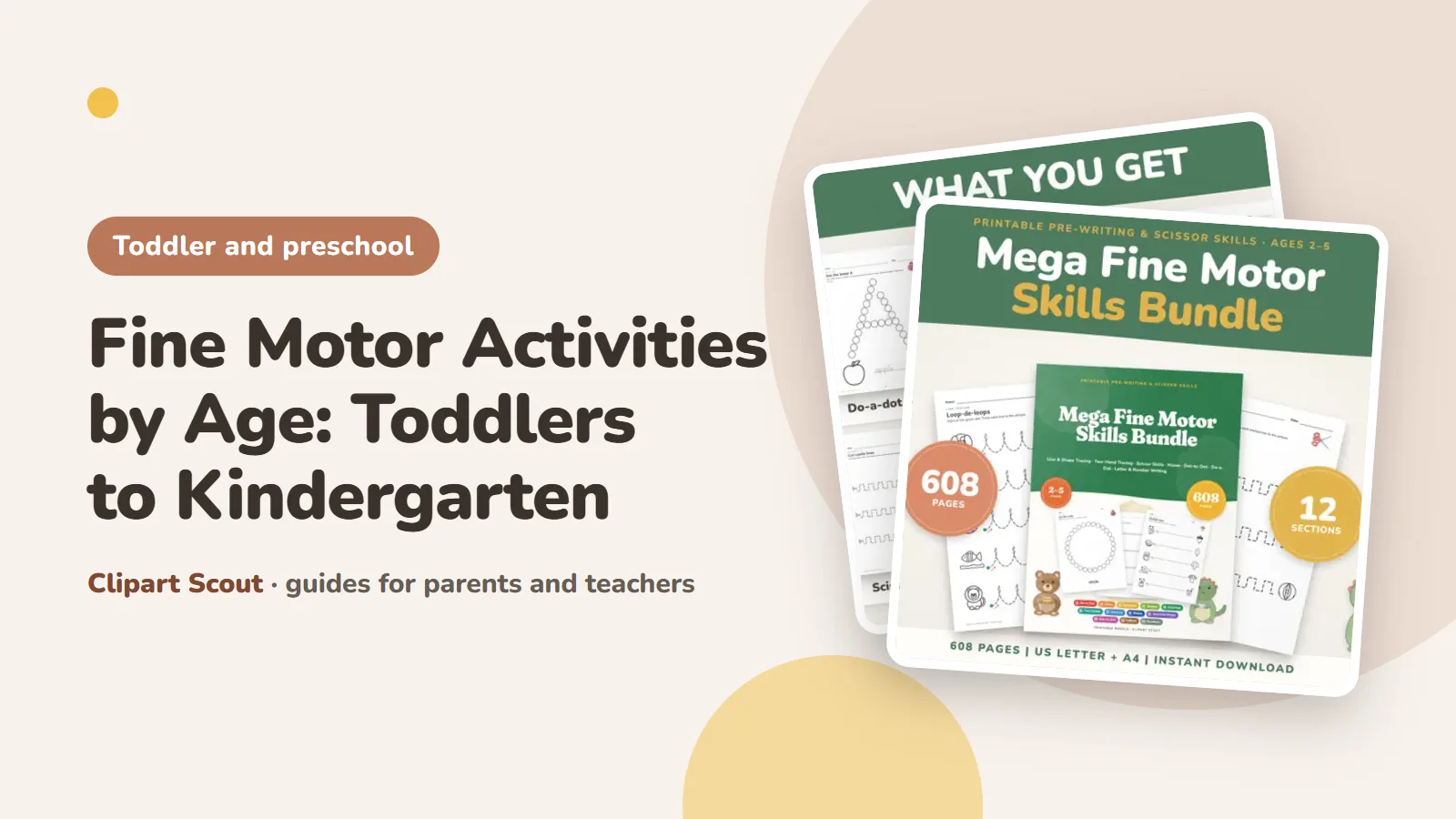
If you want printed practice, the Fine Motor Skills Bundle has Line Tracing (56 pages), Shape Tracing (20 pages) and Scissor Skills (40 pages) among its 608 pages.
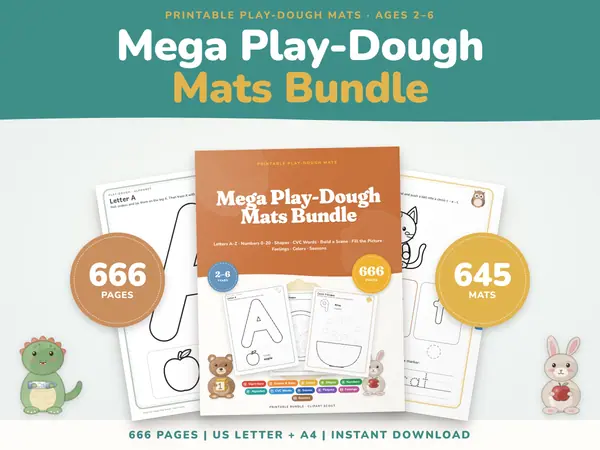
For play dough, the Play Dough Mats Bundle starts with six skill cards: roll, squash, pinch, poke, twist and cut.
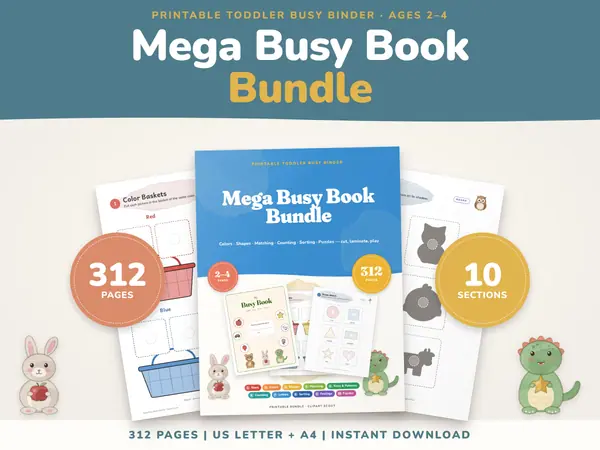
For a quiet-time binder with hook-and-loop pieces, the Toddler Busy Book Bundle is made for ages 2 to 4. Loose pieces are small parts, so see our busy book ideas for the safety notes first. If you are checking what else your child can do at this age, our guide to what a 3-year-old can do uses the same CDC lists.
What to do next
- Choose two activities for your child’s age band and put them in a basket today.
- Spend five to ten minutes on one of them, and stop while it is going well.
- Check the table once a month, not every week, and note what your child enjoys.
- Keep scissors and small pieces under your control until your child is ready for them.
- Browse our fine motor and early learning printables when you want ready-made pages.
Sources
- Important Milestones: Your Child By Age 2 Years, Centers for Disease Control and Prevention.
- Important Milestones: Your Child By 30 Months, Centers for Disease Control and Prevention.
- Important Milestones: Your Child By Age 3 Years, Centers for Disease Control and Prevention.
- Important Milestones: Your Child By Age 4 Years, Centers for Disease Control and Prevention.
- Important Milestones: Your Child By Age 5 Years, Centers for Disease Control and Prevention.
- Hand and Finger Skills: 2 Year Olds, American Academy of Pediatrics, HealthyChildren.org.
- Hand and Finger Skills of Your Preschooler, American Academy of Pediatrics, HealthyChildren.org.
- Head Start Early Learning Outcomes Framework: Ages Birth to Five, Office of Head Start.
This guide is general information for parents and teachers. It is not medical, legal or professional advice. Every guide lists its sources at the end. More about our guides is on the About page.