How to Teach a Child to Write Their Name, Step by Step
By the Clipart Scout team6 min read
Short answer
Most children write some letters of their name by age 5, according to the CDC, and with help may make letter-like marks and some letters at about 3 to 4. Writing the whole first name correctly or nearly so is a Head Start goal for the end of preschool, not a CDC milestone. Seven steps, from saying the name to writing it from memory, are our suggestion.
Key points
- The CDC's 5-year list says most children write some letters in their name. Head Start works toward the whole first name by age 5.
- Before writing comes saying and recognizing: the CDC lists saying a first name when asked at 3 years.
- Writing your own name is one of six early skills the National Early Literacy Panel linked to later reading, but the evidence is correlational.
- No source says capitals or lowercase letters come first. Asking the school how it teaches names is our suggestion.
- A seven-step path, from recognizing the name to writing it from memory, is our suggestion and not a schedule.
On this page
Maybe your child has started to scribble a wobbly letter on the fridge door, or the preschool teacher says the class is starting names. You want a clear way to help without turning it into a chore.
The short answer: most children write some letters of their name by age 5, and writing the whole first name correctly comes a little later in the Head Start goals. This guide gives the ages the sources state, then seven steps you can follow at your child’s pace. The steps are our suggestion.
At what age do children write their name?
The sources give a range, so here is each one on its own. Every line names the source, because the CDC, AAP and Head Start measure different things.
| Age | What the source says | Source |
|---|---|---|
| 3 years | Says first name, when asked | CDC |
| 36 to 48 months | With modeling and support, writes some letter-like forms and letters; recognizes letters from one’s name | Head Start framework |
| 3 to 4 years | Begins to copy some capital letters | AAP |
| 48 to 60 months | Recognizes and names at least half of the letters, including those in their own name | Head Start framework |
| 5 years | Writes some letters in their name (75 percent or more of children) | CDC |
| By 60 months | Writes first name correctly or close to correctly | Head Start framework |
So the pattern is: saying the name comes first, then making marks and some letters with help at about 3 to 4, then some letters of the name by 5, and the whole first name correctly or nearly so as a goal for the end of preschool. No source we read gives an age for writing the last name.
These are not tests. The Head Start framework says it is not to be used as a curriculum, assessment or checklist. If you are worried about your child’s development, the CDC’s advice is to talk with your child’s doctor, share your concerns and ask about developmental screening.
Why does name writing matter?
Writing your own name is one of the early skills the National Early Literacy Panel found to have a medium to large predictive relationship with later literacy. The panel’s finding is a correlation. Children who can write their name and know letters before school tend to do better in reading later. It does not say that teaching name writing causes the later results.
That is a good reason to treat the name as a useful first writing project, with letters that matter to the child. It is not a reason to push.
What are the seven steps?
This order is our suggestion. Stay on a step as long as it is fun, and go back whenever your child needs.
| Step | What to do |
|---|---|
| 1. Say and recognize | Say the name together and point to it on a card, a door sign and a cubby label |
| 2. Build it with letters | Put the letters in order with large letter cards or play dough |
| 3. Pre-writing lines and shapes | Draw lines, circles and squares with chunky crayons or in a tray of salt |
| 4. Trace big | Trace the name on a large sheet with a finger, then a marker |
| 5. Trace small | Trace the name at a smaller size on lined paper |
| 6. Copy | Write the name beside a model on a card |
| 7. Write from memory | Write the name without a model, and keep a dated sample |
On step 3, the AAP says 3-year-olds can copy a circle and trace a square, and the CDC lists drawing a circle when shown how at 3 years. We do not give an age for each pre-writing line, since we found no sourced chart.
Safety: If you build the name with small letter pieces, remember that small pieces are a choking hazard for children under 3 and for any child who still puts things in the mouth. Use large pieces and stay with your child.
Should your child write capitals or lowercase?
We found no source that says which to teach first, so this is our suggestion: a capital for the first letter and lowercase for the rest, because that is how the name will appear on school papers. Ask your child’s school how it teaches names, since schools differ.
The AAP’s list for ages 3 to 4 mentions beginning to copy some capital letters, and Head Start’s by-5 goal counts both upper-case and lower-case letters. Neither is an instruction about teaching order. If your child finds capitals easier at first, start there and add lowercase letters over time.
Is name tracing good for preschoolers?
Tracing is useful as one step, mainly because it gives the hand a model to follow. We found no source that compares tracing with copying, so we cannot say which is better. A balance is our suggestion: trace big first, then trace small, then copy from a model, then write from memory.
If you use tracing pages, keep each session short and stop while it is going well. The CDC’s 5-year list says most children pay attention for 5 to 10 minutes during activities such as story time or crafts (screen time does not count), which is a useful guide for session length. For a younger child, shorter is our suggestion.
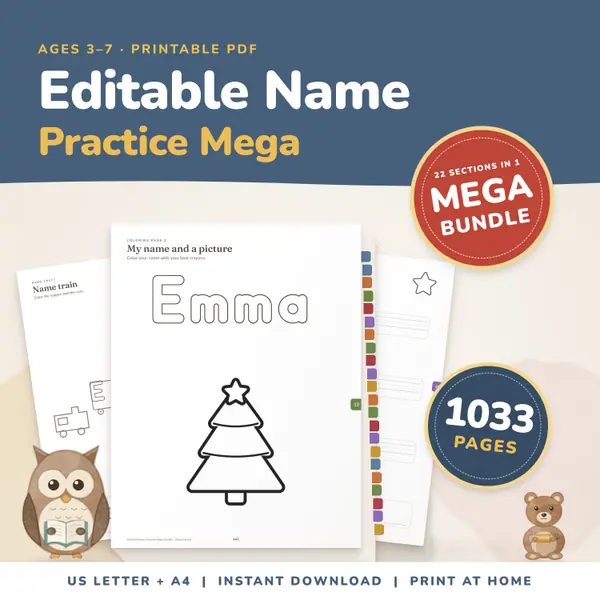
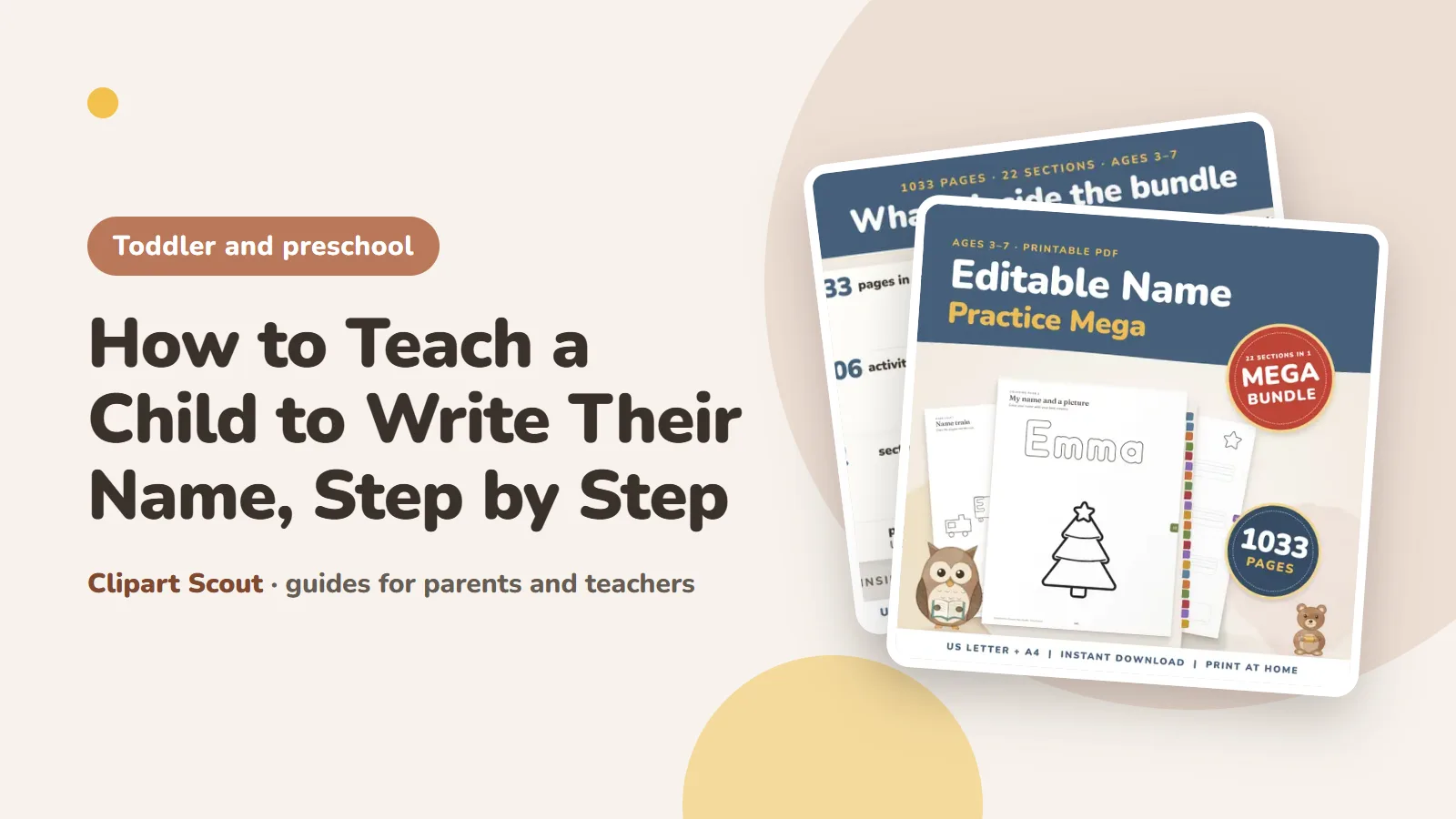
Our Editable Name Tracing Worksheets let you type the name once into first and last name boxes. They come in five letter styles: ball-and-stick print, slanted print, print with flicks, precursive and cursive, with 24 tracing pages in each. Ask your child’s school which style it teaches before you choose one.
How do you teach a 3-year-old to write their name?
At 3, put your effort into steps 1 to 3. Say the name, find its letters on labels and in books, build it with big letters or play dough, and draw circles and lines. These are the same marks that later become letters. Writing the name itself can wait until your child shows interest.
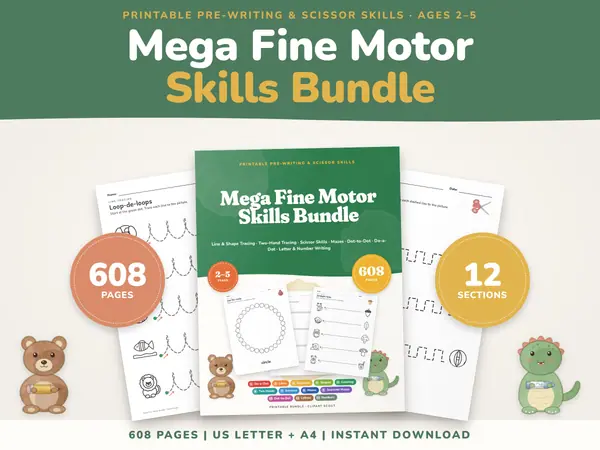
For hands that are still getting stronger, our guide to fine motor activities by age has six ideas for each age band, and our letter of the week plan shows a gentle way to meet the letters. The Fine Motor Skills Bundle has Line Tracing (56 pages) and Shape Tracing (20 pages) for the pre-writing steps.
What comes after the name?
Once your child writes the name with confidence, they can move on to other letters and short words. Our guide to what a 4-year-old knows and can do and our kindergarten readiness checklist put name writing next to the other skills schools mention.
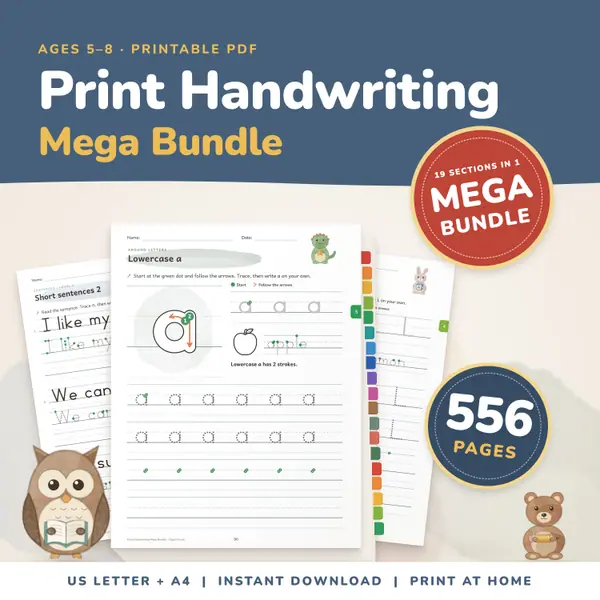
For a child aged 5 to 8 who is ready for fuller handwriting practice, the Print Handwriting Practice Bundle has a 6-page Name Practice section in which you type the name once in Adobe Acrobat Reader and it fills every row. It also has 12 pages of Warm-Up Strokes among its 556 pages.
A short checklist for each session:
What to do next
- Make three name cards and put them where your child sees them every day.
- Start at step 1 or 2 and stay there until it feels easy.
- Ask the school how it teaches names and which letter style it uses.
- Keep a dated name sample every month in a folder, to see the change over time.
- Browse our handwriting and cursive practice pages when you want ready-made sheets.
Sources
- Important Milestones: Your Child By Age 3 Years, Centers for Disease Control and Prevention.
- Important Milestones: Your Child By Age 5 Years, Centers for Disease Control and Prevention.
- Head Start Early Learning Outcomes Framework: Ages Birth to Five, Office of Head Start.
- Developmental Milestones: 3 to 4 Year Olds, American Academy of Pediatrics, HealthyChildren.org.
- Developing Early Literacy: Report of the National Early Literacy Panel (Executive Summary), National Institute for Literacy, via ERIC.
This guide is general information for parents and teachers. It is not medical, legal or professional advice. Every guide lists its sources at the end. More about our guides is on the About page.