What Should a 4-Year-Old Know Before Kindergarten?
By the Clipart Scout team7 min read
Short answer
The CDC's 4-year list shows what most children (75 percent or more) can do by 4: pretend play, sentences of four or more words, naming a few colors, drawing a person with three or more body parts, and holding a crayon between fingers and thumb. Counting to 10 and naming some letters are on the 5-year list. No single national checklist exists for kindergarten.
Key points
- The CDC's 4-year list covers play, speech, colors, drawing a person and hand skills. Counting to 10 and naming some letters first appear on the 5-year list.
- The CDC lists what most children (75 percent or more) can do. Head Start's goals for the end of preschool are higher and are a different list.
- A pencil or crayon held between fingers and thumb, not in a fist, is a CDC 4-year item. The American Academy of Pediatrics places an adult-like hold at age 3.
- No national kindergarten checklist exists. Your state and school district set the rules, so ask your school what it expects.
- If you have a worry, the CDC says to talk with your child's doctor and ask about developmental screening.
On this page
- What can most 4-year-olds do, according to the CDC?
- What does the CDC’s 5-year list add?
- How high should a 4-year-old count?
- Should a 4-year-old be able to write their name?
- What hand skills matter, and what about scissors?
- Which play ideas fit a 4-year-old?
- What does your child need before kindergarten?
- What if you have a worry?
- What to do next
A year before kindergarten, many parents start to wonder whether they are doing enough. It helps to know that the official lists for this age are shorter and calmer than most online checklists. They are about talking, pretending, drawing and using the hands as much as they are about letters and numbers.
This guide uses the CDC’s list for 4 years and the CDC’s list for 5 years, which shows where your child is heading. The CDC describes things most children (75 percent or more) can do by a certain age. We keep Head Start’s separate goals in their own section, and the play ideas are our own suggestions.
What can most 4-year-olds do, according to the CDC?
The CDC’s 4-year list has items in four areas, and it is a list of what most children (75 percent or more) can do, not a list of requirements. The CDC’s 4-year page has the whole list. In short:
| Area | What most children (75% or more) can do by 4 years |
|---|---|
| Social and emotional | Pretends to be something else during play, such as a teacher or a dog. Asks to play with children if none are around. Comforts others who are hurt or sad. Avoids danger. Likes to be a helper. Changes behavior based on where they are, such as a library or playground |
| Language | Says sentences with four or more words. Says some words from a song, story or rhyme. Talks about at least one thing that happened during the day. Answers simple questions like “What is a coat for?” |
| Thinking | Names a few colors of items. Tells what comes next in a well-known story. Draws a person with three or more body parts |
| Movement | Catches a large ball most of the time. Serves themself food or pours water, with adult supervision. Unbuttons some buttons. Holds a crayon or pencil between fingers and thumb, not in a fist |
What does the CDC’s 5-year list add?
The 5-year list is where a 4-year-old is heading, and it is the first CDC list with counting and letters. Read it as a look ahead, not as a deadline. The CDC’s 5-year page lists these items, among others:
- Thinking: counts to 10, names some numbers between 1 and 5 when you point to them, uses time words such as “yesterday” and “tomorrow”, names some letters when you point to them, and writes some letters in their name.
- Attention: pays attention for 5 to 10 minutes during activities such as story time or arts and crafts. The CDC adds that screen time does not count.
- Language: tells a story with at least two events, answers simple questions about a book, and uses or recognizes simple rhymes such as bat and cat.
- Social and emotional: follows rules or takes turns in games with other children, and does simple chores like matching socks.
- Movement: buttons some buttons and hops on one foot.
How high should a 4-year-old count?
The CDC’s 4-year list has no counting item, so no official number applies at age 4. The CDC’s first counting item is on the 5-year list: most children (75 percent or more) count to 10.
Head Start publishes a separate list of goals. By 60 months, its goals include counting aloud to at least 20 by ones, and counting about 10 objects and answering “How many?” These are goals preschool programs work toward by the end of preschool, not the CDC’s most-children marker. Do not mix the two: “the CDC says count to 20” is not accurate.
Should a 4-year-old be able to write their name?
Neither list requires it at 4, and the ranges overlap. This table keeps each source apart.
| Source | What it says |
|---|---|
| American Academy of Pediatrics, 3 to 4 years | Begins to copy some capital letters |
| Head Start, 48 to 60 months | Recognizes and names at least half the letters of the alphabet, including those in their own name |
| CDC, 5 years | Writes some letters in their name |
| Head Start, by 60 months | Writes first name correctly or close to correctly |
Our guide to teaching a child to write their name goes step by step. For a 4-year-old, one suggestion is to start with the first letter and let your child trace or copy it. Ask your child’s school how it teaches names, since no official source says whether capitals or lower-case come first.
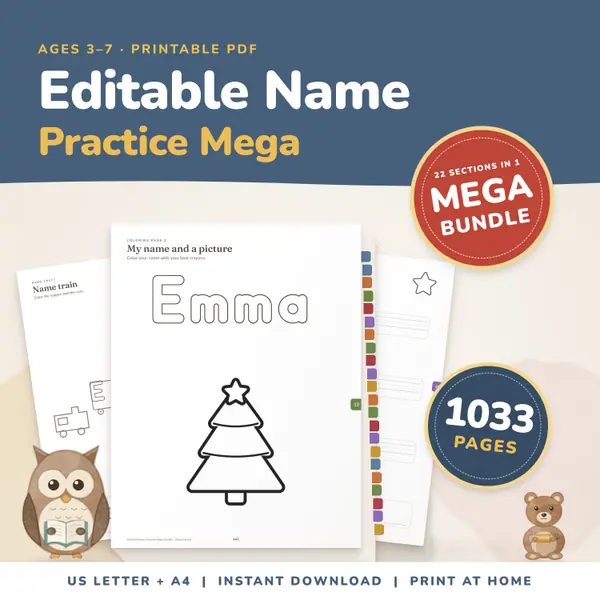
If you would like name pages ready to print, the Editable Name Tracing Worksheets have 1,033 pages and five letter styles: ball-and-stick print, slanted print, print with flicks, precursive and cursive. You type the name once.
What hand skills matter, and what about scissors?
The CDC’s 4-year list has holding a crayon or pencil between fingers and thumb, unbuttoning some buttons and pouring with supervision. It has no item on scissors, and none of its lists from 2 to 5 mentions cutting.
Other sources do mention scissors. The American Academy of Pediatrics lists “cutting (using safety scissors) and pasting” among activities for 4- to 5-year-olds. Head Start’s goals for 48 to 60 months include cutting out shapes with moderate precision and control, and by 60 months cutting along a line.
Our order of practice, from easiest to hardest, is a suggestion: snipping strips, cutting along a straight line, then curves and shapes. See our guide to scissor skills by age for more.
Safety note: The American Academy of Pediatrics advises close supervision when children use tools such as scissors, and its lists say “child-safe scissors” or “safety scissors.” Stay with your child, and keep any laminated or cut-out pieces away from children who still put things in the mouth.
Which play ideas fit a 4-year-old?
Play, stories and chores cover most of the lists. The ideas below are our suggestions.
- Pretend play: dress-up, a pretend store, or a teacher game. The American Academy of Pediatrics lists dress-up and make-believe among its play ideas for ages 4 to 6.
- Stories: read a familiar book and stop before the end. Ask, “What comes next?”
- Songs and rhymes: sing a rhyme and leave out the last word.
- Colors and drawing: draw a person together and add one more body part each time.
- Chores: matching socks, setting the table or watering plants.
- Short activities: build up to 5 to 10 minutes, the CDC’s 5-year attention item, with a book or a craft.
What does your child need before kindergarten?
No national kindergarten checklist exists. Each state defines readiness and sets its own entry rules. In a 2020 comparison by the Education Commission of the States, most states had a date by which a child must turn 5, most often around September 1. Those dates change, so confirm yours with your state or district.
For a calm year, the 5-year list is a good guide to what to nurture. Our kindergarten readiness checklist organizes these ideas by area of development.
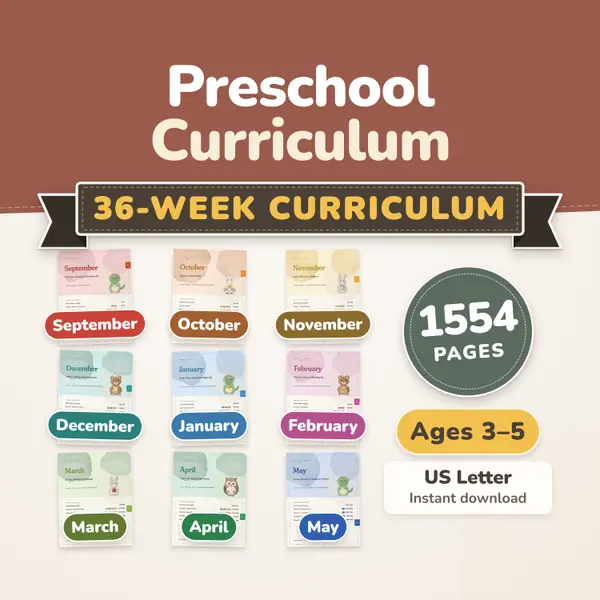
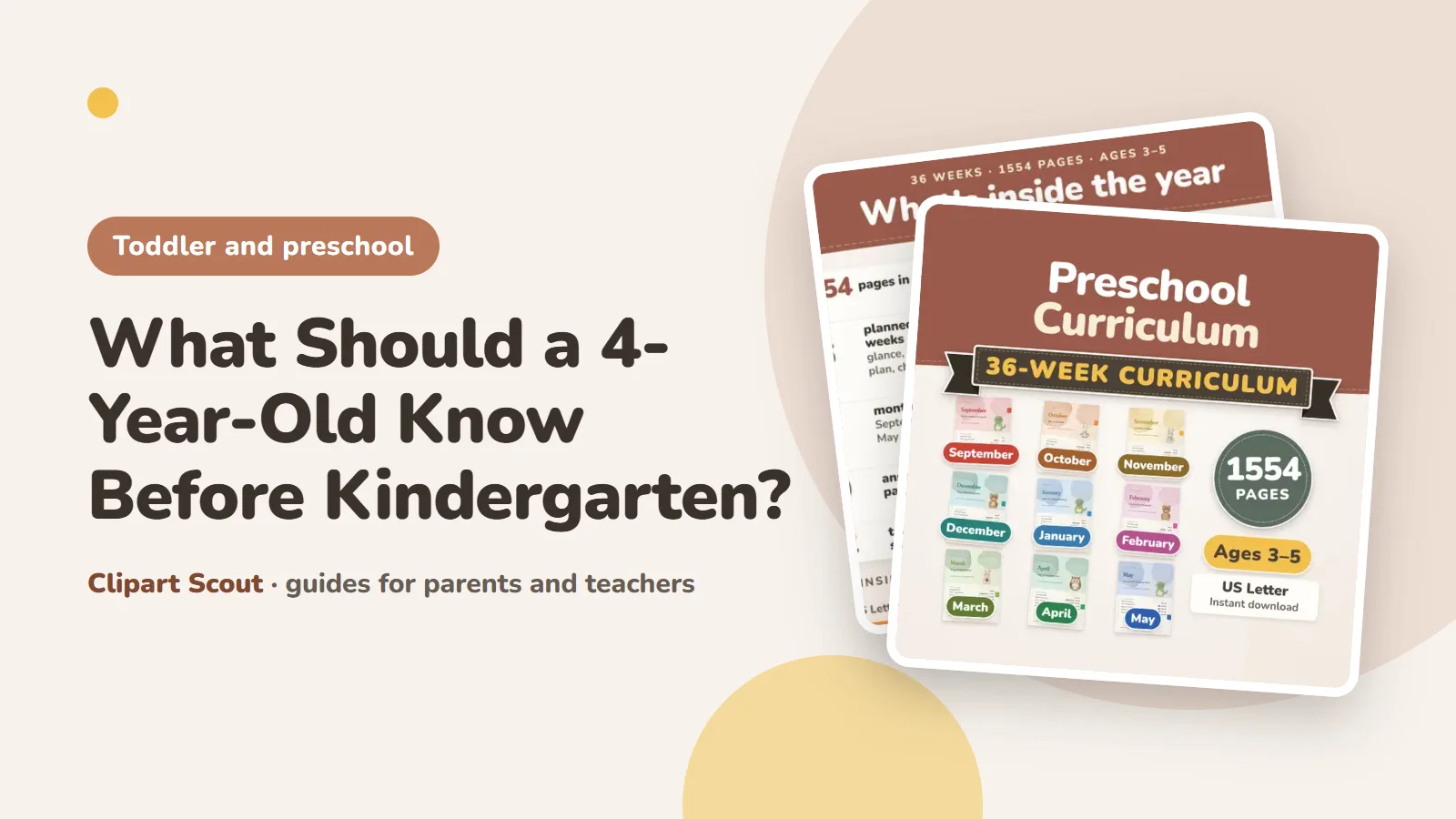
A premium preschool plan is not needed, but if you would like a ready schedule, the Preschool Curriculum Full Year (1,554 pages, ages 3 to 5) has core pages that make a calm 20 to 40 minute day, plus extra pages for centers or quiet time.
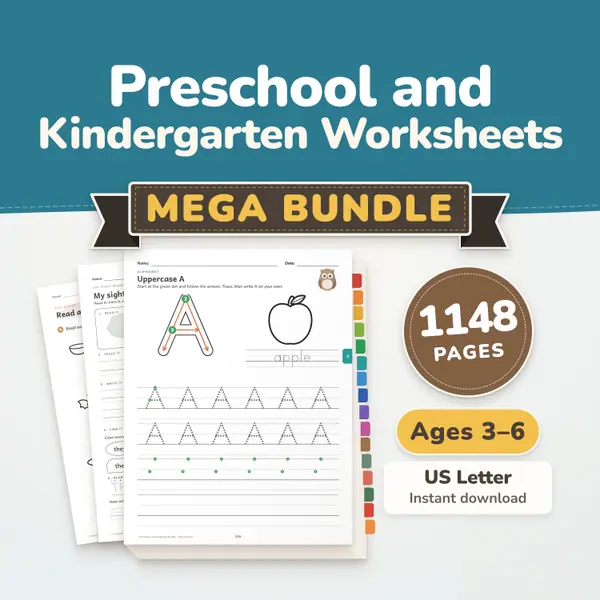
For a mix of preschool and kindergarten practice in one file, the Preschool and Kindergarten Worksheets Bundle has 1,148 pages for ages 3 to 6, including pre-writing lines, a 26-page cutting practice section and an alphabet section.
What if you have a worry?
The CDC says, “Talk with your child’s doctor, share your concerns, and ask about developmental screening.” It also says to act early if your child is not meeting one or more milestones, has lost skills, or you have other concerns. Talk to the school as well if kindergarten questions worry you. This guide cannot diagnose anything.
What to do next
- Read the CDC’s 4-year and 5-year lists once and notice what your child already does.
- Pick two play ideas, such as a rhyme game and a pretend store, and repeat them.
- Try a short 5 to 10 minute story or craft time, three or four days a week.
- Look back at what a 3-year-old can do if some items feel new.
- Browse our preschool printables for pages ready to print.
Sources
- Important Milestones: Your Child By Four Years, Centers for Disease Control and Prevention (CDC).
- Important Milestones: Your Child By Five Years, Centers for Disease Control and Prevention (CDC).
- Head Start Early Learning Outcomes Framework: Ages Birth to Five, Office of Head Start, U.S. Department of Health and Human Services.
- Hand and Finger Skills of Your Preschooler, American Academy of Pediatrics (healthychildren.org).
- 50-State Comparison: State K-3 Policies (kindergarten entrance date cut off), Education Commission of the States.
This guide is general information for parents and teachers. It is not medical, legal or professional advice. Every guide lists its sources at the end. More about our guides is on the About page.