Kindergarten Readiness Checklist: Skills That Matter Most
By the Clipart Scout team7 min read
Short answer
No single national checklist defines kindergarten readiness. Your state and school district set the rules. Official frameworks describe readiness across several areas, not only letters and numbers: approaches to learning, social and emotional development, language and literacy, cognition, and physical development. This guide groups CDC and Head Start items under those five areas as a guide for talking with your school.
Key points
- No national kindergarten readiness checklist exists in the federal sources we read. Your state and school district set the rules.
- Head Start names five learning areas. Only two of them, language and literacy and cognition, hold the letter and number goals.
- The CDC's lists show what most children (75 percent or more) can do by an age. Head Start's goals are separate and are not a pass or fail test.
- Alphabet knowledge and writing the name are linked with later reading, but the research shows a relationship, not proof that teaching them causes it.
- If you are worried about readiness, talk to the school and to your child's doctor. We do not advise holding a child back.
On this page
- Is there an official kindergarten readiness checklist?
- What are the five areas of readiness?
- How do CDC and Head Start fit together?
- What does the checklist look like?
- Does my child need to read before kindergarten?
- What can help with name writing and hand skills?
- What if my child is not ready?
- What to do next
If you have been reading kindergarten readiness lists online, you have probably seen very long ones. Some of them ask for reading, writing sentences and counting to 100. It is worth knowing that no single national checklist exists, and the official sources we read describe readiness more broadly than letters and numbers.
This guide organizes a printable checklist under the five learning areas of the Head Start framework, with CDC items for ages 4 and 5 placed where they fit. The grouping is ours. The checklist is a conversation guide for you and your child’s school, not a test, and no child passes or fails it.
Is there an official kindergarten readiness checklist?
No national checklist exists in the federal sources we read. Each state defines readiness and sets its own entry rules, and school districts add their own.
The Head Start framework says of itself that it is “not to be used as a curriculum, assessment, or checklist” and “never to be used to conclude a child has failed in any way.” So this guide does not use it that way. It uses the framework’s five areas as a way to organize ideas. The Indiana Department of Education gives one example of how a state puts it: kindergarten readiness is described as children being prepared in all domains of early learning.
The safest way to find your own rules is to ask your school or district what it expects and when the entry cutoff date is.
What are the five areas of readiness?
Head Start’s framework names five areas that it calls essential for school and long-term success. Only two of them hold the letter and number goals, which is why readiness is wider than letters and numbers.
| Learning area (Head Start) | What it covers, in plain words |
|---|---|
| Approaches to Learning | How a child goes about learning. We place the CDC’s attention and helper items here |
| Social and Emotional Development | Getting along, taking turns, handling feelings |
| Language and Literacy | Talking, listening, rhymes, print, letters and early writing |
| Cognition | Thinking skills, including early math |
| Perceptual, Motor, and Physical Development | Movement and small-muscle control, such as holding a pencil |
The names are Head Start’s. The plain-words column is our summary.
How do CDC and Head Start fit together?
They are different lists, and you need to name each one. The CDC lists what most children (75 percent or more) can do by an age. Head Start lists goals that programs work toward by the end of preschool, around age 5.
| Skill | CDC, 5 years (75% or more can do it) | Head Start, by 60 months (a goal) |
|---|---|---|
| Counting aloud | Counts to 10 | Counts verbally or signs to at least 20 by ones |
| Letters | Names some letters when you point to them | Names 18 upper-case and 15 lower-case letters |
| Name writing | Writes some letters in their name | Writes first name correctly or close to correctly |
| Numbers | Names some numbers between 1 and 5 when you point | Recognizes and, with support, writes some numerals up to 10 |
So “the CDC says count to 20” would be wrong. Counting to 20 is a Head Start goal. Both lists describe a range of children, and neither is a pass mark.
What does the checklist look like?
Use this as a guide for noticing and talking. Tick what your child already does, and circle a few things you would like to play with more. Our grouping of items under the five areas is a suggestion.
Approaches to learning
Social and emotional
Language and literacy
Cognition
Physical development
Safety note: The American Academy of Pediatrics says to supervise closely when children use tools such as scissors. Stay with your child during cutting, and keep any small cut-out pieces away from children who still put things in the mouth.
Does my child need to read before kindergarten?
Reading words is not on the CDC’s lists for ages 2 to 5. The Head Start literacy goals for the end of preschool focus on things that come before reading words: rhymes, beginning sounds, print awareness, naming letters, knowing the sounds of several letters and early writing.
The National Early Literacy Panel found that alphabet knowledge and writing letters or one’s own name were among six early skills with medium to large predictive relationships with later literacy. The panel studied correlations. That means children who know letters and can write their name before school tend to do better in reading later. It does not show that teaching those skills causes better reading.
Our guide to what a kindergartener can do covers what kindergarten itself teaches.
What can help with name writing and hand skills?
Name writing and scissors are two areas where practice at home is easy to set up. Our suggestions are short sessions, a few minutes at a time, with plenty of play.
For names, our guide to teaching a child to write their name lays out the stages. For cutting, see scissor skills by age. No official source gives an age-by-age scissor chart, so we describe what each source says and leave the order as our suggestion.
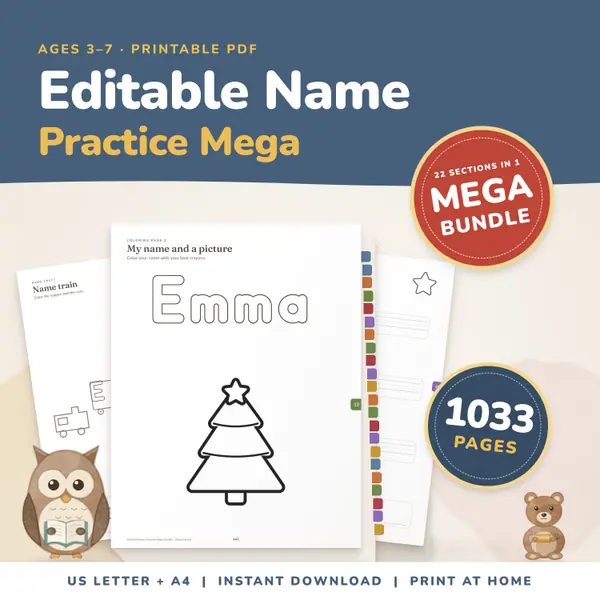
If you would like name pages to print, the Editable Name Tracing Worksheets have 1,033 pages in five letter styles, and you type the name once.
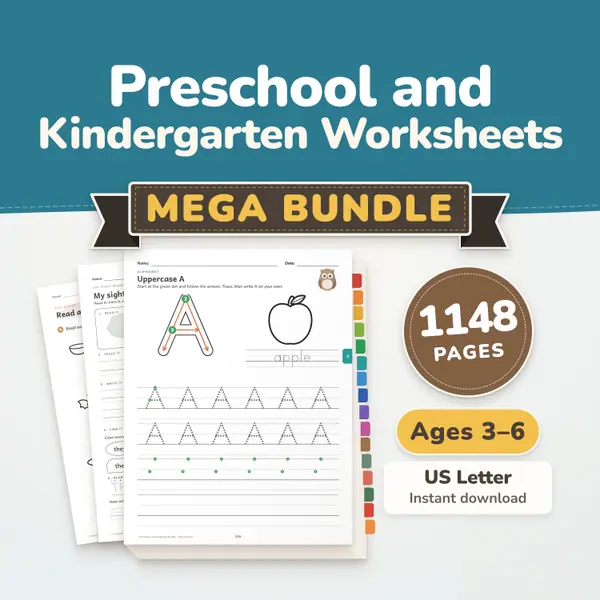
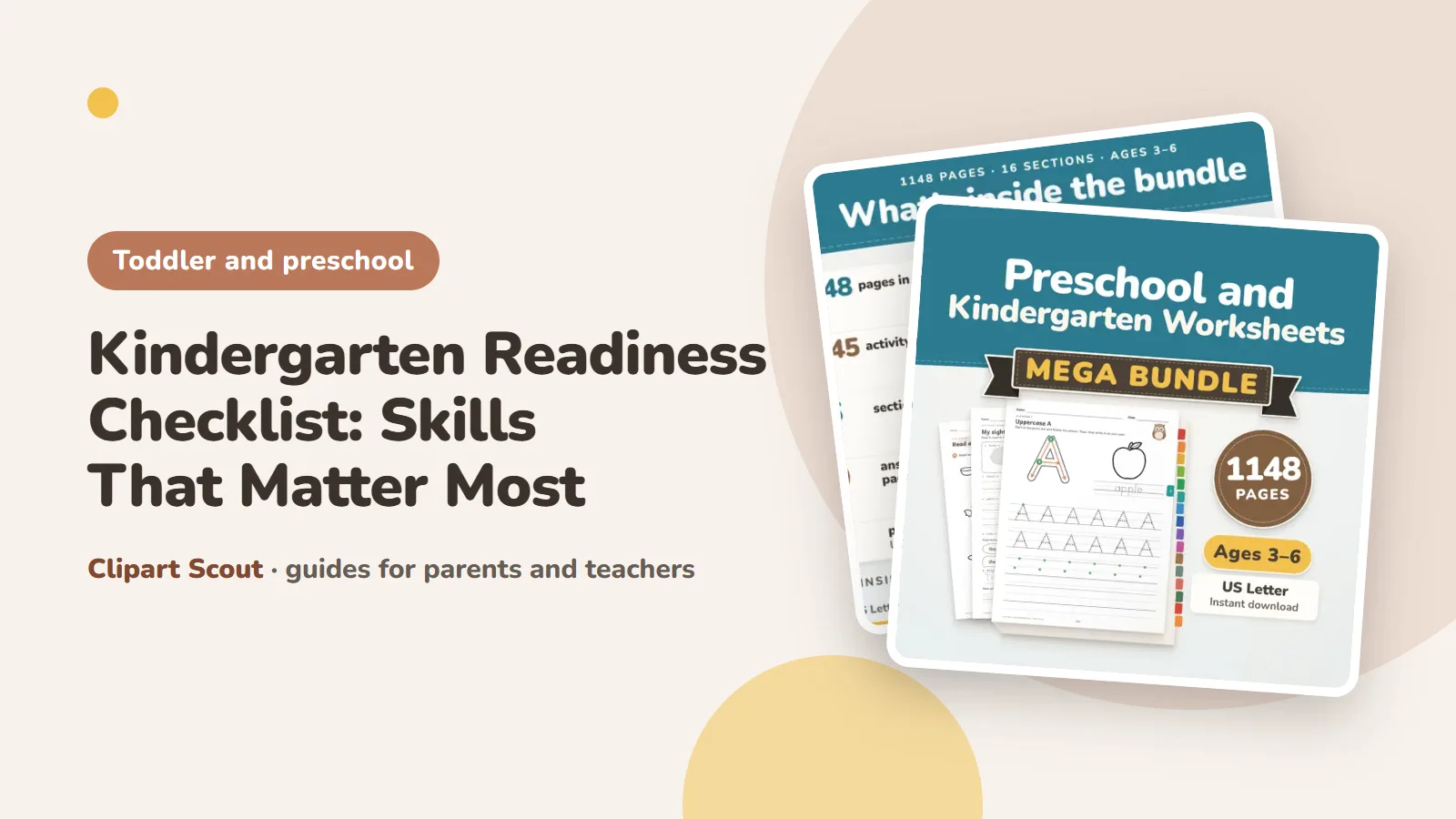
For a child heading into kindergarten, the Preschool and Kindergarten Worksheets Bundle has 1,148 pages for ages 3 to 6, with sections that range from pre-writing lines to math to 20. A 5-year-old can skip straight to the phonics and math sections.
What if my child is not ready?
Talk to the school and to your child’s doctor. The CDC’s advice if you have a concern is to talk with your child’s doctor, share your concerns and ask about developmental screening.
Most states set an entry age: in a 2020 comparison by the Education Commission of the States, at least 47 states and the District of Columbia had a specific entrance age, and September 1 was the most common date. Those dates change, so check your state’s current page. We do not advise for or against holding a child back a year. That decision belongs to you, the school and your child’s doctor.
What to do next
- Ask your school or district what it expects and when the entry cutoff date falls.
- Tick the checklist above and circle two or three items to play with more.
- Read together every day. The American Academy of Pediatrics encourages shared reading from birth through at least kindergarten.
- Read our guide to what a 4-year-old can do for the CDC lists in more detail.
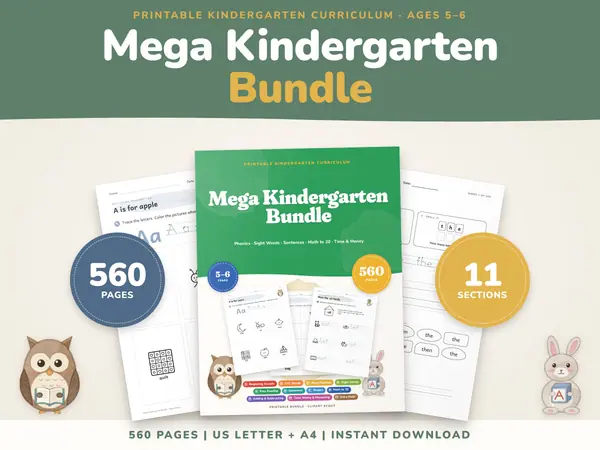
- Browse our kindergarten worksheets for pages ready to print.
Sources
- Head Start Early Learning Outcomes Framework: Ages Birth to Five, Office of Head Start, U.S. Department of Health and Human Services.
- Important Milestones: Your Child By Four Years, Centers for Disease Control and Prevention (CDC).
- Important Milestones: Your Child By Five Years, Centers for Disease Control and Prevention (CDC).
- Early learning: kindergarten readiness, Indiana Department of Education.
- Developing Early Literacy: Report of the National Early Literacy Panel, Executive Summary, National Institute for Literacy (via ERIC).
- Hand and Finger Skills of Your Preschooler, American Academy of Pediatrics (healthychildren.org).
- Beyond Literacy: Shared Reading Starting at Birth Offers Lifelong Benefits, American Academy of Pediatrics (healthychildren.org).
- 50-State Comparison: State K-3 Policies (kindergarten entrance date cut off), Education Commission of the States.
This guide is general information for parents and teachers. It is not medical, legal or professional advice. Every guide lists its sources at the end. More about our guides is on the About page.