Scissor Skills by Age: What to Expect and How to Teach
By the Clipart Scout team6 min read
Short answer
The AAP describes 3-year-olds as very interested in scissors and lists child-safe scissors in its 3-to-4 skills. Head Start works toward cutting paper at 36 to 48 months, cutting out shapes at 48 to 60 months and cutting along a line by age 5. We found no official step-by-step chart with ages, so the teaching order here is our suggestion, with no ages attached.
Key points
- The AAP says 3-year-olds are very interested in scissors and that you need to supervise closely.
- Head Start works toward cutting paper at 36 to 48 months, cutting out shapes at 48 to 60 months and cutting along a line by 60 months.
- None of the CDC milestone lists from 2 to 5 years mentions scissors.
- No authoritative chart gives ages for snips, lines, curves and shapes, so our order is a common order to try, not a schedule.
- Use child-safe scissors, cut only paper or play dough, and stay beside your child.
On this page
You hand a pair of scissors to a three-year-old and wonder if it is too early. Or your four-year-old can snip but cannot yet follow a line, and you want to know if that is typical.
This guide gives what the official sources say about scissors and age, and it is honest about what they leave out. There is no authoritative step-by-step chart with an age for each cutting step, so the teaching order that follows is our suggestion and has no ages attached.
At what age do children start using scissors?
The sources describe interest and use starting around age 3, with more control by ages 4 and 5. Each row below names its source, because the AAP describes what children typically do and Head Start names goals for preschool programs.
| Age | What the source says | Source |
|---|---|---|
| Under 3 | No official source we read lists scissor use before age 3 | None |
| 3 to 4 | 3-year-olds are “extremely interested in discovering what they can do with tools such as scissors”, and “You’ll need to supervise closely, of course”; the 3-to-4 skills list includes “Uses child-safe scissors”; cuts paper with scissors, with limited precision | AAP; Head Start (36 to 48 months) |
| 4 to 5 | Cutting (using safety scissors) and pasting; cuts out shapes with moderate precision and control | AAP; Head Start (48 to 60 months) |
| By 5 | Cuts along a line as one of the coordinated tasks, along with pouring and buttoning | Head Start (by 60 months) |
The CDC’s milestone lists from 2 to 5 years do not mention scissors or cutting. So there is no CDC marker for it, and nothing here should be read as a CDC milestone.
Why is there no age chart with snips, lines and curves?
We searched the CDC, AAP and Head Start pages and found no official chart that assigns an age to snips, straight lines, curves and shapes. Charts like that exist on therapy and teaching blogs, but they differ from each other and we could not verify them.
There is one point where the sources differ: Head Start mentions cutting out shapes in the 48 to 60 month band and cutting along a line as a by-60-months example. That means we cannot say there is an official order of lines first, then shapes. That order is our teaching suggestion. If your child skips a step or goes faster, nothing here says that is a problem.
What order can you teach cutting in?
A common order to try is to begin with the easiest cuts and make each step slightly harder. This is our suggestion, with no ages attached. Move on when your child is cutting the current step with ease and enjoying it.
| Step | What to cut | What to look for |
|---|---|---|
| 1 | Play dough snakes, cut with child-safe scissors | The scissors open and close with a steady rhythm |
| 2 | Paper strips, one snip to cut each | The paper stays in one hand while the other hand cuts |
| 3 | A thick straight line, one long cut or several snips | The child cuts toward the line, not away from it |
| 4 | Wavy and zigzag lines | The child turns the paper, not the scissors |
| 5 | Curves and circles | Small turns in the paper keep the cut on the line |
| 6 | Simple shapes such as a square and a triangle | The child can turn corners |
A word on straws: cutting drinking straws makes many small pieces. Small pieces are a choking hazard for children under 3 and for any child who still puts things in the mouth, so we leave straws for children who no longer do that, and you should sweep the pieces up at once.
Safety: The AAP’s wording is to supervise closely. Stay beside your child, use child-safe scissors, cut only paper or play dough, and put the scissors away when the activity ends.
How do you teach a child to hold scissors?
No official source describes a scissor grip, so the following is our suggestion. A common way to show it is the thumbs-up hold:
- Thumb goes in the small loop, pointing up.
- One or two fingers go in the big loop, with the other fingers tucked in.
- The helping hand holds the paper and turns it as the child cuts.
- Open and close in the air first, then cut a play dough snake, then paper.
You can say “thumbs up” as a reminder. If your child is left-handed, try a pair made for left hands and see if cutting feels easier. We found no official source on this, so it is a trial, not a rule. Check that the scissors fit the hand: loops that are too big or stiff blades make cutting harder for any child. Choose child-safe scissors, the wording the AAP uses, and test them yourself on a piece of paper first to see that they open and close easily.
If scissors seem very hard for your child over a long time, the CDC’s advice for any concern is to talk with your child’s doctor, share your concerns and ask about developmental screening.
What are good cutting activities for preschoolers?
Here are cutting activities that fit the order above. They are our suggestions.
- Snip a play dough snake into pieces, then roll them back together.
- Cut paper strips and glue them into a paper chain.
- Cut along a thick crayon line from one side of the page to the other.
- Cut a wavy line to make waves under a boat picture.
- Cut a paper plate circle to make a sun with rays.
- Cut out a big shape and paste it onto a picture.
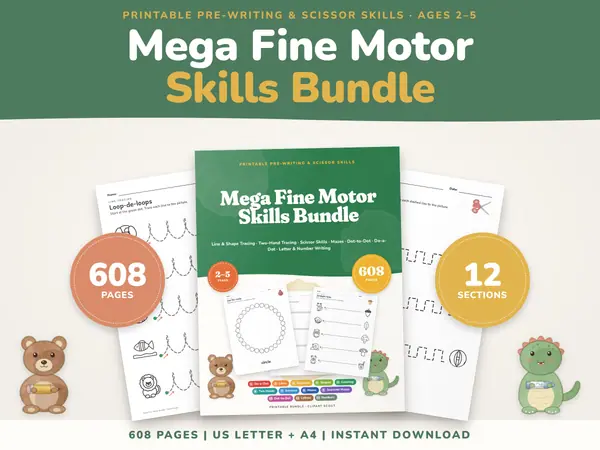
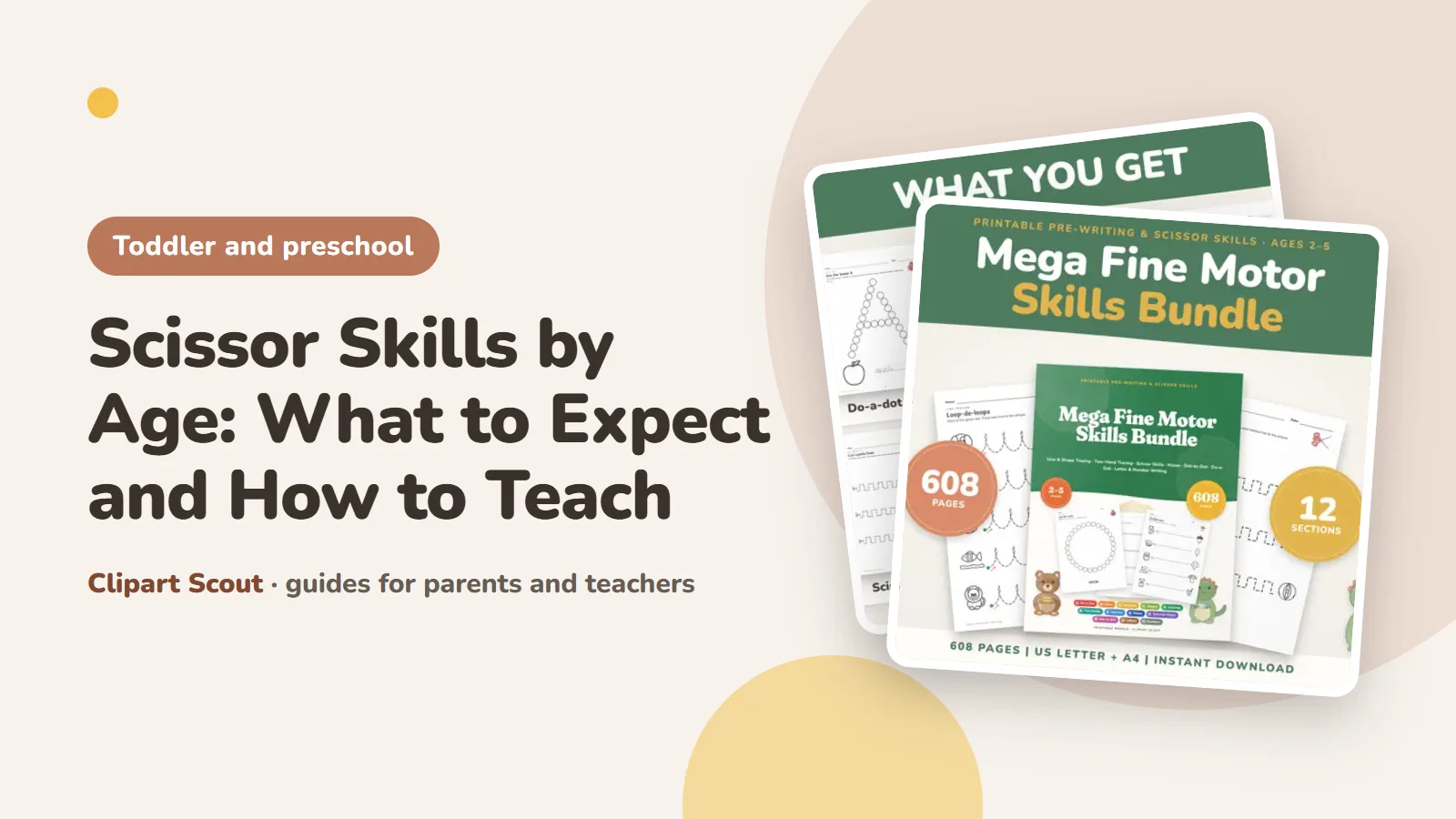
Our Fine Motor Skills Bundle has a 40-page Scissor Skills section with snip strips, straight, zigzag, wavy, castle and bumpy lines, spirals, curves, shapes, haircuts, a lion’s mane, sunshine and cut-and-glue picture puzzles.
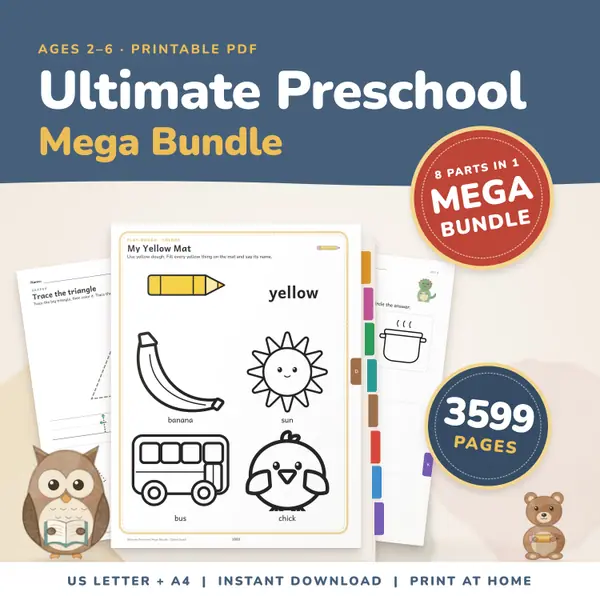
If you are building a larger preschool set, the Ultimate Preschool Mega Bundle includes a Preschool Cutting Practice section of 26 pages and the same 40-page Scissor Skills section within its 3,599 pages.
What scissor skills do 4-year-olds typically show?
Head Start works toward cutting out shapes with moderate precision and control at 48 to 60 months, and the AAP lists cutting with safety scissors and pasting for ages 4 to 5. Neither is a pass mark. A 4-year-old who is still snipping paper strips is not “failing” anything, since the Head Start framework says it is never to be used to conclude a child has failed in any way.
A simple check for your own planning, ticking what your child enjoys:
To see where cutting sits among other hand skills, read our guide to fine motor activities by age. Cutting also appears in our kindergarten readiness checklist, and our guide to what a 4-year-old knows and can do puts it next to drawing, buttons and pencil grasp.
What to do next
- Start with play dough and child-safe scissors, with you beside your child.
- Give a few minutes at a time, then stop while your child still wants more.
- Move to paper strips, then thick lines, when the first step feels easy.
- Put scissors away after each session and keep small paper pieces off the floor.
- Browse our fine motor and early learning printables for ready-made cutting pages.
Sources
- Hand and Finger Skills of Your Preschooler, American Academy of Pediatrics, HealthyChildren.org.
- Developmental Milestones: 3 to 4 Year Olds, American Academy of Pediatrics, HealthyChildren.org.
- Head Start Early Learning Outcomes Framework: Ages Birth to Five, Office of Head Start.
- Milestone checklists, Centers for Disease Control and Prevention.
This guide is general information for parents and teachers. It is not medical, legal or professional advice. Every guide lists its sources at the end. More about our guides is on the About page.