What Should a 3-Year-Old Know? A Calm Checklist
By the Clipart Scout team7 min read
Short answer
The CDC does not list academic skills for age 3. Its list shows what most children (75 percent or more) can do by 3: hold a back-and-forth conversation, say their first name, draw a circle after being shown, string large beads and use a fork. Letters and counting are not on the CDC's lists until age 5. Children work toward them at their own pace.
Key points
- The CDC's 3-year list is about talking, play, drawing a circle, dressing and using a fork. It has no letter, number or shape-naming items.
- Head Start's goals for ages 3 to 5 are a separate list. For 36 to 48 months they include awareness of letters, such as singing the ABC song.
- Writing the name builds in stages: first marks and letter-like forms, then some letters. The CDC's name item is at age 5.
- Everything in the activity sections is our suggestion. A short, playful session is enough, and you can stop whenever your child does.
- If you are worried, the CDC says to talk with your child's doctor and ask about developmental screening.
On this page
If you are searching for what a 3-year-old is expected to know, you are probably trying to decide whether to start letters, whether your child is ready for preschool, or if you are doing enough. Take a breath first. The CDC’s list for this age is mostly about talking, playing, using the hands and getting along with others.
This guide uses the CDC’s list for 3 years, which describes things most children (75 percent or more) can do by this age. It keeps the separate Head Start goals for preschoolers in their own section, and it gives play ideas that are our suggestions. None of it is a test, and you will not find a pass mark here.
What can most 3-year-olds do, according to the CDC?
The CDC’s 3-year list covers four areas, and it contains no letters, counting or shape names. The CDC’s 3-year page is the source for the table below. It is a table of what most children (75 percent or more) can do by this age.
| Area | What most children (75% or more) can do by 3 years |
|---|---|
| Social and emotional | Calms down within 10 minutes after you leave, like at a childcare drop-off. Notices other children and joins them to play |
| Language | Talks with you using at least two back-and-forth exchanges. Asks “who,” “what,” “where” or “why” questions. Says what action is happening in a picture or book. Says first name when asked. Talks well enough for others to understand most of the time |
| Thinking | Draws a circle when you show how. Avoids touching hot objects, like a stove, when you warn them |
| Movement | Strings items together, like large beads or macaroni. Puts on some clothes, like loose pants or a jacket. Uses a fork |
A child who has just turned 3 may be closer to the CDC’s 30-month list. That list includes saying about 50 words, following two-step instructions such as “Put the toy down and close the door,” and knowing at least one color.
Does a 3-year-old need to know letters, numbers and shapes?
The CDC does not list letters, counting or shape names for age 3. Letters and counting first appear on the CDC’s 5-year list, and the only shape item between ages 2 and 5 is drawing a circle at 3.
The Head Start framework is a different kind of list. It describes goals that preschool programs work toward by about age 5, and it says plainly that it is not to be used as a curriculum, assessment or checklist. For ages 36 to 48 months, it includes:
- an awareness of alphabet letters, such as singing the ABC song, recognizing letters from one’s name or naming letters seen often
- saying some number words in order, up to 10, starting with one
- recognizing and naming a circle, a square and sometimes a triangle
- engaging in writing activities that are largely drawing and scribbling
So if your child loves the ABC song or points out the letter on a stop sign, that fits the Head Start goals for this age. If your child is not interested in letters yet, nothing on the CDC’s list suggests you should push.
Can a 3-year-old write their name?
No list asks a 3-year-old to write a full name. The range across the sources is wide, so here is each one, named.
| Source | What it says |
|---|---|
| CDC, 3 years | Says first name when asked |
| Head Start, 36 to 48 months | With modeling and support, writes some letter-like forms and letters |
| CDC, 5 years | Writes some letters in their name |
| Head Start, by 60 months | Writes first name correctly or close to correctly |
Read together, the sources show name writing building in stages between about 3 and 5. We have a full guide on how to teach a child to write their name. For now, our suggestion is to let your child scribble a “name” on drawings, point out the first letter, and write the name for them to look at.
What helps before preschool?
No official source gives a national list of what to know before preschool, so any list here is our suggestion. Two of the CDC’s 3-year items are useful to think about, because they matter in a group: calming down within 10 minutes after you leave, and joining other children to play.
Some ways to practice, if you like:
- Visit the building or the playground a few times before the first day.
- Say goodbye in the same short way each time.
- Play simple turn-taking games at home, such as rolling a ball back and forth.
- Practice taking clothes off and on, since the CDC’s list has putting on some clothes, like loose pants or a jacket.
If your child spends time away from you rarely, try a short stay with a trusted adult first. Programs differ, so ask the one you have in mind what it expects. If you have questions about your child’s development, the CDC’s advice is to talk with your child’s doctor.
Which play ideas fit a 3-year-old?
Short, playful sessions fit this age. The ideas below are our suggestions, and each one is tied to a CDC or Head Start item.
- Conversation: ask “who,” “what,” “where” and “why” while looking at a picture book. Ask what is happening on the page.
- Drawing a circle: show your child how to draw one and let them copy. The American Academy of Pediatrics says 3-year-olds can copy a circle or scribble freely.
- Stringing: use large beads or macaroni, with an adult at the table.
- Scissors: the American Academy of Pediatrics says 3-year-olds are very interested in tools such as scissors and adds, “You’ll need to supervise closely, of course.” Head Start’s list for 36 to 48 months includes cutting paper with scissors, with limited precision. Offer child-safe scissors and paper, and stay with your child.
- Letters in play: sing the alphabet song, find the first letter of your child’s name on signs, and play with letter magnets or play dough.
Safety note: The U.S. Consumer Product Safety Commission says small parts present a choking hazard for children under 3. Small pieces such as beads, macaroni or cut-out cards are best kept out of reach for children who still put things in the mouth. Stay with your child during stringing and scissor play.
A calm checklist to notice
This is a list to notice, not a test. It repeats the CDC’s 3-year items, so you can see what your child is already doing.
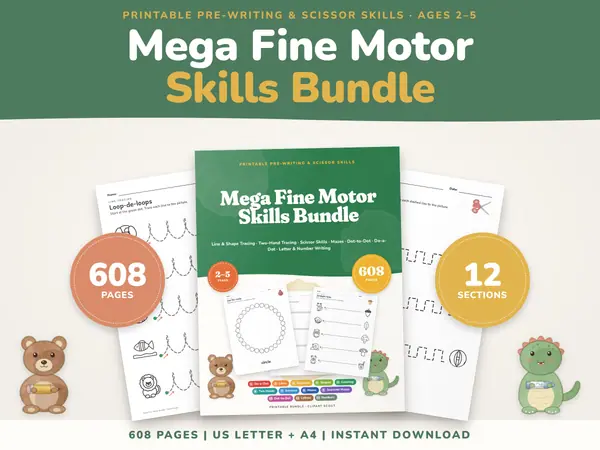
For hand and pencil practice, the Fine Motor Skills Bundle has 608 pages for ages 2 to 5, including a 40-page Scissor Skills section and 56 pages of line tracing. Pages for scissors should be used with child-safe scissors and close supervision.
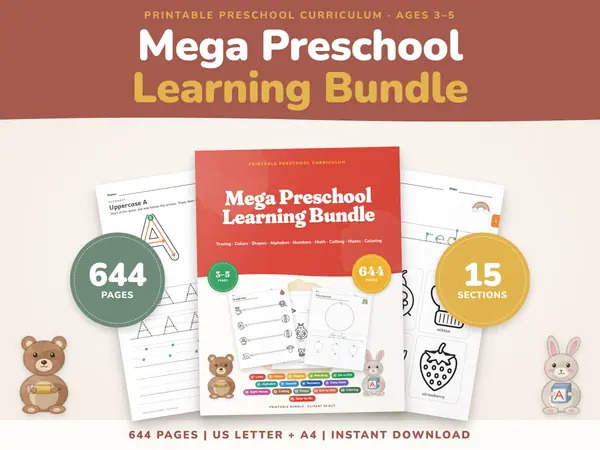
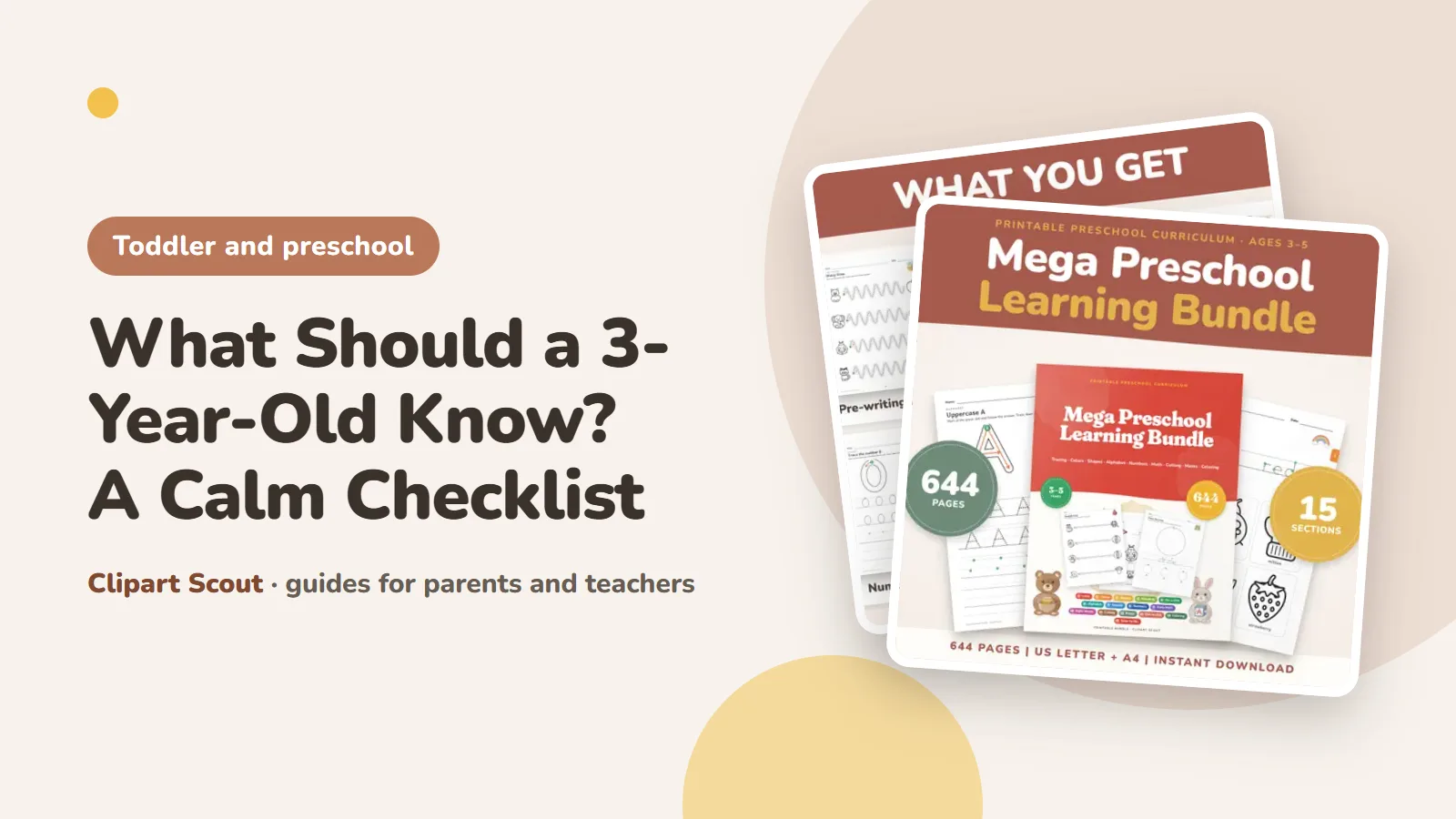
If you would like a printable set for preschool-age practice, the Preschool Worksheets Bundle has 644 pages for ages 3 to 5, with sections such as Pre-Writing Lines (28 pages) and Cutting Practice (26 pages).
What if you have a worry?
The CDC says, “If your child is not meeting one or more milestones, has lost skills he or she once had, or you have other concerns, act early.” Its advice is to talk with your child’s doctor, share your concerns and ask about developmental screening. The CDC also says its checklists are not a substitute for standardized, validated screening tools.
Only your child’s doctor or another qualified professional can tell you what your own child needs. This guide cannot diagnose anything.
What to do next
- Read the table above once and notice what your child already does.
- Choose one or two play ideas and repeat them for a week, in sessions of a few minutes.
- Read our guide to what a 2-year-old can do if your child is a young 3, and to what a 4-year-old can do to see what comes next.
- If you are thinking about a letter-by-letter plan, read our guide to letter of the week, or see preschool at home for a simple weekly rhythm.
- Browse our preschool printables for pages ready to print.
Sources
- Important Milestones: Your Child By Three Years, Centers for Disease Control and Prevention (CDC).
- Important Milestones: Your Child By 30 Months, Centers for Disease Control and Prevention (CDC).
- Head Start Early Learning Outcomes Framework: Ages Birth to Five, Office of Head Start, U.S. Department of Health and Human Services.
- Hand and Finger Skills of Your Preschooler, American Academy of Pediatrics (healthychildren.org).
- Developmental Milestones: 3 to 4 Year Olds, American Academy of Pediatrics (healthychildren.org).
- Small Parts for Toys and Children's Products, U.S. Consumer Product Safety Commission (CPSC).
This guide is general information for parents and teachers. It is not medical, legal or professional advice. Every guide lists its sources at the end. More about our guides is on the About page.