What Should a 2-Year-Old Know? Milestones and Activities
By the Clipart Scout team7 min read
Short answer
The CDC does not list academic skills for age 2. Its milestone list shows what most children (75 percent or more) can do by this age: put two words together, point to body parts and pictures in a book, kick a ball, run and eat with a spoon. Colors and about 50 words appear on the 30-month list. Letters and counting do not appear yet.
Key points
- The CDC lists what most children (75 percent or more) can do by an age. It is not a test and not a list of requirements.
- At 2 years the CDC's language items are pointing, saying at least two words together and using more gestures. About 50 words is a 30-month item.
- Knowing one color first appears on the CDC's 30-month list. Letters and counting do not appear on the lists for ages 2 to 4.
- Play, books and everyday routines cover most of what a 2-year-old needs. The activities in this guide are our suggestions.
- If you have a worry, the CDC says to talk with your child's doctor and ask about developmental screening.
On this page
- What can most 2-year-olds do, according to the CDC?
- What changes by 30 months?
- How many words should a 2-year-old say?
- Should a 2-year-old know colors, letters and numbers?
- Which play ideas fit each area?
- A gentle checklist to notice, not to pass
- What if you have a worry about your child’s development?
- What to do next
If you typed “what should a 2-year-old know” into a search box, you may be worried that your child is missing something. Most of the time the honest answer is calmer than the internet suggests. At this age, learning mostly looks like play, talking, touching things and copying you.
The main source in this guide is the CDC, the U.S. Centers for Disease Control and Prevention. Its milestone pages describe things most children (75 percent or more) can do by a certain age. That is a long way from a list of requirements, and it does not include letters or counting. Below you will find the CDC’s 2-year and 30-month items in plain words, some answers to the questions parents ask most, and play ideas that are our own suggestions.
What can most 2-year-olds do, according to the CDC?
The CDC’s 2-year list sorts what most children (75 percent or more) can do into four areas: social and emotional, language, thinking and movement. The CDC’s 2-year page gives the complete list. Here it is in short form.
| Area | What most children (75% or more) can do by 2 years |
|---|---|
| Social and emotional | Notices when others are hurt or upset. Looks at your face to see how to react in a new situation |
| Language | Points to things in a book when you ask. Says at least two words together. Points to at least two body parts when asked. Uses gestures beyond waving and pointing, such as blowing a kiss or nodding yes |
| Thinking | Holds something in one hand while using the other, such as taking the lid off a container. Tries to use switches, knobs or buttons on a toy. Plays with more than one toy at the same time |
| Movement | Kicks a ball. Runs. Walks up a few stairs with or without help. Eats with a spoon |
This is not a test, and your child does not need to show every item on one particular day. The CDC says its materials are not a substitute for standardized, validated developmental screening tools.
What changes by 30 months?
By 30 months, the CDC lists more talking, more pretend play and more use of the hands. The CDC’s 30-month page is the one to read if your child is between 2 and 3.
| Area | What most children (75% or more) can do by 30 months |
|---|---|
| Social and emotional | Plays next to other children and sometimes with them. Says “Look at me!” to show what they can do. Follows simple routines when told, like helping pick up toys at clean-up time |
| Language | Says about 50 words. Says two or more words together with one action word, like “Doggie run”. Names things in a book when you point and ask. Says words like “I,” “me” or “we” |
| Thinking | Uses things to pretend, like feeding a block to a doll. Shows simple problem-solving, like standing on a small stool to reach something. Follows two-step instructions. Shows they know at least one color |
| Movement | Twists things, like turning a doorknob or unscrewing a lid. Takes some clothes off. Jumps off the ground with both feet. Turns book pages one at a time |
How many words should a 2-year-old say?
The CDC’s 2-year list does not give a word count. Its language item is that most children (75 percent or more) say at least two words together, like “More milk.” The number “about 50 words” belongs to the 30-month list, six months later.
So the 50-word number is not a 2-year item, and you should not hold your 2-year-old to it. The 2-year list also counts gestures, such as blowing a kiss or nodding yes, next to spoken words. If you are unsure about your child’s talking, see the last section of this guide.
Should a 2-year-old know colors, letters and numbers?
Colors first appear at 30 months, and letters and counting do not appear on the CDC lists at this age. The CDC’s 30-month item is that most children (75 percent or more) show they know at least one color, such as pointing to a red crayon when you ask, “Which one is red?”
Here is what the lists say about the other early academic topics:
- Letters: no letter item appears on the lists for 2 years, 30 months, 3 years or 4 years. Letters first appear on the 5-year list.
- Counting and numbers: no counting item appears before the 5-year list, which says “Counts to 10.”
- Shapes: the only shape item is at 3 years, when most children draw a circle after you show them how. No list from 2 to 5 asks a child to name shapes.
If your child enjoys singing the alphabet song or counting stairs, that is wonderful. It is just not something the CDC expects at 2.
Which play ideas fit each area?
Everyday play, books and routines cover everything on the lists. The ideas below are our suggestions, matched to the CDC items so you can see why they fit. The American Academy of Pediatrics describes simple toys such as blocks, empty containers and shape sorters, make-believe, movement, songs and regular reading as good play for children aged 1 to 3.
- Language: read the same picture book many times and ask “Where is the bear?” Say what you are doing as you do it. Sing songs with gestures.
- Thinking: give your child a container with a lid, or a box of blocks. Let them take the lid off and put things in. Offer two toys that go together, such as a toy plate and toy food.
- Movement: kick a soft ball, run in the yard, climb a few stairs with your hand nearby. Offer a spoon at meals.
- Hands: let your child turn the pages while you read. The American Academy of Pediatrics says most 2-year-olds handle small objects with ease, and many can stack blocks, unzip a zipper and unscrew a jar lid.
- Social and emotional: name feelings out loud (“You look sad”). Invite your child to help with a simple clean-up routine.
Safety note: The U.S. Consumer Product Safety Commission says small parts present a choking, aspiration or ingestion hazard for children under 3. Keep small pieces out of reach, including cut-out pieces from printables, and stay with your child.
A gentle checklist to notice, not to pass
Use this as a prompt for play. It is not a screening tool, and no item here is required.
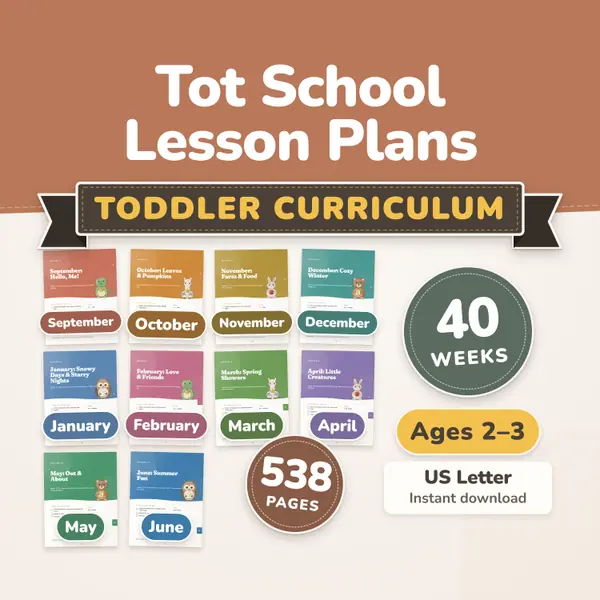
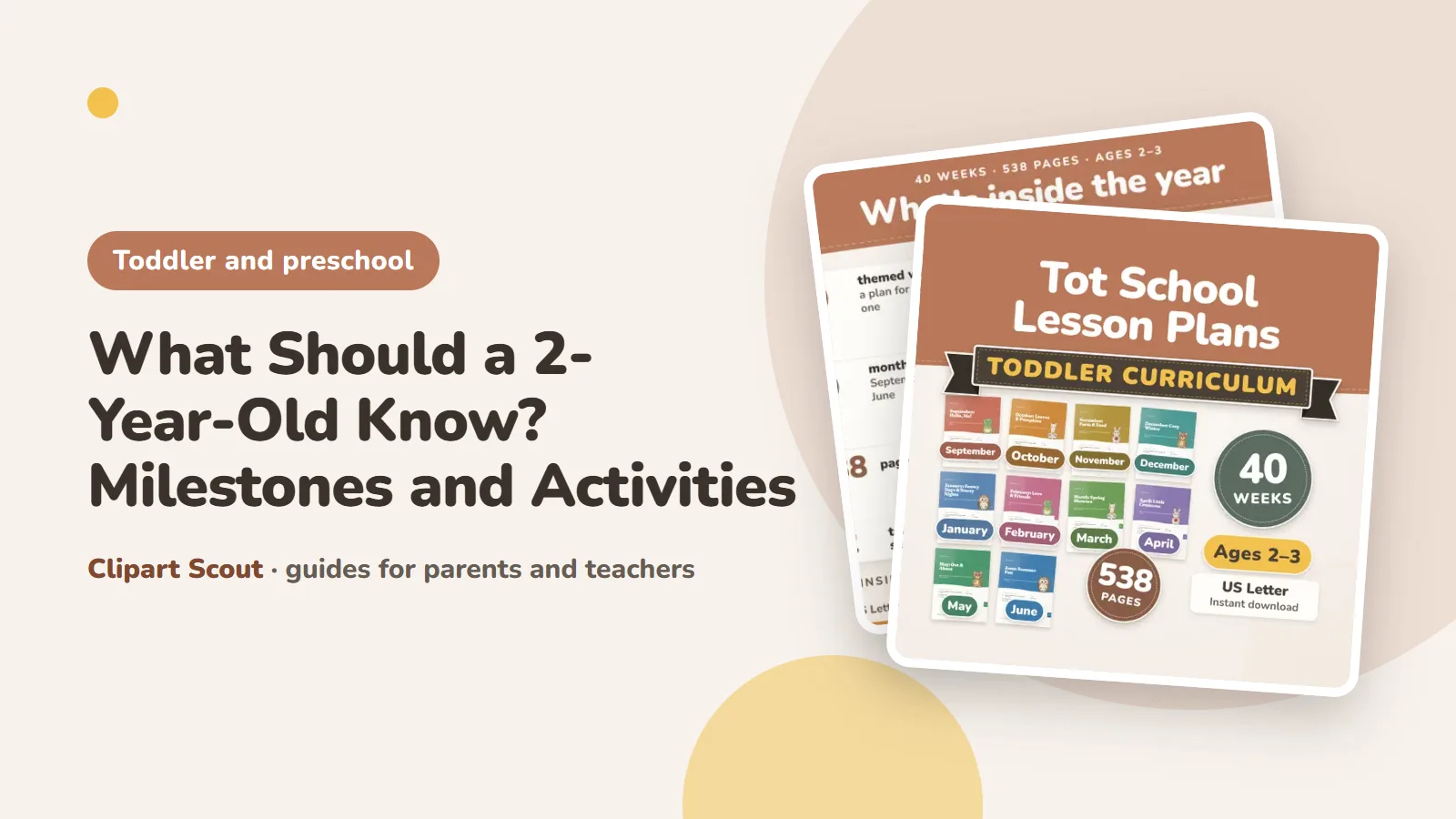
If you would like ready-made pages for short, gentle sessions, the Toddler Curriculum Full Year has 538 pages for ages 2 to 3, built from 40 themed weeks. Each week has a daily plan, and you can skip, repeat or swap anything.
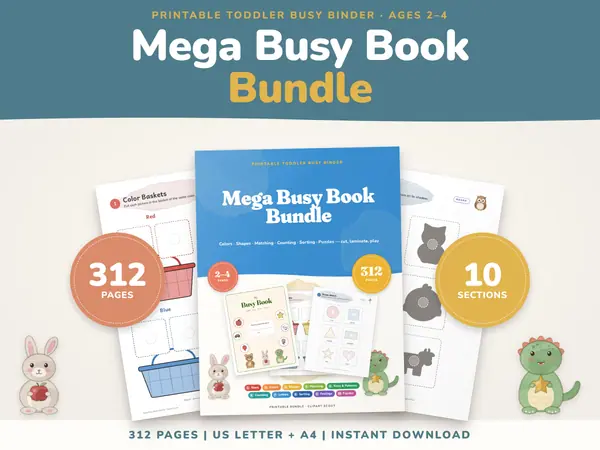
For quiet-time activities, the Toddler Busy Book Bundle has 312 pages, including full-color hook-and-loop boards with cut-out pieces such as color baskets and shape houses. Because those pieces are small, they are best used with a child who is past the age of putting things in the mouth, and always with you nearby. Our guide to busy book ideas explains how to set them up.
What if you have a worry about your child’s development?
The CDC’s advice is to act early. Its pages say: “If your child is not meeting one or more milestones, has lost skills he or she once had, or you have other concerns, act early.” It also says: “Talk with your child’s doctor, share your concerns, and ask about developmental screening.”
On the 2-year page, the CDC adds that you can call your state or territory’s early intervention program to find out if your child can get services to help. Only a doctor or another qualified professional can tell you what your own child needs, and this guide cannot diagnose anything. The CDC’s milestone index also covers other ages, from 2 months to 5 years.
What to do next
- Read the CDC’s 2-year and 30-month lists once, then put them away. Notice what your child already does.
- Pick one or two play ideas from this guide and repeat them for a week.
- Read a picture book together every day and let your child turn the pages.
- Look ahead to our guide to what a 3-year-old can do, and to fine motor activities by age for hand play.
- Browse our toddler printables if you want pages ready to print.
Sources
- Important Milestones: Your Child By Two Years, Centers for Disease Control and Prevention (CDC).
- Important Milestones: Your Child By 30 Months, Centers for Disease Control and Prevention (CDC).
- Developmental Milestones (index of age pages), Centers for Disease Control and Prevention (CDC).
- Hand and Finger Skills: 2 Year Olds, American Academy of Pediatrics (healthychildren.org).
- The Power of Play: How Fun and Games Help Children Thrive, American Academy of Pediatrics (healthychildren.org).
- Small Parts for Toys and Children's Products, U.S. Consumer Product Safety Commission (CPSC).
This guide is general information for parents and teachers. It is not medical, legal or professional advice. Every guide lists its sources at the end. More about our guides is on the About page.