How to Teach a Child to Read, Step by Step
By the Clipart Scout team8 min read
Short answer
Start with the sounds in spoken words, then teach letter sounds, then have your child blend those sounds into short words. Add a few common words by sight, then letter patterns, then books to read every day, and talk about what the words mean. This follows the National Reading Panel findings and an IES practice guide for kindergarten through 3rd grade.
Key points
- Research reviews point to the same core areas: sounds in spoken words, phonics, fluency, vocabulary and comprehension.
- The IES practice guide rates its advice on sounds, letters and decoding as strong evidence.
- A simple order is play with sounds, letter sounds, blending short words, a few sight words, letter patterns, then books and talk.
- Fifteen focused minutes a day, with reading aloud on top, is a workable pace for many families.
- Children vary in when they start and how fast they move. If you are worried, talk to the teacher or the child's doctor.
On this page
- What are the five parts of reading instruction?
- What is the first step in teaching a child to read?
- How do you teach a child to read, step by step?
- What does a 15-minute daily reading lesson look like?
- At what age should a child start reading?
- How long does it take to teach a child to read?
- What to do next
Teaching a child to read can feel like a huge task, but it breaks down into a small number of steps taken in a sensible order. You do not need a special degree. You need a clear sequence and a few minutes every day.
This guide follows two research reviews from U.S. government agencies: the 2000 National Reading Panel report and a 2016 practice guide from the Institute of Education Sciences (IES). It gives you eight steps, a 15-minute daily lesson, and straight answers on age and timing, including what the research does not say.
What are the five parts of reading instruction?
The five areas most often cited are phonemic awareness, phonics, fluency, vocabulary and text comprehension. A companion teacher booklet to the report, Put Reading First, presents the National Reading Panel’s findings under exactly these five headings.
| Area | In plain words |
|---|---|
| Phonemic awareness | Hearing the separate sounds in spoken words |
| Phonics | Linking those sounds to letters |
| Fluency | Reading smoothly and accurately |
| Vocabulary | Knowing what words mean |
| Text comprehension | Understanding what you read |
One accuracy note: the Panel’s own report is organized as Alphabetics (phonemic awareness and phonics), Fluency, and Comprehension (vocabulary and text comprehension). “Five components” or “five pillars” is the later shorthand. The agency’s summary of the Panel’s conclusion is that the best approach combines explicit instruction in phonemic awareness, systematic phonics instruction, methods to improve fluency and ways to enhance comprehension.
The IES guide, Foundational Skills to Support Reading for Understanding in Kindergarten Through 3rd Grade, gives four recommendations. The first is to teach academic language, the second is to build awareness of the separate sounds in spoken words and how they link to letters, the third is to teach children to decode words, analyze word parts, and write and recognize words, and the fourth is to make sure every child reads connected text every day. The guide rates the evidence for the second and third as strong, for the fourth as moderate and for the first as minimal.
What is the first step in teaching a child to read?
The first step is helping your child hear the separate sounds in spoken words. That is the second IES recommendation, and it is rated as strong evidence. A child who cannot yet hear that “cat” has three sounds will find it hard to link those sounds to letters.
You can do this with no paper at all. The Common Core Kindergarten standards ask children to recognize and make rhymes, to count and split syllables, and to pick out the first, middle and last sound in simple three-sound words. Those skills make good play activities:
- Say two words and ask “do they rhyme?” (hat and cat, or hat and dog).
- Clap the beats in a name: Su-san, Ben-ja-min.
- Say a word slowly and ask for the first sound: “mmm-oon, what is the first sound?”
How do you teach a child to read, step by step?
The steps below follow the order the IES guide gives for letter-sound teaching, with a few of our own suggestions at the start and end. Move to the next step when your child is comfortable, not on a calendar.
Step 1: Play with sounds
Spend as long as your child needs on rhymes, clapping syllables and saying the sounds in short words. Do this by ear, with no letters. It can be a car game or a bedtime routine.
Step 2: Teach letter names and sounds
Teach a few letters at a time, giving the sound each one makes. Common Core Kindergarten asks children to name all upper and lowercase letters and to give the primary sound of each consonant. The IES guide recommends starting with single-letter consonants and short vowel sounds, and its example first group is s, m, d, p and a. If you like a weekly rhythm, our letter of the week guide gives a plan for one letter at a time.
Step 3: Blend sounds into short words
Once your child knows a few letters, show them how to say the sounds slowly and blend them into a word. Start with words that have a consonant, a vowel and a consonant, like the example “fan” in the IES guide. Our guide to CVC words has 215 of them and a five-minute routine.
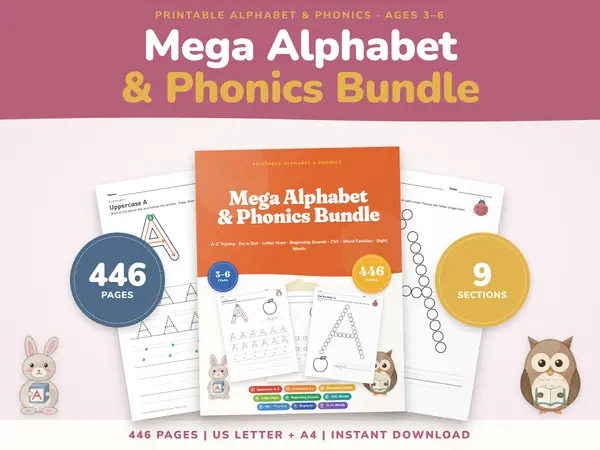
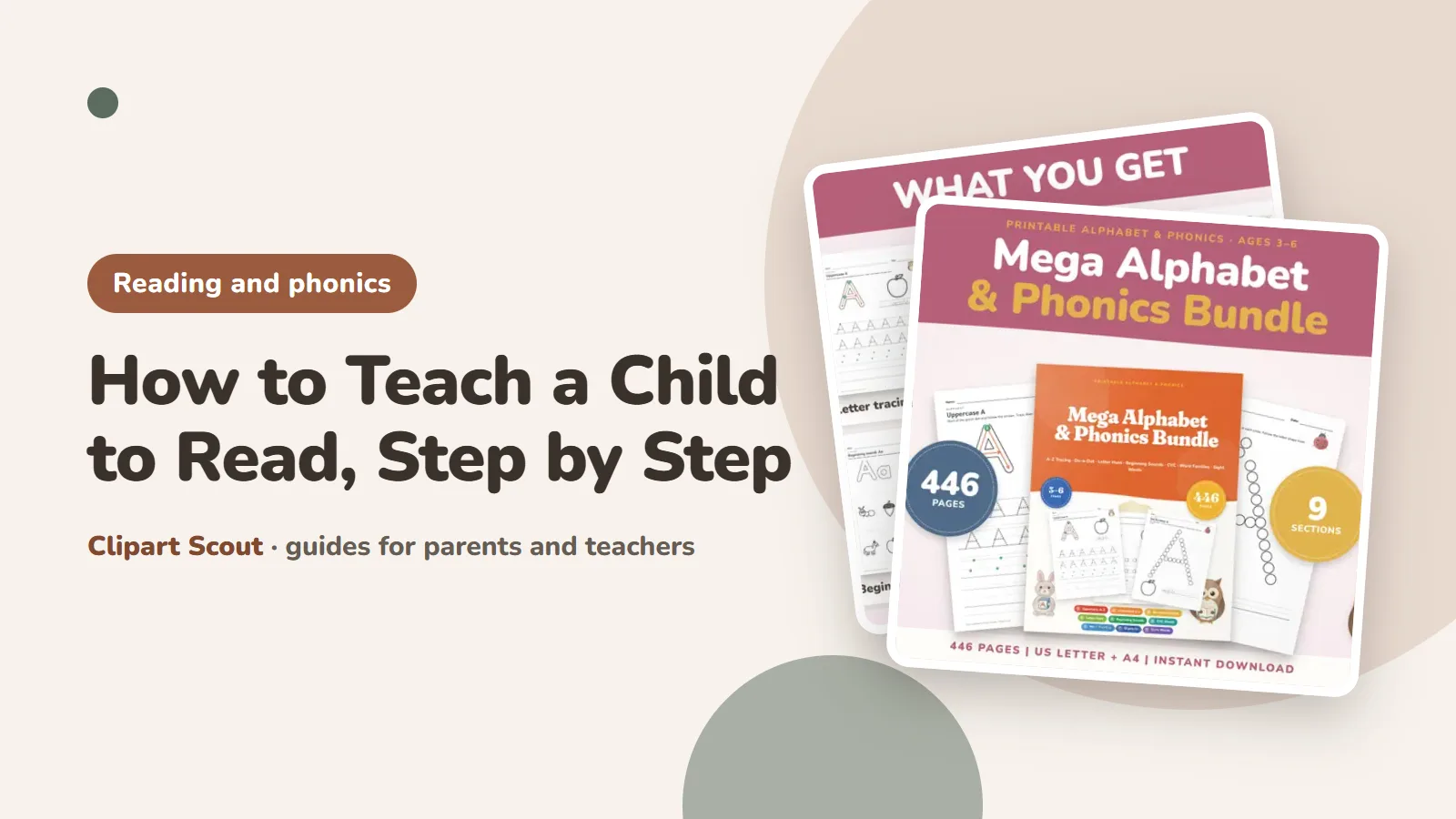
For practice pages, the Alphabet Worksheets and Phonics Bundle has a Letter Hunt section, a 65-page CVC Words section and a 79-page Word Families section.
Step 4: Add a few sight words
Some of the most common words in books do not follow simple sound rules, so children also learn some as whole words. Common Core Kindergarten asks children to read common high-frequency words by sight, such as the, of, to and you. Add two or three at a time and keep going with phonics. Our guide to sight words by grade explains the Dolch and Fry lists.
Step 5: Teach consonant blends and digraphs
Next come consonant blends, such as fl, sm and st, and common two-letter digraphs such as sh, th and ch. The IES guide puts these together as one step, and says to teach each sound in a blend but to teach a digraph as one unit because it makes a single sound.
Step 6: Teach long vowels and vowel teams
The IES order then moves to long vowels with a silent e (as in cake or hope) and finally two-letter vowel teams such as ea and ou. Word building follows the same path: CVC words first, then CVC words with a silent e, then words with two consonants at the start or end.
Step 7: Read connected text every day
The fourth IES recommendation is to make sure every child reads connected text every day, to build accuracy, fluency and comprehension. Connected text means sentences and short books, not only word lists. Choose books where your child can read most of the words, and listen as they read.
Step 8: Talk about what the words mean
Reading is about meaning, so ask questions during and after reading. Vocabulary and comprehension are two of the five areas. Our guide to reading comprehension strategies gives question starters for each stage.
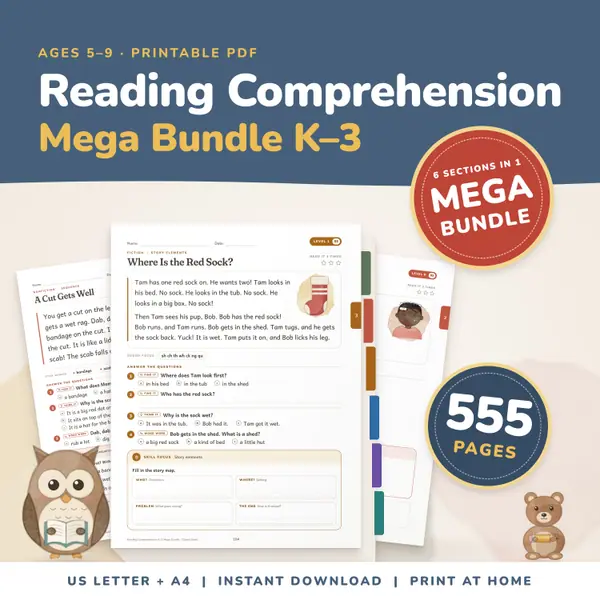
Our Reading Comprehension Passages K-3 collection has a five-minute placement check and a phonics path in its Start Here section. Its Level K has 80 one-page decodable passages with short-vowel CVC words, and Level 1 has 80 passages in phonics order covering digraphs, blends, magic e and vowel teams.
Note: The order of letter-sound teaching in steps 2 to 6 is one expert panel’s recommended sequence, not a law. Published phonics programs vary in detail, and your child’s teacher may use a different order.
What does a 15-minute daily reading lesson look like?
A 15-minute lesson can fit all the steps you need for the day. This is our suggestion for a pattern, not a research-based schedule.
| Minutes | Activity | Example |
|---|---|---|
| 2 | Sounds play | Rhyming game or clapping syllables |
| 3 | Review letters and sounds | Flash cards of the letters you have taught |
| 4 | Blend and read new words | Four words from one word family |
| 2 | Sight words | Two or three words: see it, say it, spell it |
| 4 | Read a short text aloud | A page of a decodable book or a sentence strip; talk about it |
Read aloud to your child as well, apart from the lesson. If the day is short, keep the blending and the reading and drop the rest. If your child needs a break, take one.
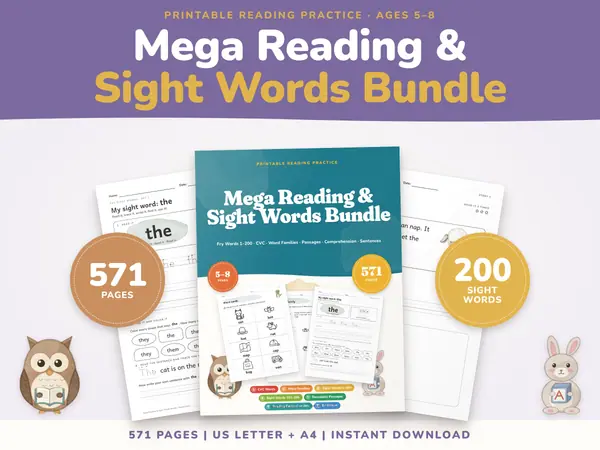
For the sight word part of the lesson, the Sight Words and Reading Bundle has 114 pages for the first 100 Fry words and 120 pages for the second 100.
At what age should a child start reading?
The sources used for this guide give no single starting age, and children vary a lot. What they do give is what schools expect at each grade.
The Common Core Kindergarten standards ask children to name all upper and lowercase letters, give the primary sound of each consonant, read common high-frequency words by sight and read emergent-reader texts with purpose and understanding. The Grade 1 standards ask children to decode regularly spelled one-syllable words, read grade-level text with enough accuracy and fluency to understand it, and know the sounds for common consonant digraphs.
States set their own standards, so your child’s school may word these differently. Our guide to what a kindergartener should know puts the Kindergarten goals in plain language.
If your child seems far from the goals for their grade, or you are worried about their speech, hearing or reading, talk to the teacher or the child’s doctor.
How long does it take to teach a child to read?
The sources used for this guide give no timeframe, and no honest guide can promise one. Children start at different points and move at different speeds. What the research describes is a content sequence, not a calendar.
If you are looking for a quick method, the sources used here do not offer a shortcut. They point to explicit instruction in a clear order and to reading connected text every day. Our own suggestion is to keep practice short and regular, because it is easier to keep up than one long weekend session.
Track progress by steps, not by weeks. Can your child hear the first sound in a word? Name the sounds for the letters you have taught? Blend three sounds? Read a short sentence? Each yes means you can move on.
What to do next
- Play one sound game today: rhymes, syllable claps or first sounds.
- Pick four or five letters and teach their sounds. Our letter of the week guide can help you pace it.
- Once those sounds are known, begin blending with words from our CVC words list.
- Set up a 15-minute daily slot using the table above and add a short book every day.
- For ready-to-print pages in every step, browse our reading and phonics worksheets.
Sources
- Teaching Children to Read: An Evidence-Based Assessment of the Scientific Research Literature on Reading and Its Implications for Reading Instruction, National Institute of Child Health and Human Development (NICHD), National Reading Panel, 2000.
- Put Reading First: The Research Building Blocks for Teaching Children to Read, Partnership for Reading, third edition, 2001.
- National Reading Panel: findings by topic area, National Institute of Child Health and Human Development (NICHD).
- Foundational Skills to Support Reading for Understanding in Kindergarten Through 3rd Grade, What Works Clearinghouse, Institute of Education Sciences (IES), U.S. Department of Education, 2016.
- Kindergarten reading: foundational skills (online copy of the Common Core standards), thecorestandards.org, an unofficial copy of the standards.
- Grade 1 reading: foundational skills (online copy of the Common Core standards), thecorestandards.org, an unofficial copy of the standards.
This guide is general information for parents and teachers. It is not medical, legal or professional advice. Every guide lists its sources at the end. More about our guides is on the About page.