Reading Comprehension Strategies for K to 3rd Grade
By the Clipart Scout team8 min read
Short answer
A 2010 practice guide from the Institute of Education Sciences gives five recommendations for comprehension in kindergarten through 3rd grade: teach comprehension strategies, teach how texts are organized, lead focused discussion about meaning, choose texts on purpose, and make reading engaging. At home, that means asking questions before, during and after reading and talking about the answers.
Key points
- The IES guide rates teaching comprehension strategies as strong evidence, and text organization and an engaging setting as moderate.
- Reading the words and understanding them are different skills, and the research reviews treat them as separate areas.
- Ask questions before, during and after reading, and let your child explain in their own words.
- Choose the text on purpose: short, interesting and a good match for what you want to practice.
- Common Core expects Grade 2 children to read stories and poems from the grades 2 to 3 band, with support on the hardest texts.
On this page
Your child can read every word on the page and still shrug when you ask what happened. That is common, and it does not mean something is wrong. It means reading the words and understanding them are two different jobs.
The fix is mostly talk. This guide follows the five recommendations of a 2010 practice guide from the Institute of Education Sciences (IES), and for each one gives you a plain explanation, what to say and an example using a short story. It also has a table of question starters and a section on 2nd and 3rd grade expectations.
What are the main reading comprehension strategies?
The main strategy advice comes from the IES practice guide Improving Reading Comprehension in Kindergarten Through 3rd Grade, published in September 2010. It makes five recommendations and rates the evidence for each.
| # | Recommendation | Evidence rating |
|---|---|---|
| 1 | Teach children how to use reading comprehension strategies | Strong |
| 2 | Teach children to notice and use the way a text is organized to understand and remember it | Moderate |
| 3 | Lead focused, high-quality discussion about what the text means | Minimal |
| 4 | Choose texts on purpose to support comprehension | Minimal |
| 5 | Create an engaging, motivating setting for teaching comprehension | Moderate |
The guide rates recommendations 3 and 4 as minimal evidence, so treat those as good habits rather than proven recipes. The next section turns each one into something you can say to your child.
How do you teach each of the five recommendations at home?
Use one short text for all five. Here is the example story used below:
Mina found one red mitten on the path. Her other mitten was gone. She looked under the bench and behind the tree. Then she saw a small dog with something red in its mouth. “That is mine!” said Mina. The dog dropped the mitten and wagged its tail.
1. Teach comprehension strategies
A strategy is a thing a reader does on purpose to understand, like making a guess about what comes next or retelling the text. The guide’s recommendation is to teach strategies, and the examples below are our own suggestions.
- Predict: Before reading, show the title or picture. “What do you think will happen?”
- Ask questions as you read: “Where did Mina look first?”
- Retell: Afterward, “Tell me the story in your own words.”
For the example story, you might say before reading, “The title is about a mitten. What might go wrong?” Midway, “Mina has looked in two places. Where might she look next?” At the end, “Tell me what happened, from the start.”
Say your own thinking out loud, too. “I wonder why the dog has something red. I think it is the mitten.” Your child learns that good readers keep thinking while they read.
2. Teach how the text is organized
Show your child how the text is built. A story has a beginning, a middle and an end. A fact book has headings, and each heading tells you what the next part is about.
For the example story: “At the beginning, Mina loses a mitten. In the middle, she looks for it. At the end, she finds it.” You can draw three boxes on paper and have your child fill them in. For a fact book, point to a heading first and ask, “What do you think this part will tell us?”
3. Lead a focused talk about meaning
Ask a question that needs more than one word to answer, then listen. Stay on the question until your child has said what they think and why.
For the example story: “Why did Mina say ‘that is mine’?” or “How do you think Mina felt when she saw the dog?” Then ask, “What in the story makes you think that?”
4. Choose the text on purpose
Pick the book for a reason. If you want to practice retelling, choose a story with a clear beginning, middle and end. If you want to practice headings, choose a short fact book. Keep the text short enough that you can talk about it in one sitting.
If your child can read it with ease, you can spend your time on meaning. If they stumble on many words, read it aloud together first so that decoding does not use all their attention.
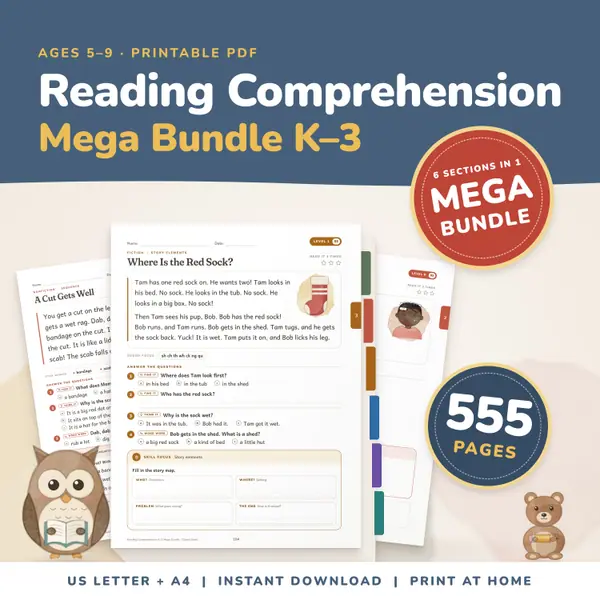
Our Reading Comprehension Passages K-3 collection gives you short texts matched to a level. Its Level K has 80 one-page decodable passages, each with three questions and an organizer. Level 2 has 160 pages with 80 fiction and nonfiction passages, words to know and question pages on main idea, lesson, fact and opinion and character traits.
5. Make reading engaging
Keep the setting calm and the pace relaxed. Let your child choose some of the books. Stop for a laugh when something is funny. A child who dreads questions will stop thinking about the story.
Tip: Keep the questions to two or three per book. One good question your child enjoys answering is worth more than ten they rush through.
What questions should I ask after reading?
Use question starters that fit the moment: before, during and after reading. These are suggestions you can print and keep with your books.
| When | Question starters | What it practices |
|---|---|---|
| Before reading | What do you think this will be about? What do you already know about this? | Predicting and using what you know |
| During reading | What just happened? What do you think comes next? What does that word mean? | Checking understanding and word meaning |
| After reading | Who was this about? What happened first, next and last? Why did it happen? | Retelling and cause and effect |
| After reading | How did the character feel? What in the text tells you that? | Thinking about meaning and finding proof |
| After a fact book | What is the main thing this told us? What is one new fact you learned? | Main idea and details |
Start with one question from each row, not all of them. Too many questions can turn a book into a test.
Why can my child read the words but not understand them?
Decoding and comprehension are different skills, and a child can be stronger in one than the other. The National Reading Panel findings, as presented in the booklet Put Reading First, list phonics, fluency, vocabulary and text comprehension as separate areas. The IES foundational skills guide likewise treats decoding words and teaching academic language as separate recommendations.
If your child reads the words but cannot say what happened, these are things you can check:
- Word meanings. Ask what a few words in the text mean. Vocabulary is one of the five areas, and one unknown word can block a sentence.
- Retelling. Ask for the story in their own words. If the retelling is thin, read the text again together and stop to talk.
- Pace. A child who reads each word slowly may have no attention left for meaning. Read the text aloud once, then let them read it.
Tell your child’s teacher what you notice. They see your child read every day and can tell you whether this is a vocabulary question, a fluency question or something else.
For a child who is still working on decoding, our guide to how to teach a child to read covers the steps from sounds to books, and our guide to sight words by grade covers common words.
What reading should 2nd and 3rd graders be doing?
Common Core sets reading goals for each grade. They are expectations for the end of the year, not a test of any one book.
- Grade 1: Retell stories with key details and show understanding of the central message or lesson (Grade 1 literature standards).
- Grade 2: By the end of the year, read stories and poetry in the grades 2 to 3 text complexity band, with support as needed at the high end. The same band and condition apply to informational texts (Grade 2 literature standards).
- Grade 3: By the end of the year, read stories, dramas and poetry at the high end of the grades 2 to 3 band independently and proficiently, and the same for informational texts (Grade 3 literature standards).
States set their own standards and some have reworded the Common Core, so your child’s school may list the goals differently. Our guides to what a 2nd grader should know and what a 3rd grader should know give the full lists in plain words.
For 2nd and 3rd grade practice, the Reading Comprehension and Grammar Bundle has 62 pages of 2nd grade stories with questions and, for 3rd grade, 25 original stories and 25 nonfiction texts, each with a page of questions, plus a 12-page set of reading response organizers.
If you are working mainly on 2nd grade, the Second Grade Worksheets Bundle has a 62-page Reading Comprehension section with 60 level-3 stories and questions, alongside its other 2nd grade sections.
What to do next
- Pick one short text, a story or a fact book, and read it with your child today.
- Ask one question before reading, one during and two after, using the table above.
- Ask your child to retell the text in their own words and listen for the order of events.
- Choose a different text on purpose each day: a story for retelling, a fact book for headings.
- For ready-to-print passages and questions, browse our reading and phonics worksheets.
Sources
- Improving Reading Comprehension in Kindergarten Through 3rd Grade, What Works Clearinghouse, Institute of Education Sciences (IES), U.S. Department of Education, 2010.
- Foundational Skills to Support Reading for Understanding in Kindergarten Through 3rd Grade, What Works Clearinghouse, Institute of Education Sciences (IES), U.S. Department of Education, 2016.
- Put Reading First: The Research Building Blocks for Teaching Children to Read, Partnership for Reading, third edition, 2001.
- Common Core State Standards for Mathematics and English Language Arts (official documents), National Governors Association Center for Best Practices and Council of Chief State School Officers.
- Grade 2 reading: literature standards (online copy of the Common Core standards), thecorestandards.org, an unofficial copy of the standards.
- Grade 3 reading: literature standards (online copy of the Common Core standards), thecorestandards.org, an unofficial copy of the standards.
- Grade 1 reading: literature standards (online copy of the Common Core standards), thecorestandards.org, an unofficial copy of the standards.
This guide is general information for parents and teachers. It is not medical, legal or professional advice. Every guide lists its sources at the end. More about our guides is on the About page.