Sight Words by Grade: How Many and Which Lists to Use
By the Clipart Scout team8 min read
Short answer
There is no single number of sight words every child must know by a certain grade. Schools set their own targets. The Dolch list has 220 words in five levels, from pre-primer (40 words) to third grade (41 words), and the Fry lists are longer. Use a level as a yardstick, teach a few new words a week, and keep reviewing old ones.
Key points
- Schools and states set their own sight word targets, so ask your child's teacher which list the class uses.
- The Dolch list of 220 words has five levels: pre-primer 40, primer 52, first grade 41, second grade 46 and third grade 41.
- The Fry lists are a different list. Dolch and Fry share only 70 words.
- Common Core Kindergarten asks children to read common high-frequency words by sight, with examples such as the, of, to, you and she.
- Teach a sight word by seeing it, saying it, spelling it, writing it and finding it in a sentence.
On this page
- What is a sight word?
- How many sight words should a kindergartener know?
- What are the Dolch sight words?
- What is the difference between Dolch and Fry words?
- Which sight words should 1st, 2nd and 3rd graders know?
- What about sight words for preschool?
- How do you teach a sight word?
- How many new sight words a week?
- What to do next
If your child’s teacher sent home a list of sight words, or you searched for one, the first question is usually how many words your child should know. The honest answer is that schools set their own targets, so the best number comes from your child’s teacher.
What this guide gives you instead is a yardstick. The Dolch list is split into five levels of 40 to 52 words each, and the Fry lists go further. Below you will find ten example words from each Dolch level, the difference between the two lists, a simple way to teach a word and how many new words to add in a week.
What is a sight word?
A sight word is a word a reader recognizes instantly, without stopping to sound it out. Teachers use the term for common words that appear again and again in books, such as the, to, and and said.
Some sight words follow regular sound patterns. Others do not, and those have to be learned as whole words. Common Core Kindergarten treats this as its own skill: the Kindergarten foundational skills standards ask children to read common high-frequency words by sight. The examples on that page include the, of, to, you, she, my, is, are, do and does.
How many sight words should a kindergartener know?
Schools and states set their own targets, so there is no single number that applies everywhere. Ask your child’s teacher which list the class uses and how many words they expect by the end of the year.
If you want a yardstick, use the Dolch levels. The first two levels, pre-primer and primer, hold 40 and 52 words, which is 92 words together. That is our suggestion for a comparison, not a rule. Children learn at different speeds.
The Kindergarten standard, as summarized on the Common Core pages, names no word count. It asks children to read common high-frequency words by sight, and it keeps asking for irregularly spelled words in later grades, so sight words do not end after kindergarten.
What are the Dolch sight words?
The Dolch list is the best-known sight word list in US schools. Edward W. Dolch published it in 1936 in an article titled “A Basic Sight Vocabulary”, and the year and author are confirmed by reading researcher Timothy Shanahan’s article on sight vocabulary.
The list has 220 “service” words plus a separate list of 95 nouns, which makes 315 words in total. The 220 words contain no nouns and lean on small function words. The list was built from word counts of the 1920s.
The 220 words are commonly published in five levels. The ReadWriteThink Dolch word list gives these sizes. The grade names are how the list is usually published, not something taken from Dolch’s original article.
| Dolch level | Words in the level | Ten example words |
|---|---|---|
| Pre-primer | 40 | the, to, and, a, I, you, it, in, said, for |
| Primer | 52 | he, was, that, she, on, they, but, at, with, all |
| First grade | 41 | of, his, had, him, her, some, as, then, could, when |
| Second grade | 46 | would, very, your, its, around, don’t, right, green, their, call |
| Third grade | 41 | if, long, about, got, six, never, seven, eight, today, myself |
The five levels add up to 220 words. Ask the teacher for the full list, or look for a printed copy from a school or library.
What is the difference between Dolch and Fry words?
Dolch and Fry are two separate lists, and they share only 70 words. The Dolch list dates from 1936. Edward Fry published an updated list, “The New Instant Word List”, in The Reading Teacher in December 1980. You can find it in the ERIC record.
| Dolch list | Fry Instant Words | |
|---|---|---|
| Author | Edward W. Dolch | Edward Fry |
| Year | 1936 | Updated in 1980 and later expanded to 1,000 words in his book of that name |
| Size | 220 service words plus 95 nouns | Sources describe different sizes (see below) |
| How it is split | Five levels, pre-primer to third grade | Described as 300, 600 or 1,000 words, depending on the source |
| Built from | Word counts of the 1920s | A large collection of 1960s and 1970s texts, per Shanahan |
Sources disagree on how big “the Fry list” is. Shanahan describes it as the 300 most common words from a corpus of about 5 million words from the 1960s and 1970s. The Utah Education Network presents a 600-word Fry list. Fry’s later book is called “1000 Instant Words”. So when a worksheet says “Fry words”, check which part of the list it uses.
Fry’s first 100 words are very frequent. Shanahan says they make up about half of written material. That is a reason to learn them early, but it is not a reason to skip phonics. The Fry lists are published in copyrighted books, so this guide does not reprint them.
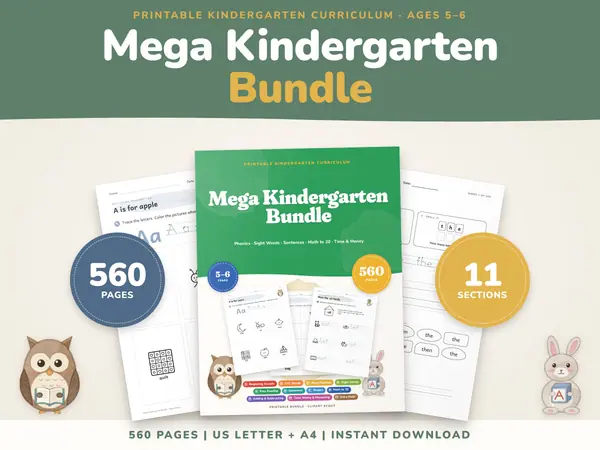
Our products use Fry words. The Kindergarten Worksheets Bundle has a 114-page Sight Words section for Fry words 1 to 100, with flashcards and practice.
Which sight words should 1st, 2nd and 3rd graders know?
A 1st grader is expected to keep learning irregularly spelled words, and the same goal appears in 2nd and 3rd grade standards. Common Core Grade 1 asks children to read grade-appropriate irregularly spelled words, and Grades 2 and 3 repeat the goal.
By the Dolch levels, the first grade level has 41 words, the second grade level has 46 and the third grade level has 41.
- 1st grade: Work on the Dolch first grade words (of, his, had, him, her, some, as, then, could, when) or the second hundred Fry words, and read short books every day.
- 2nd grade: Work on the Dolch second grade words (would, very, your, its, around, don’t, right, green, their, call) and watch for words your child reads correctly in a list but misses in a sentence.
- 3rd grade: By now sight word lists matter less. Common Core Grade 3 also asks for decoding of multisyllable words, so longer words and spelling take more time than lists. The Dolch third grade words (if, long, about, got, six, never, seven, eight, today, myself) make a quick check.
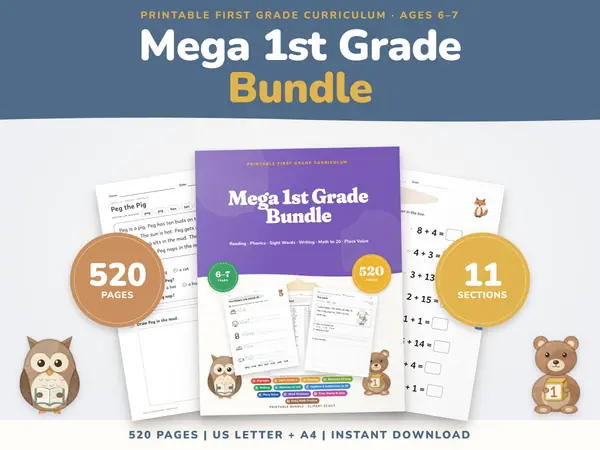
For 1st grade, the First Grade Worksheets Bundle has a 120-page Sight Words section for the second 100 Fry words (Fry 101 to 200).
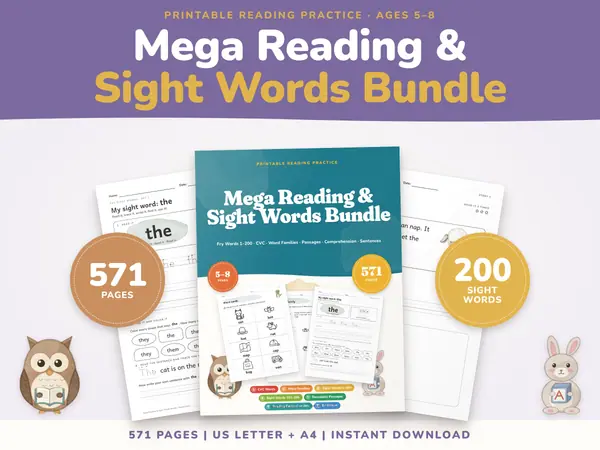
For kindergarten and 1st grade in one file, the Sight Words and Reading Bundle has 114 pages for the first 100 Fry words and 120 pages for the second 100.
You can see more of what a 1st grader is expected to know in our guide to what a 1st grader should know.
What about sight words for preschool?
The sources used for this guide set no preschool target for sight words, so a list is optional. Many children at this age are still learning letters and sounds.
If your child is curious about words, start with a few that matter to them: their own name, “mom” or “dad”, or a word on a favorite book. The pre-primer words in the table above are a gentle next step. Keep it playful, and read aloud together every day.
How do you teach a sight word?
Teach a sight word by having your child see it, say it, spell it, write it and find it in a sentence. This is a practical routine for one word at a time, not a research-based protocol.
- See it. Show the word on a card and read it aloud once.
- Say it. Your child says the word back.
- Spell it. Point to each letter and say the letter names together.
- Write it. Your child writes the word on paper, a whiteboard or in sand, saying it as they write.
- Find it. Look for the word in a sentence, a picture book or on a sign.
Tip: Say the word in a short sentence first (“I said thank you”). A word with meaning is easier to remember than a word on its own.
Sight words often go hand in hand with sounding out. Our guide to CVC words covers the short words children blend from sounds, and the broader plan is in how to teach a child to read.
How many new sight words a week?
Two to five new words a week is a comfortable pace for many young children. This is our suggestion, and the right number depends on your child.
| Week | New words | Review |
|---|---|---|
| 1 | 3 new words | None yet |
| 2 | 3 new words | Last week’s 3 |
| 3 | 3 new words | All 6 earlier words |
| 4 | Review only | All 9 words, then read a short book |
Keep each session to five or ten minutes, and stop while it is going well. A word counts as known when your child reads it quickly in a sentence, not only on a card. If a word keeps slipping, keep it in the review pile for another week.
Once words are solid in isolation, the next step is reading them in connected text. Our guide to reading comprehension strategies covers what to ask after a book.
What to do next
- Ask your child’s teacher which sight word list the class uses and how many words they expect.
- Check your child against one Dolch level, using the ten examples in the table.
- Pick three words and use the see, say, spell, write and find routine for five minutes a day.
- Add a short book each day and look for the words you are learning.
- For ready-to-print pages, browse our reading and phonics worksheets.
Sources
- Common Core State Standards for Mathematics and English Language Arts (official documents), National Governors Association Center for Best Practices and Council of Chief State School Officers.
- Kindergarten reading: foundational skills (online copy of the Common Core standards), thecorestandards.org, an unofficial copy of the standards.
- Grade 1 reading: foundational skills (online copy of the Common Core standards), thecorestandards.org, an unofficial copy of the standards.
- Grade 2 reading: foundational skills (online copy of the Common Core standards), thecorestandards.org, an unofficial copy of the standards.
- Grade 3 reading: foundational skills (online copy of the Common Core standards), thecorestandards.org, an unofficial copy of the standards.
- Dolch Word List, ReadWriteThink, International Reading Association and National Council of Teachers of English.
- The Whats, Hows, and Whys of Teaching Sight Vocabulary, Timothy Shanahan, Shanahan on Literacy, 19 April 2025.
- The New Instant Word List (Edward Fry, The Reading Teacher, December 1980), ERIC record, Education Resources Information Center (ERIC).
This guide is general information for parents and teachers. It is not medical, legal or professional advice. Every guide lists its sources at the end. More about our guides is on the About page.