How to Start Homeschooling: A Step-by-Step Checklist
By the Clipart Scout team7 min read
Short answer
Start by reading your own state's homeschool law, because homeschooling is regulated state by state. Then, if your child is enrolled, withdraw them formally; send any notice your state asks for; learn which subjects and records apply; choose a curriculum; and plan a short first week. HSLDA sorts states into four levels of regulation, from no notice required to high regulation.
Key points
- Homeschooling is regulated state by state, so reading your state's law comes before buying anything.
- HSLDA sorts states into four levels: no notice required, low, moderate and high regulation.
- If your child is enrolled in a school, you normally withdraw them formally. Your state's rules explain how.
- Many states ask for a notice, some name required subjects, some ask for records or testing, and a few set a parent qualification.
- You do not need to start big. A short, calm first week is enough.
On this page
- What is the first step to start homeschooling?
- What are the steps to start homeschooling?
- Your printable getting-started checklist
- Do I need a teaching degree to homeschool?
- Can I start homeschooling in the middle of the school year?
- What records do homeschoolers need to keep?
- How much does it cost to homeschool?
- How do you start homeschooling a 4-year-old or a kindergartener?
- What to do next
Starting homeschooling can feel like standing in front of a locked door with no map. The first step is smaller than it looks. Homeschooling is regulated state by state, so the first job is to find out what your state says. After that, the rest is a short list of practical steps.
This guide gives those steps in order, with a printable checklist. It does not give legal advice, because the rules differ by state and change. Wherever the law comes up, the safe answer is to check with your state education department and read the law itself.
You are in good company. In the 2022–23 school year, 3.4 percent of US students aged 5 to 17, about 1,765,000 children, were homeschooled, according to the National Center for Education Statistics.
What is the first step to start homeschooling?
The first step is to learn your own state’s law, before you withdraw your child or buy anything. HSLDA is a membership advocacy organization. Its list of seven simple steps starts with talking to other homeschooling parents and puts “get to know your state’s homeschool law” second.
HSLDA’s state-by-state legal map sorts states into four levels:
- No notice required.
- Low regulation: the parent notifies the school district.
- Moderate regulation: notice, plus test scores or a professional evaluation.
- High regulation: adds things such as curriculum approval, parent qualifications or home visits.
HSLDA is not a government body. Use it to find your way, then confirm on your state education department’s home education page and in the statute.
What are the steps to start homeschooling?
The steps are the same in most places, though the details vary. Do them in this order.
- Read your state’s law. Find the home education page of your state education department and read the statute it points to.
- Withdraw your child if they are enrolled in a school. HSLDA says the parent normally withdraws the child formally, and its state pages explain how. Do not simply stop sending your child.
- Send any notice your state asks for. Some states ask for a notice, declaration or affidavit, and some ask for none.
- Learn which subjects you must cover. Some states name them.
- Set up your record keeping. Some states ask for records even when nothing is filed.
- Choose how you will teach and what you will use. A curriculum, a set of workbooks or a plan of your own.
- Plan a short first week. Aim for a calm start, not a full school day.
Here is what the states we checked ask for. They are examples, not a full list.
| Topic | Examples from the sources we checked |
|---|---|
| Notice | New York: by 1 July each year, or within 14 days of starting mid-year, followed by an individualized home instruction plan. Pennsylvania: a notarized affidavit or unsworn declaration before starting and by 1 August each year. Georgia: a declaration of intent to the state Department of Education within 30 days of starting and by 1 September each year. Ohio: notice to the district superintendent by 30 August each year, or within five days of starting. Missouri: HSLDA lists notification as not required. |
| Subjects | Missouri: reading, language arts, math, social studies and science. Wisconsin: six subject areas. Pennsylvania: a long list at elementary and secondary level. |
| Records | Missouri: a plan book or diary, samples of work and a record of evaluations. Pennsylvania: a portfolio with a log and work samples. |
| Testing or evaluation | Pennsylvania: standardized tests in grades 3, 5 and 8 plus an annual written evaluation. New York: an annual assessment. Georgia: a standardized test at least every three years from the end of grade 3, with results not submitted. Ohio: none, according to HSLDA. |
| Parent qualification | Pennsylvania and Georgia: a high school diploma or equivalent for the teaching parent. |
Sources for each row are in the list at the end. Check the current text for your state, because rules change.
Your printable getting-started checklist
Print this and tick each line as you go. Use it with your own state’s rules next to it.
Our guide to how many hours a day to homeschool will help you size the day, and homeschool schedule by grade has example days with clock times.
Do I need a teaching degree to homeschool?
It depends on your state. A few states set a parent qualification. Pennsylvania and Georgia, for example, ask the teaching parent for a high school diploma or equivalent. We found no teaching-degree rule in the sources we checked, but we did not check every state.
The safe step is to look at your state education department’s home education page. If the page lists a qualification, it will name it.
Can I start homeschooling in the middle of the school year?
Often you can, and some states write notice rules with a start date in mind. New York asks for notice within 14 days of starting mid-year. Georgia asks for a declaration within 30 days of starting. Ohio asks for notice within five days of starting, moving or withdrawing.
If your child is in school now, withdraw them formally first, and send any notice on the date your state sets. Then give your child a week or two to settle before you build a full routine.
What records do homeschoolers need to keep?
Some states require records even when nothing is filed with the state, and some require none. Missouri asks for a plan book or diary, samples of work and a record of evaluations. Pennsylvania asks for a portfolio with a log and work samples.
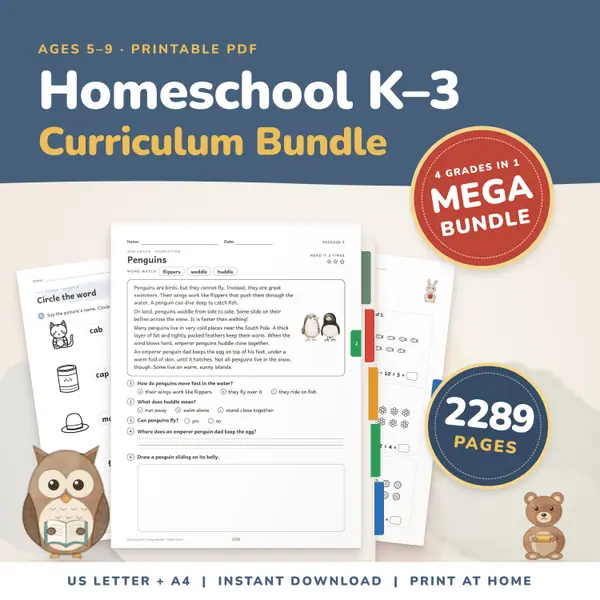
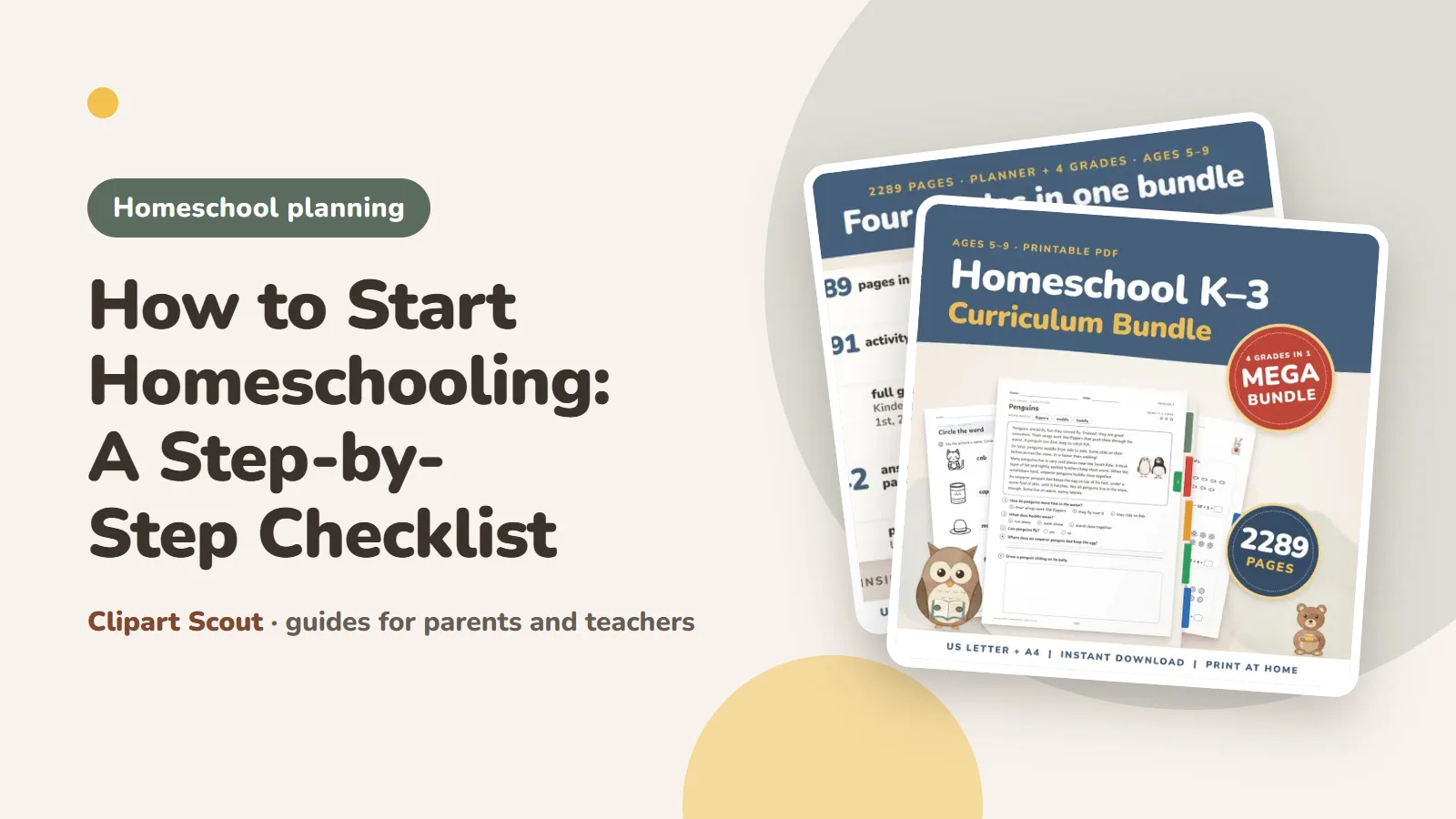
Even where nothing is required, HSLDA advises keeping records of each child’s progress every year. A simple folder with a dated list of what you did and a few work samples is enough to start. If you want ready-made pages for this, the Homeschool Curriculum Bundle K-3 has 2,289 pages and includes a 99-page planner with school and student profiles, a reading log and portfolio pages, in a student section for up to 6 children.
How much does it cost to homeschool?
The cost depends on your choices, so we give no figures. The usual costs are:
- A curriculum or set of books
- Supplies such as pencils, paper, glue and craft materials
- Paper and ink, if you print
- Outings, classes or co-op fees
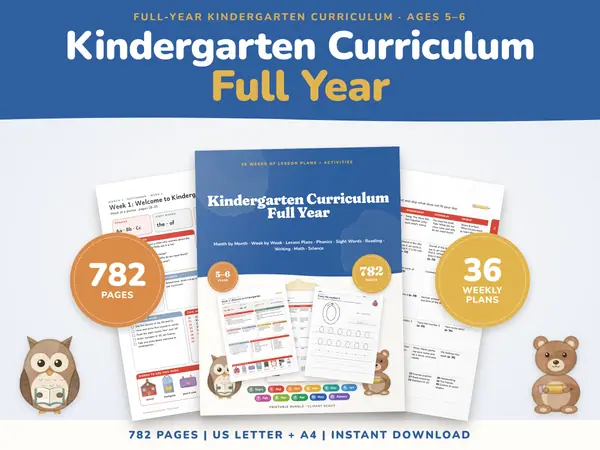
A printable curriculum can keep the curriculum part of the cost down, because you print only the pages you use. The Kindergarten Curriculum Full Year has 782 pages in 11 sections, with a Start Here guide, a daily lesson plan each week and a progress chart.
How do you start homeschooling a 4-year-old or a kindergartener?
For a 4-year-old, keep it to play, stories and a little letter and number practice. For a kindergartener, follow the same steps above, then keep lessons short.
Whether your state’s rules apply to a 4-year-old depends on your state’s compulsory school age, so ask your state education department. Our guides to preschool at home and how to homeschool kindergarten cover what to teach.
What to do next
- Find your state education department’s home education page today and bookmark it.
- Read the law, and write down the notice date, the subjects and the record rules in one place.
- Print the checklist above and tick off the first three lines this week.
- Pick one curriculum or one set of workbooks. Do not buy more until you have used the first.
- Browse homeschool printables when you are ready to plan your first month.
Sources
- Homeschool Laws By State, HSLDA (Home School Legal Defense Association), a membership advocacy organization.
- 7 Simple Steps to Start Homeschooling, HSLDA.
- 8 NYCRR 100.10, Instruction by Parent at Home, Cornell Legal Information Institute (Regulations of the Commissioner of Education, New York).
- Home Education Program (Pennsylvania Public School Code, Section 1327.1), Pennsylvania Department of Education.
- How to Comply With Georgia's Homeschool Law, HSLDA.
- Homeschool law in Missouri, HSLDA.
- RSMo 167.012 (home school definition, subjects and records), Missouri Revisor of Statutes.
- Home-Based Private Education, Wisconsin Department of Public Instruction.
- How to Comply With Ohio's Homeschool Law, HSLDA.
- Parent and Family Involvement in Education: 2023 (NCES 2024-113), National Center for Education Statistics.
This guide is general information for parents and teachers. It is not medical, legal or professional advice. Every guide lists its sources at the end. More about our guides is on the About page.