How Many Hours a Day Should You Homeschool? By Grade
By the Clipart Scout team8 min read
Short answer
No official body sets a recommended homeschool day by grade. As a reference point only, Illinois suggested 30 to 90 minutes a day for kindergarten, 45 to 90 for grades 1 and 2 and 60 to 120 for grades 3 to 5 in spring 2020 remote-learning guidance for public schools. Kansas set lower maximums. A few states set yearly hours or days for homeschools, so check yours.
Key points
- There is no official homeschool day by grade. The only published tables are public-school remote-learning guidance from Illinois and Kansas, spring 2020.
- Illinois suggested 30 to 90 minutes for kindergarten and 60 to 120 for grades 3 to 5. Kansas set maximums of 45 minutes for K-1 and 90 for grades 4-5.
- Some states set hours or days for homeschools, such as Missouri, Pennsylvania, New York, Wisconsin and Georgia. Ohio no longer does, and Texas says it does not regulate home schools.
- A homeschool day is usually shorter than a school day because there is no waiting, no line-ups and no class to manage.
- Your state education department is the place to confirm what applies to you.
On this page
- How many hours a day should you homeschool by grade?
- What does that look like for each grade?
- Which states set hours or days for homeschools?
- Why is a homeschool day shorter than a school day?
- What counts as learning time at home?
- How do you know your homeschool day is too long or too short?
- What to do next
If you are new to homeschooling, one of the first things you want to know is how long the day should be. The honest answer is shorter than you expect, and there is no single official number.
There is one useful reference point. In spring 2020, the education departments of Illinois and Kansas published daily time guidance for public-school students learning from home. Neither document was written for homeschools, and neither is law. Illinois suggested 30 to 90 minutes a day for kindergarten and 60 to 120 minutes for grades 3 to 5. Kansas set lower maximums.
This guide gives those figures by grade, shows which states set hours or days for homeschools, and explains what counts as learning time and how to tell whether your own day is off. For example days with clock times, see our guide to homeschool schedules by grade.
How many hours a day should you homeschool by grade?
Across the two official tables, a focused day for the early grades runs from about 30 minutes to two hours, and it grows with age. Illinois gives a minimum and a maximum. Kansas gives a maximum only.
| Grade | Illinois: minimum to maximum per day | Kansas: maximum per day |
|---|---|---|
| Kindergarten | 30–90 minutes | 45 minutes (grades K-1) |
| 1st grade | 45–90 minutes (grades 1-2) | 45 minutes (grades K-1) |
| 2nd grade | 45–90 minutes (grades 1-2) | 60 minutes (grades 2-3) |
| 3rd grade | 60–120 minutes (grades 3-5) | 60 minutes (grades 2-3) |
| 4th and 5th grade | 60–120 minutes (grades 3-5) | 90 minutes (grades 4-5) |
| Grades 6-8 | 90–180 minutes in total across classes | 3 hours at most, 30 minutes per teacher (grades 6-12) |
| Grades 9-12 | 120–270 minutes in total across classes | 3 hours at most, 30 minutes per teacher (grades 6-12) |
Both documents were written in March 2020 for public-school students working from home during school closures. They describe how long a student should be engaged in remote school work. They are not a homeschool rule. Kansas says its limits apply to any delivery model, including packets, online and hybrid.
One more detail about the Illinois figures. The state’s own file would not open when we checked, so we read the table on an Illinois school district page that reproduces it. The page and the state document are both listed in the sources below.
Tip: Read the table as a range, not a target. A child who is happy and learning at the lower end of a range does not need to be pushed to the top of it.
What does that look like for each grade?
In practice, think of a few short, focused lessons added up across the morning. Illinois also suggested how long a child can stay on one task, which is a useful guide for how long to make each lesson.
- Kindergarten: 30 to 90 minutes in the Illinois table, 45 at most in Kansas. Illinois suggested 3 to 5 minutes of sustained attention at a time, so plan many short activities.
- 1st grade: 45 to 90 minutes in Illinois, 45 at most in Kansas. Sustained attention of 5 to 10 minutes.
- 2nd grade: 45 to 90 minutes in Illinois, 60 at most in Kansas. Sustained attention of 5 to 10 minutes.
- 3rd grade: 60 to 120 minutes in Illinois, 60 at most in Kansas. Sustained attention of 10 to 15 minutes.
- 5th grade: 60 to 120 minutes in Illinois, 90 at most in Kansas. Sustained attention of 10 to 15 minutes.
- High school: Illinois suggested 20 to 45 minutes per class and 120 to 270 minutes in total, and Kansas set 3 hours as the daily maximum. Both tables count time in classes, so a high schooler with four or five subjects reaches the total quickly.
For a kindergartener, our guide to how to homeschool kindergarten shows what to teach in that time.
Which states set hours or days for homeschools?
Some states set a number of hours or days for homeschools, and others do not, so the rule depends on where you live. The examples below come from state laws and from state education departments. They are examples, not a full list, and laws change.
| State | What the source says |
|---|---|
| Missouri | At least 1,000 hours of instruction per school term. At least 600 of them in reading, language arts, mathematics, social studies and science, and at least 400 of those 600 at the regular home school location. The hour rules do not apply to pupils aged 16 or older. |
| Pennsylvania | 180 days of instruction, or 900 hours a year at the elementary level, or 990 hours a year at the secondary level, in the home education program. |
| New York | The substantial equivalent of 180 days a year, with 900 hours a year in grades 1-6 and 990 hours a year in grades 7-12. |
| Wisconsin | At least 875 hours of instruction each school year, in a sequentially progressive curriculum covering reading, language arts, mathematics, social studies, science and health. |
| Georgia | The equivalent of 180 days, each day at least four and a half hours, unless the child is physically unable, according to HSLDA. |
| Ohio | No required number of hours, according to HSLDA. An older 900-hour rule stopped applying on 3 October 2023, when home education became an exemption with a notice to the district. |
| Texas | The Texas Education Agency says it does not regulate, monitor, approve, register or accredit home school programs. A district may ask for a written letter of assurance. |
Ohio shows how quickly the rules move. Many older web pages still quote its 900 hours. Before you plan around any number, look up your own state’s current law.
This is general information, not legal advice. Start with your state education department. HSLDA’s state-by-state pages are a handy map, but HSLDA is a membership advocacy organization, and the statute itself is the final word.
Why is a homeschool day shorter than a school day?
A homeschool day is usually shorter because one-to-one teaching wastes less time than teaching a class. This is common sense, not a research finding.
In a classroom, part of the day goes to taking attendance, lining up, moving between rooms, waiting for everyone to finish and managing a group. At home, you can move on the moment your child understands, and you can stop the moment they do not. A short stretch of focused work with one child can cover ground that takes a class longer.
That does not mean a short day is a thin one. It means the lesson part of the day is compact, and the rest of the day does a lot of the learning.
What counts as learning time at home?
In most homes, learning time includes more than worksheets: reading aloud, projects, outdoor time and real-life tasks all teach something. Whether they count toward an hours total is a different question.
If your state sets hours, ask your state education department what may be counted. The examples below are our suggestions for what fills a good day:
- Reading aloud, and your child reading to you
- A project such as building, drawing a map, growing seeds or baking with measuring cups
- Outdoor time with a nature walk, collecting leaves or watching weather
- Practice on skills like handwriting, counting or spelling
- Library visits and outings
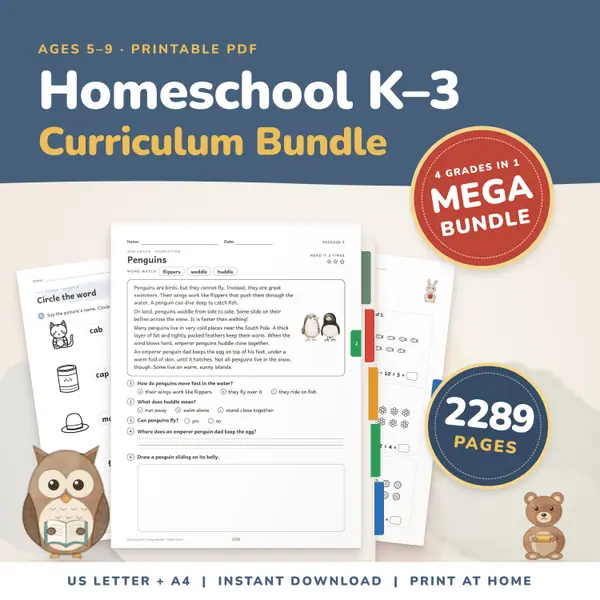
If your state does ask for hours or a log, a planner saves effort. The Homeschool Curriculum Bundle K-3 has 2,289 pages and includes a 99-page Homeschool Planner, with a student section for up to 6 children that has attendance and hours pages, a reading log and a portfolio page.
How do you know your homeschool day is too long or too short?
Your child’s behavior tells you more than any table. These signs are our suggestions, not a research-based checklist.
A day may be too long if:
- Your child stalls, cries or argues at the same point every day
- Work gets sloppier in the last half hour
- You are still teaching at 3 p.m. and everyone is worn out
A day may be too short if:
- Your child finishes before you have started to enjoy it and asks for more
- They seem bored and the work looks easy
- You feel rushed to fit things in later, because the early part left room
Change one thing at a time. Add or remove ten minutes from a single subject, then watch for a week. A short, calm day repeated for months does more than a long day that everyone dreads.
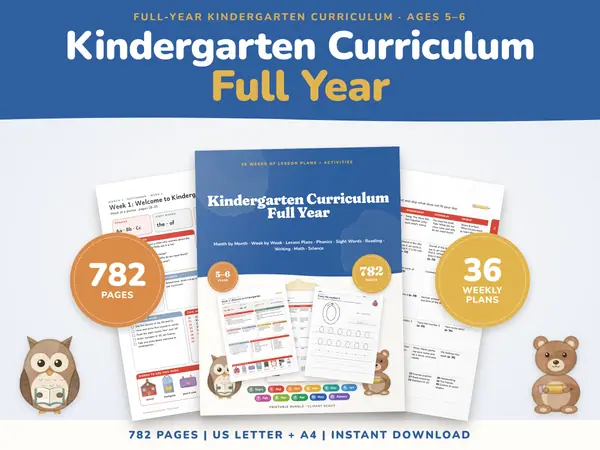
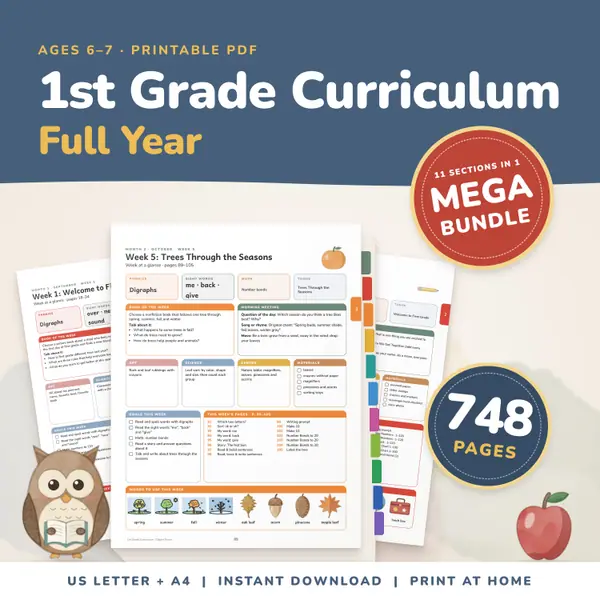
If you would rather have the year planned for you, both of the next two products include homeschool schedules in a Start Here section. The Kindergarten Curriculum Full Year has 782 pages in 11 sections, and the 1st Grade Curriculum Full Year has 748 pages. Each week has a daily lesson plan, so you can see the day’s work before you start.
What to do next
- Look up your state’s homeschool law on your state education department’s website, and note whether it sets hours or days.
- Pick your child’s grade in the table and choose a daily total inside that range as a starting point.
- Run one week, write down the real minutes, and note when your child’s focus fades.
- Adjust by ten minutes at a time. Use our how to start homeschooling checklist if you are still setting up.
- Browse full-year homeschool curricula or homeschool printables if you want lessons ready to print.
Sources
- Continuous Learning Task Force Guidance (recommended maximum student commitment each day, printed page 13), Kansas State Department of Education.
- Remote Learning Recommendations During COVID-19 Emergency, 27 March 2020 (table of suggested minimum and maximum times of engagement, page 17), Illinois State Board of Education.
- Remote Learning - ISBE Guidelines (page reproducing the Illinois table, 10 April 2020), Jefferson Elementary School, Illinois school district 170.
- Homeschool Laws By State, HSLDA (Home School Legal Defense Association), a membership advocacy organization.
- RSMo 167.012 (home school definition and hours), Missouri Revisor of Statutes.
- Public School Code, Section 1327.1 (home education program), Pennsylvania General Assembly.
- 8 NYCRR 100.10, Instruction by Parent at Home, Cornell Legal Information Institute (Regulations of the Commissioner of Education, New York).
- Home-Based Private Education, Wisconsin Department of Public Instruction.
- How to Comply With Georgia's Homeschool Law, HSLDA.
- How to Comply With Ohio's Homeschool Law, HSLDA.
- Home Schooling, Texas Education Agency.
This guide is general information for parents and teachers. It is not medical, legal or professional advice. Every guide lists its sources at the end. More about our guides is on the About page.