Homeschool Schedule by Grade: Simple Daily Examples
By the Clipart Scout team8 min read
Short answer
A homeschool schedule can be a short list of blocks: reading, math and writing first, then hands-on time and outdoor play. The examples here, which are our suggestions, use about 40 minutes of core lessons for kindergarten, 45 for grades 1 and 2, and 75 for grades 3 to 5. Those fit inside the Illinois and Kansas remote-learning reference tables, which are guidance for public schools, not law.
Key points
- Our example days are suggestions: 40 minutes of core lessons for kindergarten, 45 for grades 1 and 2, 75 for grades 3 to 5.
- The minutes sit inside the Illinois reference ranges, and mostly inside Kansas's maximums. Both tables are 2020 public-school remote-learning guidance, not law.
- A block schedule fixes the order of the day. A loop schedule rotates a list of subjects and picks up where you stopped.
- A four-day week can work, but where a state counts 180 days, four days a week takes 45 weeks. Check your state.
- When the day falls apart, keep reading and math, shrink everything else and start again tomorrow.
On this page
- What is a good homeschool schedule for kindergarten?
- What does a homeschool schedule for 1st and 2nd grade look like?
- What does a homeschool schedule for grades 3 to 5 look like?
- What types of homeschool schedule can you choose from?
- How do you teach several ages at once?
- Can you homeschool four days a week?
- Do homeschoolers need a strict schedule?
- What do you do when the schedule falls apart?
- What to do next
A good homeschool schedule is less a timetable than an order of blocks that you can repeat. This guide gives three example days with clock times: one for kindergarten, one for grades 1 and 2 and one for grades 3 to 5.
Every schedule here is our suggestion. None of it is a rule, and your family’s best day will look different. We kept the core lesson time inside the reference ranges that Illinois and Kansas published in spring 2020 for public-school remote learning. Those tables are guidance, not law, and they were not written for homeschools. Our guide on how many hours a day to homeschool explains them in full.
After the three days you will find the main schedule styles in plain words, how to teach several ages at once and what to do when the day falls apart.
What is a good homeschool schedule for kindergarten?
A good kindergarten day is a few short lessons with breaks and plenty of play. The example below has 40 minutes of core lessons. That is inside Illinois’s range of 30 to 90 minutes for kindergarten and below Kansas’s maximum of 45 minutes for grades K-1.
Illinois also suggested only 3 to 5 minutes of sustained attention at a time for kindergarten, so each block holds several tiny activities, not one long task.
| Time | What happens | Minutes |
|---|---|---|
| 9:00 | Songs, calendar and a read-aloud | 15 |
| 9:15 | Phonics: letter sounds and a few sight words | 15 |
| 9:30 | Movement break and snack | 15 |
| 9:45 | Math: counting and number games with objects | 15 |
| 10:00 | Handwriting and drawing | 10 |
| 10:10 | Outdoor time | 45 |
| 11:00 | Free play, chores and lunch | |
| 1:00 | Quiet time with picture books | 30 |
The core lessons are the phonics, math and handwriting blocks: 40 minutes. The rest is the part of kindergarten that no worksheet replaces. For what to put in each block, see how to homeschool kindergarten.
What does a homeschool schedule for 1st and 2nd grade look like?
A 1st or 2nd grade day has three core lessons of about 15 minutes each, then hands-on time. The example has 45 minutes of core lessons, which is the Illinois minimum for grades 1 and 2 and equals the Kansas maximum for grades K-1.
Illinois suggested 5 to 10 minutes of sustained attention at a time for these grades, so move on or change position when a task starts to drag.
| Time | What happens | Minutes |
|---|---|---|
| 8:30 | Read-aloud and morning talk | 15 |
| 8:45 | Reading and phonics | 15 |
| 9:00 | Break and snack | 15 |
| 9:15 | Math | 15 |
| 9:30 | Writing, handwriting and spelling | 15 |
| 9:45 | Outdoor time or free play | 45 |
| 10:30 | Hands-on project: science, history, art or cooking | 30 |
| 11:00 | Lunch and chores | |
| 1:00 | Independent reading and a library book | 30 |
Core lessons: reading, math and writing, 45 minutes. Everything else is optional enrichment. On a hard day, the three core blocks are the day.
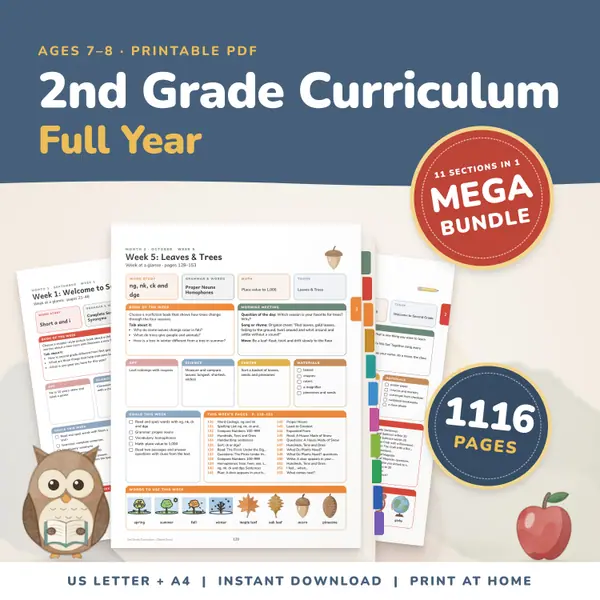
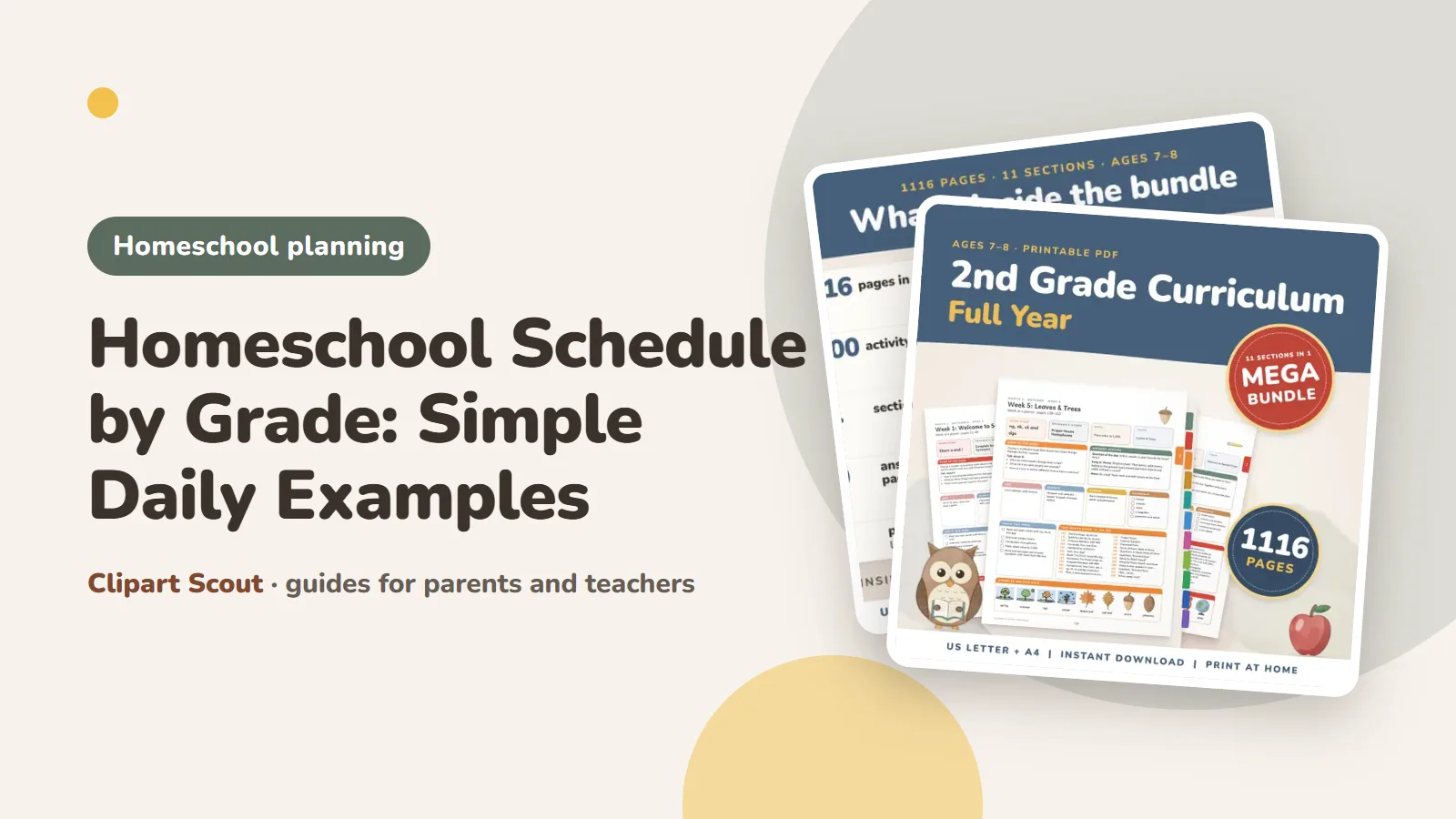
A full-year plan can take the weekly planning off you. The 2nd Grade Curriculum Full Year has 1,116 pages and a Start Here section with homeschool and classroom schedules, and each week has a daily lesson plan.
What does a homeschool schedule for grades 3 to 5 look like?
A day for grades 3 to 5 has four core lessons and about 75 minutes of focused work. The Illinois range for these grades is 60 to 120 minutes. Kansas sets a maximum of 60 for grades 2-3 and 90 for grades 4-5, so a 3rd grader may drop the science block.
Illinois suggested 10 to 15 minutes of sustained attention at a time, so most blocks below are two short tasks and not one long one.
| Time | What happens | Minutes |
|---|---|---|
| 8:30 | Read-aloud or independent reading | 20 |
| 8:50 | Math | 25 |
| 9:15 | Break and snack | 15 |
| 9:30 | Reading and comprehension questions | 20 |
| 9:50 | Writing, grammar and spelling | 15 |
| 10:05 | Outdoor time or free play | 30 |
| 10:35 | Science or social studies | 15 |
| 10:50 | Project, music or art | 40 |
| 12:00 | Lunch and chores | |
| 1:00 | Independent reading and a free choice | 45 |
Core lessons: math 25, reading 20, writing 15 and science or social studies 15, which is 75 minutes. For a 3rd grader, drop the science block on some days to stay at 60.
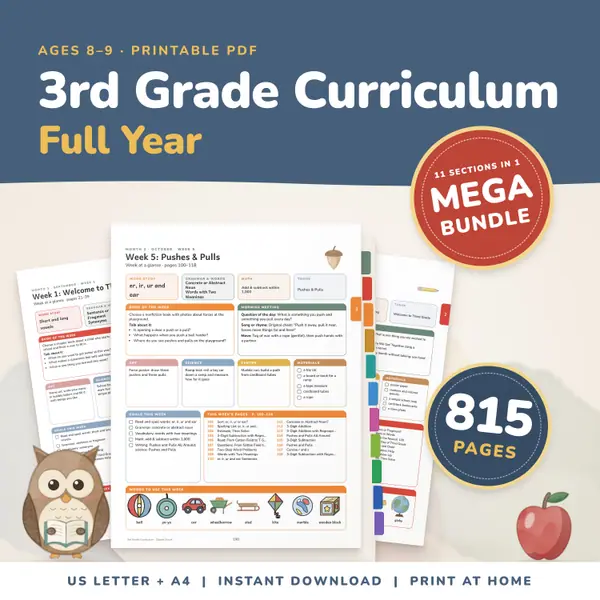
The 3rd Grade Curriculum Full Year has 815 pages, and each week has a week at a glance and a daily lesson plan, so the blocks above already have content.
What types of homeschool schedule can you choose from?
There are four common ways to organize a homeschool day, and you can mix them. These are plain descriptions of common practice, not official categories.
- Clock schedule: each block has a start time, as in the tables above. It suits families who like predictability.
- Block schedule: the day has big blocks, such as “core lessons in the morning, projects after lunch”, with no exact times. It keeps the order and drops the stopwatch.
- Loop schedule: you write a list of subjects that do not need to happen daily, such as art, music, nature study, history and a foreign language. Each day you do the next one or two on the list and pick up where you stopped. Nothing is “missed”; the loop just keeps going.
- Routine without times: a fixed order such as breakfast, reading, math, outside, lunch, with no clock at all.
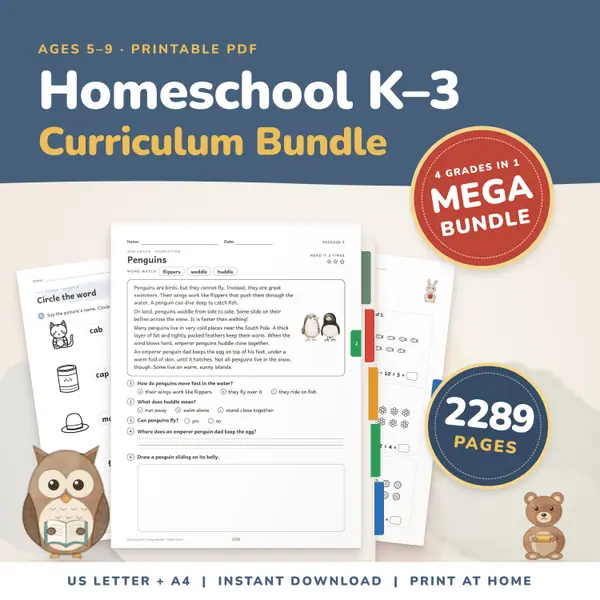
Loops are the easiest way to fit the many subjects that would never fit in a day. The Homeschool Curriculum Bundle K-3 has a Homeschool Planner with a loop schedule page, so you can print one and fill it in.
How do you teach several ages at once?
Teach together where you can and apart where you must. These are suggestions from common practice.
- Share one subject. Read-aloud, science, history, art and music can often be taught to everyone at once, with each child doing a task at their level.
- Start with the youngest or most dependent child. Give them your time first, then set them up with a quiet task and move to the next child.
- Stagger independent work. While one child writes, sit with another on math. A timer helps the child who is waiting.
- Keep one family block. A shared morning start or end gives the day a shape.
- Give each child their own grade of work. Siblings do not have to use the same level to share a day.
The Homeschool Curriculum Bundle K-3 is made for families with one or more children from kindergarten to 3rd grade, and siblings can each use their own grade from one purchase. It has 2,289 pages in 48 sections with colored edge tabs by grade, which makes it easy to find each child’s pages.
Can you homeschool four days a week?
You often can, but check how your state counts. A four-day week is a plan that gives one day for outings, appointments, co-op classes or catching up.
Some states count days. Pennsylvania’s home education program refers to 180 days, or hours as an alternative. New York asks for the substantial equivalent of 180 days. Georgia’s rule is the equivalent of 180 days, each at least four and a half hours. At four days a week, 180 days takes 45 weeks, so a four-day plan needs a longer year.
In a state that counts hours, four slightly longer days can add up. In a state with no hours or days rule, the choice is yours. This is general information, not legal advice. Your state education department can tell you what applies.
Do homeschoolers need a strict schedule?
No, not by the clock, though a steady order helps children feel safe. Many families keep the order of the day the same, such as reading and math first, and let the times move.
The exception is the law. If your state sets hours or days, you need a way to show that you met them, and a simple log does the job. A schedule is for you and your child. A record is for your state, if your state asks for one. Our how to start homeschooling checklist covers where to look.
A picture-based plan also works well for young children who cannot yet read a clock. See our guide to a visual schedule for kids.
What do you do when the schedule falls apart?
Every homeschool schedule falls apart some days. The fix is to shrink the day, not to catch up.
- Keep only the two or three core lessons, such as reading and math.
- Drop or shorten everything else. A story and a walk still count as a day.
- Do not double up tomorrow. Start from the next page.
- If the same block fails every week, move it to a different time or shorten it by ten minutes.
- Keep a “minimum day” in mind: read together, one math page, and outside time.
If the whole schedule keeps falling apart, the plan is too big for your life right now. Cut it by a third and try again.
What to do next
- Choose the example day closest to your child’s grade and copy it onto paper.
- Change the clock times to fit your family, and keep the core lessons first.
- Try it for one week and note which block fails most often.
- Move or shorten that block, and write a “minimum day” on the back of the page.
- Browse full-year homeschool curricula if you want the weekly plans done for you.
Sources
- Continuous Learning Task Force Guidance (recommended maximum student commitment each day, printed page 13), Kansas State Department of Education.
- Remote Learning Recommendations During COVID-19 Emergency, 27 March 2020 (table of suggested minimum and maximum times of engagement, page 17), Illinois State Board of Education.
- Remote Learning - ISBE Guidelines (page reproducing the Illinois table, 10 April 2020), Jefferson Elementary School, Illinois school district 170.
- Public School Code, Section 1327.1 (home education program), Pennsylvania General Assembly.
- 8 NYCRR 100.10, Instruction by Parent at Home, Cornell Legal Information Institute (Regulations of the Commissioner of Education, New York).
- How to Comply With Georgia's Homeschool Law, HSLDA (Home School Legal Defense Association), a membership advocacy organization.
This guide is general information for parents and teachers. It is not medical, legal or professional advice. Every guide lists its sources at the end. More about our guides is on the About page.