Visual Schedule for Kids: How to Make One That Works
By the Clipart Scout team7 min read
Short answer
A visual schedule shows the steps of a routine as pictures or words in order. Visual supports, which include visual schedules, are listed as an evidence-based practice for autistic children and young people in a 2020 research review (NCAEP). We found no source that tested them with children in general. The CDC says routines help children feel safe because they know what to expect.

Key points
- Visual supports, which include visual schedules, are an evidence-based practice for autistic children and young people in a 2020 research review (NCAEP) of studies from 1990 to 2017.
- We found no source that tested visual schedules with children in general, so we do not call them proven for all children.
- The CDC says routines help children feel safe because they know what to expect. Its page on routines does not mention picture schedules.
- Start with two or three steps, show the next step only, and let your child move a picture or tick a box as each step ends.
- Plan for change: keep a flexible card such as Something new so surprises have a place on the schedule.
On this page
The morning rush is the same every day: shoes missing, someone is crying, and you are repeating the same sentence for the fifth time. A visual schedule moves part of that repeating from your voice onto a card on the wall.
A visual schedule shows the steps of a routine in order, with pictures, photos or words. This guide explains what it is, what the research says and does not say, and how to make one for a toddler, a preschooler or an older child. The routines, step counts and layouts are our suggestions.
What is a visual schedule?
A visual schedule is a set of pictures or words showing what happens first, next and last. It can be a short strip for the morning, a first-then board with two cards, or a chart for the whole day.
The 2020 research review we use below describes visual supports as concrete cues that provide information about an activity, routine or expectation. It lists visual schedules, activity schedules, work systems, graphic organizers, visual cues and scripts as examples. Our focus here is on schedules at home and in a preschool.
Do visual schedules only help autistic children?
The evidence we found is about autistic children and young people, and we do not say more than that. The National Clearinghouse on Autism Evidence and Practice (NCAEP) published a 2020 report by Steinbrenner, Hume, Odom and colleagues. It synthesizes intervention research from 1990 to 2017 and names 28 evidence-based practices from 972 acceptable articles. Visual supports are one of the 28, credited with 65 articles in the full report. The report says visual supports are often combined with other practices such as prompting and reinforcement.
The Frank Porter Graham Child Development Institute also describes visual supports as an evidence-based practice on its AFIRM module page.
What we cannot say:
- We found no source that tested visual schedules with children in general, so we do not call them proven for all children.
- We could not read from the report which outcomes are supported for preschoolers, so we make no claim for a specific age.
- A visual schedule does not treat or diagnose anything, and it is no substitute for advice from your child’s doctor.
For all children, the CDC’s page on routines says children feel safe and secure because they know what to expect. It describes consistency, predictability and following through. The page gives sample daily schedules as text lists and does not mention picture schedules or charts. So the CDC supports routines, and a visual schedule is one way, ours to suggest, of showing a routine.
What types of visual schedule can you use?
Choose the smallest type that works. Here are three, with a suggestion for how many steps to show. No source gives step counts by age, so the numbers are our suggestions.
| Type | What it looks like | Steps to start with |
|---|---|---|
| First-then board | Two cards: the thing to do now, and what comes after | 2 |
| Morning or bedtime strip | A short row of cards for one routine, in order | 3 to 5 |
| Whole-day schedule | Cards for the main parts of the day, from waking to bedtime | 5 to 8 |
A first-then board is a good starting point for a toddler or any child new to schedules: “First shoes, then park.” As a routine becomes familiar, add a step at a time.
The CDC’s 30-month list includes following simple routines when told, such as helping to pick up toys at clean-up time. That makes a short, familiar routine a good place to begin.
How do you make a visual schedule at home?
Follow these steps:
- Choose one routine, such as getting ready in the morning.
- List the steps and keep to three at first.
- Make a card for each step using a photo of your own child, a drawing or a printed picture, with a word in large letters.
- Print and cut the cards. Laminate them if you want them to last.
- Fix them in order on a strip, with hook-and-loop dots so cards can move, or put them in a checklist with tick boxes.
- Put it where the routine happens: by the door for shoes, in the bathroom for teeth.
Safety: Cards, dots and laminated pieces can be small parts. Small pieces are a choking hazard for children under 3 and for any child who still puts things in the mouth. Use large cards, keep loose pieces out of reach and stay with your child. Supervise scissors closely.
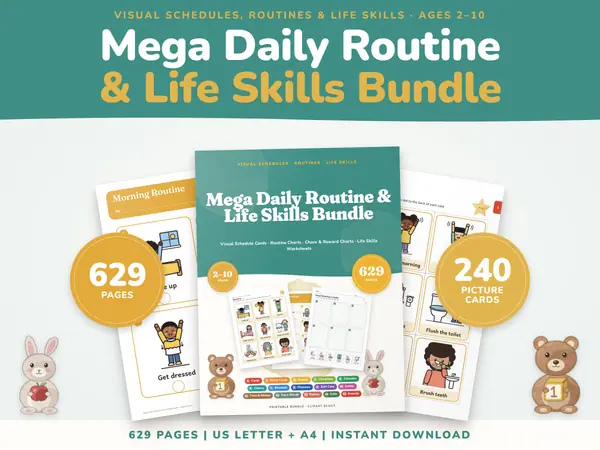
Our Visual Schedule for Kids printable has 240 picture cards in 10 categories, including morning, self-care, meals and evening and bedtime. It also has first/then and first/then/next boards, schedule strips and routine checklists at three levels, for ages 2 to 4, 4 to 7 and 7 to 10.
What does a good morning routine look like?
Here is an example morning strip for a preschooler. It is our suggestion, so change the steps to match your home.
| Order | Card | Notes |
|---|---|---|
| 1 | Get up | A wake-up song or a quiet knock |
| 2 | Get dressed | Clothes laid out the night before |
| 3 | Eat breakfast | Cards for bowl, spoon, cup |
| 4 | Brush teeth | Include a short timer or a song |
| 5 | Shoes on | Last card before leaving |
For a younger child, show only the first three. The CDC’s bedtime example is a short routine, “Brush, book, bed”, which makes a good three-card strip. A longer bedtime for an older child might add a bath and pajamas.
| Order | Bedtime card | Notes |
|---|---|---|
| 1 | Bath or wash | Same order every night |
| 2 | Pajamas | Cards for top and bottom |
| 3 | Brush teeth | Short song |
| 4 | Book | One or two books |
| 5 | Lights off | Same goodnight words |
How do you teach your child to use it?
Teach it as a game, not a rule. These steps are our suggestions:
- Show your child the schedule when you are both calm, not in the middle of a hurry.
- Point to the first card, say the step, and do it together.
- Let your child move the card to a finished pocket or tick the box.
- Point to the next card and repeat.
- Praise the doing of the step, not just the finishing.
To fade your help, start by pointing to the card, then only glance at it, then wait. Our suggestion is to wait a few seconds before you prompt, so your child has time to look at the card and decide. Keep prompts the same each time, so they are predictable.
What do you do when the day changes?
Plan for change, since days rarely run to plan. Keep a flexible card, such as Something new or Surprise, and put it on the schedule when plans change. Tell your child what is different before it happens, in a calm voice, and show the new card. The CDC suggests introducing a change when your child is calm.
If your child resists the schedule, shorten it, go back to a first-then board, or take a break and try again the next day. Our guide to preschool at home shows how a simple daily rhythm can fit into a home day, and the homeschool schedule by grade guide covers older children. A chore chart by age is a natural next step when your child can handle jobs.
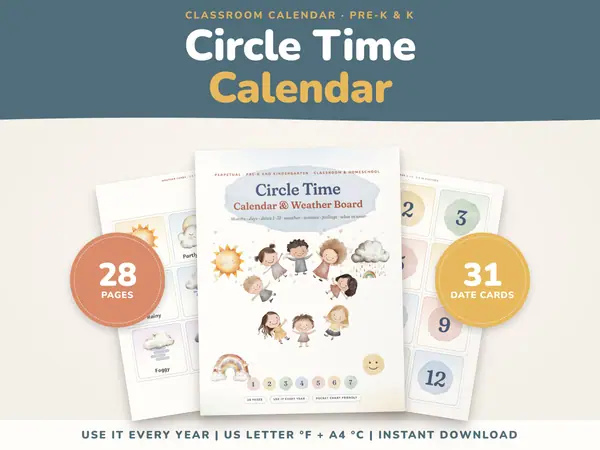
For circle time or a morning meeting, the Circle Time Calendar Printable is a 28-page set with a one-page morning board, a Yesterday, today and tomorrow board, weather cards and a daily routine in its start guide.
What to do next
- Choose one routine, such as the morning, and list its steps.
- Make cards for three steps and put them in order on a strip.
- Show your child the schedule when you are both calm, and do the first card together.
- Add a flexible Something new card for days when plans change.
- Browse our routine charts and life skills printables for ready-made cards.
Sources
- Evidence-based practices for children, youth, and young adults with Autism (2020 report), Steinbrenner, Hume, Odom and others, National Clearinghouse on Autism Evidence and Practice, UNC Chapel Hill.
- National Clearinghouse on Autism Evidence and Practice, Frank Porter Graham Child Development Institute, UNC Chapel Hill.
- Visual Supports (AFIRM module), Frank Porter Graham Child Development Institute, UNC Chapel Hill.
- Tips for Relying on Routines and Rules, Centers for Disease Control and Prevention.
- Important Milestones: Your Child By 30 Months, Centers for Disease Control and Prevention.
This guide is general information for parents and teachers. It is not medical, legal or professional advice. Every guide lists its sources at the end. More about our guides is on the About page.