Chore Chart by Age: What Kids Can Do From 2 to 12
By the Clipart Scout team8 min read
Short answer
Three child-health sources list age-appropriate chores. Ages 2 to 4 can put toys away and help set the table. Ages 5 to 7 can make the bed, clear dishes and sweep. Ages 8 to 10 can help make dinner and vacuum. Ages 11 to 12 can clean the kitchen and do laundry. The sources use different age bands, so treat ages as rough guides.
Key points
- The American Academy of Pediatrics says most preschoolers can help with simple tasks, and a chore chart helps.
- Three sources give different age bands and sometimes place a chore at different ages, so treat ages as rough guides.
- For a child new to chores, the AAP advises adding one task at a time and praising effort over perfect results.
- Picture charts let children who cannot read yet follow the list on their own.
- Our extra examples in the table are marked as our suggestions.
On this page
- What chores can kids do at each age?
- What chores should a 5-year-old do?
- What chores can a 7-year-old do?
- How do you introduce a chore chart?
- How do you make a chart for kids who cannot read yet?
- How many chores should a child have?
- Should kids get paid for chores?
- How do you keep a chore chart going?
- What to do next
You want your kids to help around the house, and you want a plan that fits their age. Ask for too little and they miss a chance to be capable. Ask for too much and the chart ends up in a drawer by Thursday.
The short answer: toddlers and preschoolers can help with simple tasks, school-age children can take on regular jobs, and by 11 or 12 many children can clean a kitchen or do laundry. This guide gives an age-by-age table from three child-health sources, with our own extra ideas in a separate column, and then covers how to introduce a chart and keep it going.
What chores can kids do at each age?
Kids can do more than most parents expect, in small steps. The table below combines lists from three sources: the American Academy of Pediatrics (AAP), the American Academy of Child and Adolescent Psychiatry (AACAP) and Children’s Hospital of Philadelphia (CHOP). Each uses different age bands, so the ages are rough guides. Our extra ideas are in the last column and are our own suggestions, not from those sources.
| Age | What the sources list | Our extra ideas (our suggestion) |
|---|---|---|
| 2 to 4 | AACAP (ages 2 to 3): put away toys and groceries, dress with help. CHOP (ages 3 to 4): tidy toys, help set the table, dust, put clothes in the hamper | Wipe up a small spill with a cloth, carry a napkin or spoon to the table |
| 4 to 6 | AACAP (ages 4 to 5): feed pets, make the bed (not perfectly), clear the table. CHOP (ages 5 to 6): make the bed, feed pets with supervision, clear their own dishes, empty trash cans | Match clean socks, water a plant with a small cup |
| 5 to 7 | AAP: make their own bed, set and clear the table, put toys away, put dirty clothes in a hamper, fill the pet’s dish, empty wastebaskets, sweep, sort laundry, water flowers, help pack school lunch. AACAP (ages 6 to 7): wipe tables and counters, put laundry away, sweep | Wipe the bathroom sink with a cloth, put shoes on the shoe rack |
| 7 to 10 | AACAP (ages 7 to 9): load and unload the dishwasher, help prepare meals, pack their own lunch. CHOP (ages 7 to 9): vacuum or sweep, wipe counters, load the dishwasher, start the washing machine, help cook simple foods, pack lunch. AAP (ages 8 to 10): all of the above, plus vacuum, help make dinner, make their own snacks, walk a pet, put away their own laundry, put away groceries | Fold towels, take out the recycling |
| 10 to 12 | AACAP (ages 10 to 11): change sheets, clean the kitchen or bathrooms, do yard work. CHOP (ages 10 to 12): simple yard work, mow with supervision, prepare a simple meal, clean bathrooms, fold laundry, wash windows. AAP (ages 11 to 12): clean the kitchen, change bedsheets, unload the dishwasher, do and fold laundry, clean the bathroom, wash the car, cook a simple meal with supervision, watch younger siblings with an adult at home | Plan and cook one family meal a week with help |
The sources do not agree on every chore. Loading the dishwasher is listed at ages 7 to 9 by AACAP and CHOP, while the AAP lists unloading it at ages 11 to 12. Read the table as a menu, not a schedule.
What chores should a 5-year-old do?
A 5-year-old can make the bed, clear their dishes, put toys away and help feed a pet. The sources agree on several of these: AACAP lists feeding pets, making the bed (not perfectly) and clearing the table for ages 4 to 5. CHOP lists making the bed, feeding pets with supervision, clearing their own dishes and emptying trash cans for ages 5 to 6.
For a chore chart at age 5, pick two or three jobs and keep them the same each day. A good starter set is: put dirty clothes in the hamper, put toys away and help clear the table. The AAP says to praise effort over perfect results, so a crooked bed is a success.
What chores can a 7-year-old do?
A 7-year-old can sweep, wipe counters, put laundry away and begin to help in the kitchen. AACAP lists wiping tables and counters, putting laundry away and sweeping at ages 6 to 7, and loading and unloading the dishwasher, helping prepare meals and packing their own lunch at ages 7 to 9. CHOP lists vacuuming or sweeping, wiping counters, loading the dishwasher, starting the washing machine and helping cook simple foods for ages 7 to 9.
For a 7-year-old chart, three to four jobs is a reasonable start. Add an item only when the earlier ones are happening on their own.
How do you introduce a chore chart?
Introduce a chart by starting small and showing the job before you ask for it. The AAP advises that a school-age child new to chores add one task at a time, and that a chore chart helps. This is the order we suggest:
- Pick one job that your child can do almost alone.
- Show it once, doing it alongside them, then let them try.
- Put it on the chart with a space to tick or a sticker.
- Check it together at the same time each day, and say what went well.
- Add a second job only after a week or two of the first going smoothly.
Tip: Praise effort and the specific thing: “You lined the shoes up so neatly” works better than “good job”. The AAP advises praising effort over perfect results.
If your day has a lot of steps, our guide to a visual schedule for kids shows how to lay out a whole routine with pictures.
How do you make a chart for kids who cannot read yet?
Use pictures. A child who cannot read can still follow a row of small pictures: a toy box, a hamper, a plate. Put the pictures in the order the jobs happen and give each a box to tick.
Keep the words short and match each picture to a real action. For toddlers, one or two pictures are plenty, and an adult does the ticking.
For picture cards, the Visual Schedule for Kids bundle has 629 pages and includes 240 picture cards in 10 categories, one of which is chores. Its Chores and Responsibilities section has 24 pages: jobs I can do by age (2 to 3, 4 to 5, 6 to 8 and 9 to 10), weekly and daily chore charts, family chore charts and a chore wheel.
How many chores should a child have?
A child should have as many chores as they can do without a daily struggle, and no source gives a number. Start with one or two, and let the list grow slowly. The AAP’s advice to add one task at a time is a good rule.
AACAP lists benefits that it associates with chores, such as responsibility, self-esteem and time-management skills. That is AACAP’s own statement, not a measured result, and we do not promise any of them from a chart.
If a chart is not working, cut the list in half before you change anything else. A short list that gets done teaches more than a long one that is ignored.
Should kids get paid for chores?
Families disagree on paying for chores, and both choices have reasons behind them. We found no source to settle it, so we give both views and no amounts.
- Not paying: Chores are a normal part of being in a family, like eating meals together. Nobody is paid for making their own bed.
- Paying for extra jobs: Everyday chores are expected, and extra jobs, such as washing the car, earn money. This can be a way to practice earning and saving.
Some families mix the two. Whatever you choose, say the rule clearly and keep it steady. If you want a way to track money, the Visual Schedule for Kids bundle includes an earnings tracker and a saving goal page in its chores section.
How do you keep a chore chart going?
Keep it going by keeping it small, visible and a little bit boring. A chart that sits in a drawer does nothing. Hang it where the jobs happen.
- Look at it together at the same time each day.
- Change the jobs now and then so that they stay fitted to the child’s age.
- Use a chore wheel or rotation if several children share the work.
- Skip a day without fuss when life gets busy, and start again the next day.
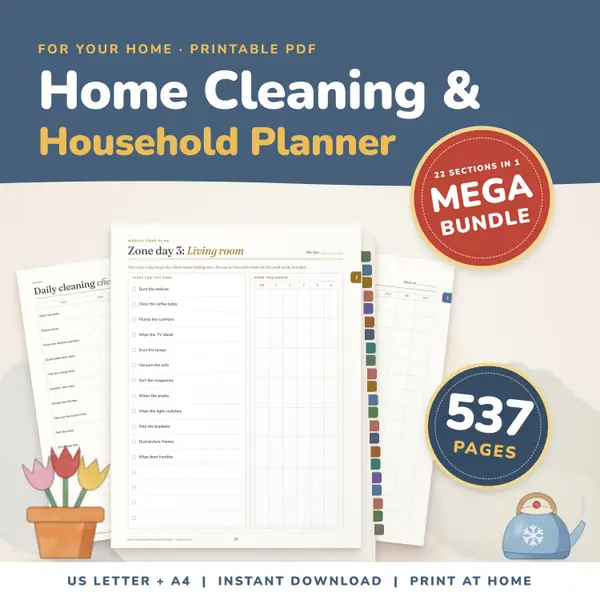
For a whole-family system, the Home Cleaning and Household Planner Mega Bundle has 537 pages. Its Chores and Kids section has 27 pages: chore ideas by age (2 to 4, 5 to 7, 8 to 11 and 12 and up), personal and family chore charts, reward charts, chore rotations and 50 cut-out chore cards.
For more charts and routines, browse our routine charts and life skills and our printable planners and trackers. If your family also learns at home, our homeschool schedule by grade shows where chores can fit in the day.
What to do next
- Find your child’s age in the table and pick one or two jobs from it.
- Show each job once, side by side, before putting it on the chart.
- Choose a chart with pictures if your child cannot read yet, and hang it where the job happens.
- Check it together at the same time each day for two weeks, then add one job.
- Decide your family’s rule on paying for chores, and tell your children what it is.
Sources
- Age-Appropriate Chores for Children (last updated 9 February 2024), American Academy of Pediatrics, HealthyChildren.org.
- Chores and Children, Facts for Families No. 125 (updated June 2018), American Academy of Child and Adolescent Psychiatry.
- Chores and Kids: How Much Should You Expect? (18 May 2015), Children's Hospital of Philadelphia.
This guide is general information for parents and teachers. It is not medical, legal or professional advice. Every guide lists its sources at the end. More about our guides is on the About page.