How to Improve Your Handwriting as an Adult
By the Clipart Scout team7 min read
Short answer
Many people find their handwriting gets neater with focused practice, but we found no solid research on adults, so treat this as practical advice, not proven fact. Start by finding what is actually wrong: size, slant, spacing, letter shapes or speed. Then fix one thing at a time with 10 to 15 minutes of slow, daily practice.
Key points
- There is good evidence that handwriting improves with instruction in school-age children. We found no solid research on adults, so this advice is practical, not proven.
- Find the real problem first: size, slant, spacing, letter shapes or speed. Each has a different fix.
- Slow, relaxed practice builds shape and control. Speed comes after.
- A 30-day plan is a way to organize 10 to 15 minutes a day. It is not a promise of a result.
- Choose one style, print or cursive, and practice that. Do not mix several at once.
On this page
- Can adults improve their handwriting?
- What is actually wrong with your handwriting?
- What pen and paper should you use?
- How should you hold the pen and sit?
- Which warm-up drills help?
- Should you practice print or cursive?
- What does a 30-day handwriting plan look like?
- How do you keep it going?
- What to do next
If your handwriting has slipped over the years, you are in good company. Most adults type far more than they write, and the pen gets used for a shopping list, a card or a signature. When you do want to write something by hand and have it look decent, it can feel like a skill you have lost.
The short answer: many people can make their writing neater, and the method is simple. Find what is actually wrong, choose one style, and practice slowly for 10 to 15 minutes a day. A 30-day plan is below.
One honest note first. There is good evidence that handwriting improves with instruction and practice in school-age children. We found no solid research on adults, so treat every tip here as common sense, not proven fact. Teens can follow the same plan.
Can adults improve their handwriting?
Many adults find their handwriting looks better after regular practice, but we cannot back that with research. A 2016 meta-analysis of K-12 intervention studies by Santangelo and Graham found that teaching handwriting improved legibility and fluency in students. It covers school-age children only, so it tells us nothing certain about adults.
The only adult study we found was small and narrow. In a 2025 trial, 36 healthy university students practiced tracing with their non-dominant hand for 15 minutes a day over five days. Practice alone did not differ significantly from no practice. That study does not answer whether ordinary adults can improve their usual writing, and we do not stretch it to do so.
What we can offer is practical advice that many people find useful. Use it as a plan to try, and judge by your own before-and-after samples.
What is actually wrong with your handwriting?
Start with a self-test, because untidy writing has several different causes and each needs a different fix. Write the same sentence you will use throughout, such as “The quick brown fox jumps over the lazy dog”, on a ruled page in your normal pen and at your normal speed. Date it and keep it.
Then look at it against this table. Pick the one or two rows that describe your page best.
| What you see | Likely cause | Where to focus |
|---|---|---|
| Letters vary in size from word to word | No steady sense of the line | Size drills on ruled or four-line paper |
| Lines lean in different directions | Paper angle or wrist position changes | Slant drills, and fix the paper angle |
| Words run together or gaps vary | No fixed space between words | Word-spacing drills: leave a space about the width of an “o” |
| Letters are hard to tell apart (a and o, n and u) | Unclear letter shapes | Slow practice of the confusing letters, one pair at a time |
| Writing drifts above or below the line | Poor alignment | Practice on guide lines, and write more slowly |
| It looks fine slowly but falls apart when rushed | Speed is ahead of control | Slow practice first, then short timed lines |
Next, time yourself. Write the sentence over and over for one minute and count the words. That count is your speed baseline. Do not try to push it up in the first two weeks.
What pen and paper should you use?
Use a pen that glides without pressing and paper with clear lines. These choices change how relaxed your hand feels, and a relaxed hand writes more steadily.
- Pen: A smooth gel pen or a ballpoint that flows without pressure suits most people. Very thin or scratchy pens make people press hard.
- Barrel: A slightly thicker barrel is often more comfortable than a thin one, especially if your hand cramps.
- Paper: Start with college-ruled or wide-ruled lines so that size and alignment are easy to see. Move to dot grid or plain paper later.
- Left-handed writers: Tilt the paper the other way, keep your hand below the line and try a quick-drying ink so you do not smudge.
How should you hold the pen and sit?
Sit with your back supported and the paper where you can see it, and hold the pen lightly. Pressing hard is a common cause of tired hands and cramped letters, so check your grip before you start.
- Rest the pen between your thumb and first two fingers, with a loose grip. If your fingertips turn white, loosen it.
- Keep your forearm on the table and let your whole arm move a little, not only your fingers.
- Tilt the paper so the line you are writing on slopes slightly upward as you write: for right-handers, tilt the top of the page a little left. For left-handers, tilt it a little right.
- Take a breath, shake out your hand and begin each session slowly.
Tip: If your hand aches after five minutes, stop. A shorter session with a relaxed grip beats a longer one with a tight one.
Which warm-up drills help?
Warm-up drills loosen the hand and train the shapes inside letters. Spend two to three minutes on them at the start of each session. Draw each pattern slowly across a full line, keeping the height even.
- Loops, both tall and low
- Waves and zigzags
- Ovals, running from left to right
- Arches and cups
- Push and pull lines that slant the same way
After the warm-up, write a line of letters, then words, then your chosen sentence. Keep the same focus all the way through: a drill about slant is not the time to worry about size.
Should you practice print or cursive?
Choose the style you will use and stick with it for the month. We found no research that says one is better for adults. Neat print is often easier to read and to learn, and cursive can feel faster once the joins are smooth. Mixing several styles in one month usually just muddies each of them.
If you want to try cursive, start with small, simple joins. Our guide to teaching cursive is written for children, but the order of steps works for any beginner.
What does a 30-day handwriting plan look like?
A 30-day plan gives each week one focus and a short, regular session of 10 to 15 minutes. It is a plan for you to follow, not a promise of a result. Everyone starts from a different place, and you judge success by comparing your last page with your first.
| Days | Focus | A typical 10 to 15 minute session |
|---|---|---|
| 1 | Baseline | Write the test sentence and time one minute of writing. Note your weakest row from the table |
| 2 to 7 | Shape and size | Warm-up drills, then one line of each confusing letter, then the test sentence slowly |
| 8 to 14 | Slant and alignment | Warm-up, slant lines, then words and a short sentence on guide lines |
| 15 to 21 | Spacing | Warm-up, then words with even gaps, then a short paragraph |
| 22 to 28 | Putting it together | Warm-up, then copy a short paragraph or a real note carefully |
| 29 | Speed check | Repeat the one-minute test, but only after writing carefully first |
| 30 | Compare | Put the day-1 page beside today’s. Note what changed and what to keep working on |
Missing a day is fine. Pick up where you left off.
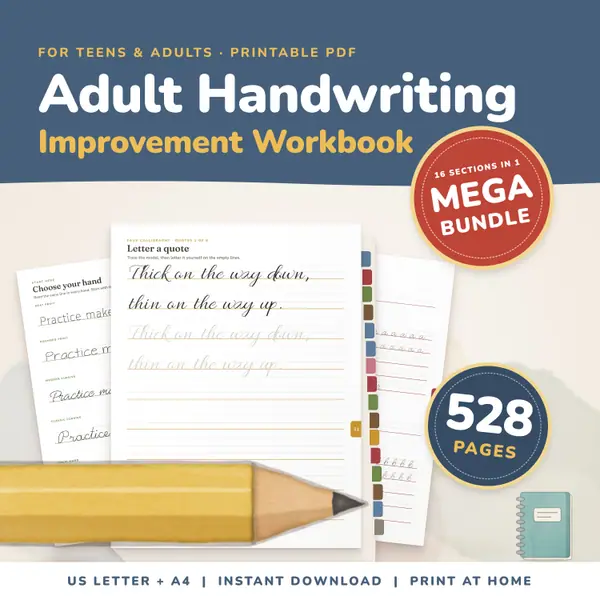
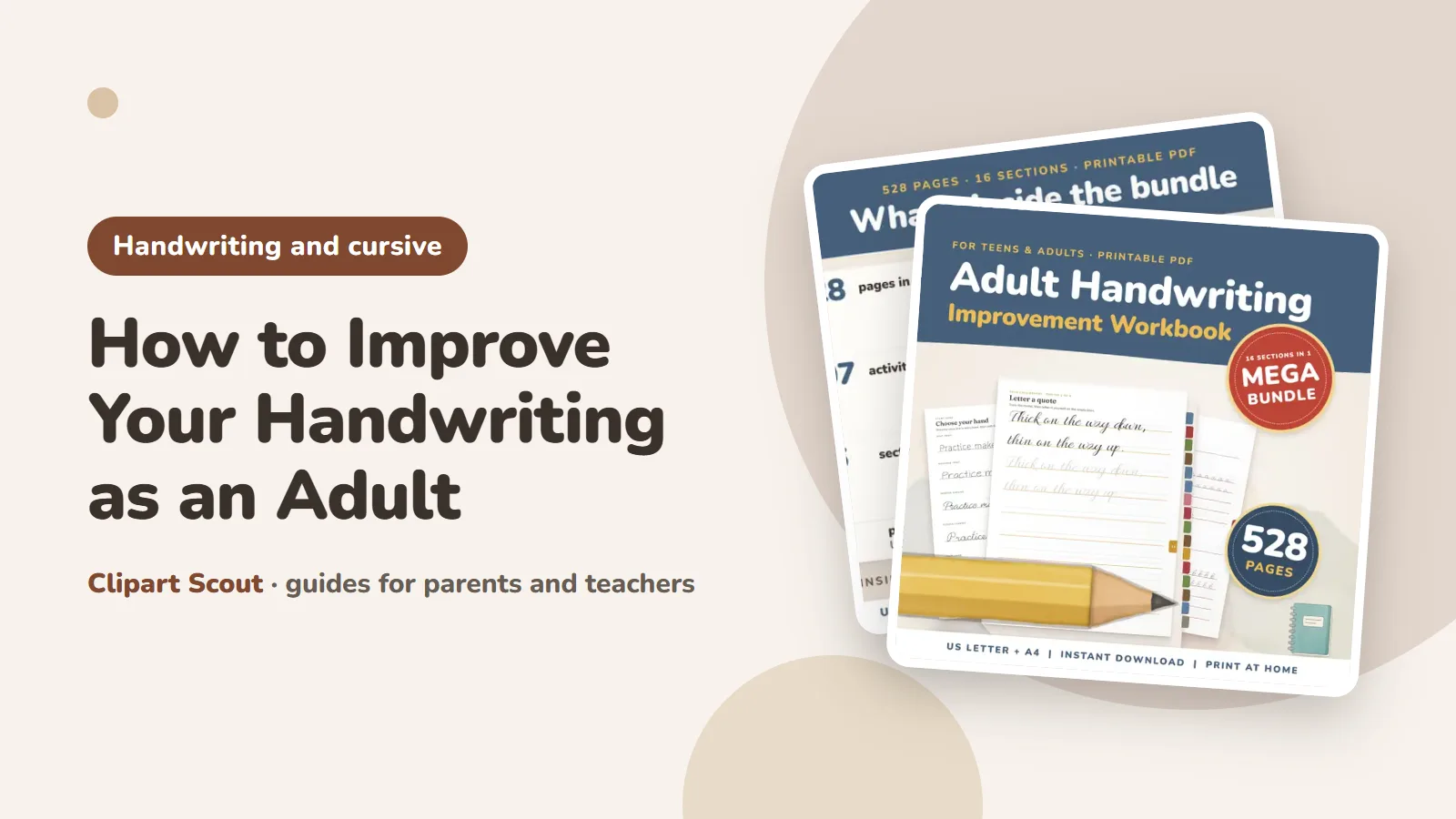
If you would like these pages ready to print, our Adult Handwriting Practice Workbook has 528 pages and includes a 30-day improvement plan of 32 pages. Each daily page has a warm-up, a drill, a line for today and free writing, and there is a progress log. It also has a 12-page handwriting guide and a Self-Check section of 6 pages that covers size, slant, spacing, alignment, letter shapes, legibility and speed.
The workbook offers five hands to choose from: neat print, rounded print, modern cursive, classic cursive and italic, plus a faux calligraphy section. You can browse more in our handwriting and cursive practice pages and our printables for adults.
How do you keep it going?
Tie the session to something you already do, and give it a clear end. Ten minutes after morning coffee, or while the evening news is on, is easier to keep than a vague plan to practice sometime.
Copy things you enjoy. A line from a poem, a recipe or a real letter is more interesting than the same drill every day. Our guide to copywork explains the method, which works for adults as well as children.
Keep every dated sample in a folder. The pile becomes proof that your writing is changing, and it shows you when you can move on to the next problem.
What to do next
- Write the test sentence today, date it and time one minute of writing.
- Mark your weakest row in the table and pick one style, print or cursive.
- Choose a pen and paper that feel comfortable, and check your grip and seat.
- Block 10 to 15 minutes at the same time each day for the next 30 days.
- On day 30, compare your first page with your last, and decide what to work on next.
Sources
- A Comprehensive Meta-Analysis of Handwriting Instruction, Santangelo and Graham, Educational Psychology Review (2016), ERIC record EJ1100680.
- Small exploratory trial of non-dominant-hand tracing practice in 36 university students, Sato et al., Cureus 17(9) (2025).
This guide is general information for parents and teachers. It is not medical, legal or professional advice. Every guide lists its sources at the end. More about our guides is on the About page.