Multiplication Worksheets Bundle
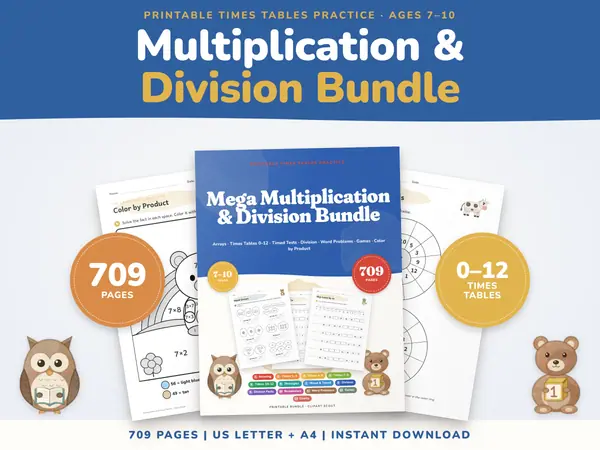
709 pagesUS Letter + A43rd grade & 4th gradeEnglish
See price and buy on EtsyShort answer
The 1 times table is 1, 2, 3, 4, 5, 6, 7, 8, 9, 10, 11, 12. Each answer is 1 more than the one before it, so you can also find the table by skip counting by 1. 1 × 6 = 6 and 1 × 12 = 12. Multiplying by 1 means one group of the number, so the answer is the number itself.
| Multiplication | Answer | Division fact |
|---|---|---|
| 1 × 1 | 1 | 1 ÷ 1 = 1 |
| 1 × 2 | 2 | 2 ÷ 1 = 2 |
| 1 × 3 | 3 | 3 ÷ 1 = 3 |
| 1 × 4 | 4 | 4 ÷ 1 = 4 |
| 1 × 5 | 5 | 5 ÷ 1 = 5 |
| 1 × 6 | 6 | 6 ÷ 1 = 6 |
| 1 × 7 | 7 | 7 ÷ 1 = 7 |
| 1 × 8 | 8 | 8 ÷ 1 = 8 |
| 1 × 9 | 9 | 9 ÷ 1 = 9 |
| 1 × 10 | 10 | 10 ÷ 1 = 10 |
| 1 × 11 | 11 | 11 ÷ 1 = 11 |
| 1 × 12 | 12 | 12 ÷ 1 = 12 |
Start at 1 and add 1 each time. Saying the numbers out loud, forwards and then backwards, is a quick way to learn the table.
1 × 6 = 6 and 1 × 12 = 12. Multiplying by 1 means one group of the number, so the answer is the number itself.
6 × 1 and 1 × 6 are both 6. The order of the two numbers never changes the answer in multiplication.
Use counters: 1 × 4 is one group of four, 4 × 1 is four groups of one. Both make 4.
For the order to teach the tables in and how to practice them, read How to Teach Multiplication Facts: An Order That Works.
Choose the right answer. Ten questions each round.
709 pagesUS Letter + A43rd grade & 4th gradeEnglish
See price and buy on Etsy2,289 pagesUS Letter + A4Kindergarten to 3rd gradeEnglish
See price and buy on Etsy1,390 pagesUS Letter + A43rd grade & 4th gradeEnglish
See price and buy on EtsyThe 1 times table is the list of answers you get when you multiply 1 by 1, 2, 3 and so on. Up to 12 it is 1, 2, 3, 4, 5, 6, 7, 8, 9, 10, 11, 12.
1 × 12 = 12. Some schools teach each table up to 10 and others up to 12, so it is worth learning both 1 × 11 = 11 and 1 × 12 = 12.
Start at 1 and add 1 each time: 1, 2, 3, 4, 5, 6, 7, 8, 9, 10. Skip counting by 1 gives the same numbers as the 1 times table.
Children usually need the most practice with the facts that have larger numbers, such as 1 × 7 = 7, 1 × 8 = 8, 1 × 1 = 1. Practice a few at a time, mixed with facts the child already knows.
Every multiplication fact gives two division facts. Because 1 × 6 = 6, you also know 6 ÷ 1 = 6 and 6 ÷ 6 = 1.
Teachers and parents are welcome to link to this page. Copy the address or the ready-made link.