Escape Room for Kids at Home: How to Set One Up
By the Clipart Scout team6 min read
Short answer
To make a kids' escape room at home, pick a prize and a story, then work backwards: write four to six puzzles in a chain, where each answer tells players where to find the next. Use ciphers, jigsaw messages, hidden objects, mirror writing, a map and a number lock. Never lock a door, and keep hints ready.
Key points
- Plan backwards: choose the final prize first, then build a chain of four to six puzzles that lead to it.
- Six simple puzzle types are explained with a worked example of each.
- Younger children need fewer puzzles and more help; ages 11 and up can handle six.
- At a party, run teams of three to five and give every team the same hint allowance.
- Never lock a real door. Use a paper story, a box with a combination lock or a host who checks the answers.
On this page
A homemade escape room is mostly paper, a few hiding places and a good story. It costs very little, takes an evening to set up and gives children a reason to read clues and think as a team.
The method here is simple: choose the prize, then work backwards to the start. You will find six puzzle types with an example of each, a table of timings by age, advice for a birthday party and a complete room you can copy tonight.
How do you make an escape room for kids at home?
Start with the ending and plan backwards: pick the prize, write the last puzzle, then build each step before it until you reach the opening. A chain of four to six puzzles in one room is enough.
Follow these steps:
- Pick a story. “The pirate has hidden his treasure” or “the detective has lost the case file” is plenty.
- Choose the prize. A box of small treats, stickers or a certificate. Check for food allergies.
- Write the final puzzle. It should open the prize box.
- Work backwards. Each puzzle’s answer must tell players where the next clue is hidden.
- Hide and number. Put a small number on the back of each clue so you can reset the room.
- Test the chain. Walk through it yourself, ideally with another adult.
Safety: Never lock a door, a closet or a room, and never block an exit. Use a combination lock on a small box, or no lock at all and let the host confirm the final answer.
What puzzles can you use?
Six types of puzzle work well at home because each can be made with paper and a pen. Mix three or four types so the room does not feel repetitive.
1. Cipher
Shift every letter one place forward in the alphabet and write the message. “LOOK UNDER THE RUG” becomes MPPL VOEFS UIF SVH. Give players a strip of paper with the alphabet written twice, and a hint that the shift is one. Children aged 8 and up enjoy it; younger ones can use a picture code where each symbol stands for a letter.
2. Jigsaw message
Write the clue in large letters on a postcard or a sheet of card, then cut it into six irregular pieces. Hide the pieces in different spots or tape them under chairs. Players must find all six and assemble them to read the clue.
3. Hidden object
Hide small items in plain sight, each with a letter on the underside. For example, three paper stars on a lamp, a plant pot and a window frame, each with one letter: M, A, P. Players find all the stars and put the letters in order to spell the answer.
4. Mirror writing
Write a message backwards, with each letter reversed, on a sheet of paper. Place a small mirror next to it. Players hold the mirror beside the writing to read it. Practice on a spare sheet; it is harder to write than to read.
5. Map
Draw a simple map of the room as a grid, with columns A to D and rows 1 to 3. Mark an X in one square, say B3, and place the next clue in the matching spot in the room. Label each corner of the room so players can find the match.
6. Number lock from a maths clue
Write a three-digit code as three small sums: “3 × 2, 20 − 13, 5 + 4.” The code is 6, 7, 9, or 679. Put the sums on a card and set the code on a small combination lock fastened to a box. For younger children, use addition only and let a grown-up check the answer by hand.
How many puzzles and how much time by age?
Younger children need fewer puzzles and more help; older children can handle longer chains. This table is our suggestion, not a rule, so adjust it to your group.
| Age | Puzzles | Time | Who helps |
|---|---|---|---|
| 5–6 | 3 | 20–25 minutes | A grown-up reads the clues aloud |
| 7–8 | 4 | 25–30 minutes | A grown-up gives hints on request |
| 9–10 | 5 | 30–40 minutes | Hints on cards, host watches |
| 11–13 | 6 | 40–50 minutes | Harder ciphers, host stays near |
A shorter room is better than a long one that tires children. If a team solves it early, a bonus puzzle can fill the time.
How do you run an escape room for a birthday party?
Run it in teams of three to five children so everyone has something to do, give each team the same clues and set a timer for the whole room. Teams can race, or all work towards the same prize.
For a party:
- Teams. Three to five children each. Mix ages and reading levels, and give each team a captain who reads clues aloud.
- Same room, different order. Make two copies of the chain with the clue spots in a different order, so teams do not follow each other.
- Hints. Print five hint cards per team and tell children they can use them whenever they like. A hint can be a single word that points to the answer.
- Time. Allow 30 to 40 minutes for ages 8 to 10, then plan a snack and cake after.
- Prizes. Give every team something, so nobody leaves with nothing.
Tip: Keep a “reset” bag with spare clue pieces, a pen and tape. You will lose a jigsaw piece at least once.
What does a full example room look like?
This example room, “The Pirate’s Treasure,” has six puzzles and takes about 40 minutes for ages 9 and 10. Copy it, change the names and fill it with your own hiding places.
Story: A pirate hid a treasure box in the house and left six clues. The children must find it before the timer ends.
| Step | Puzzle | Where it is | Answer leads to |
|---|---|---|---|
| 1 | Cipher: MPPL VOEFS UIF SVH | Opening letter on the table | Look under the rug |
| 2 | Jigsaw message, six pieces | Taped under the rug | “The third book on the shelf” |
| 3 | Mirror writing | Inside the third book | “Find the three stars” |
| 4 | Hidden object: three stars with the letters M, A, P | Lamp, plant pot, window | The word MAP, so look at the map |
| 5 | Map with an X on B3 | On the wall | The spot in the room that matches B3 |
| 6 | Number lock: 3 × 2, 20 − 13, 5 + 4 | On a card at the spot, with a locked treasure box | Code 679 opens the box |
Set it up in this order: place the box and the sums card first, then the map, stars, book, rug and letter. Walk it backwards to check that each answer really leads to the next clue.
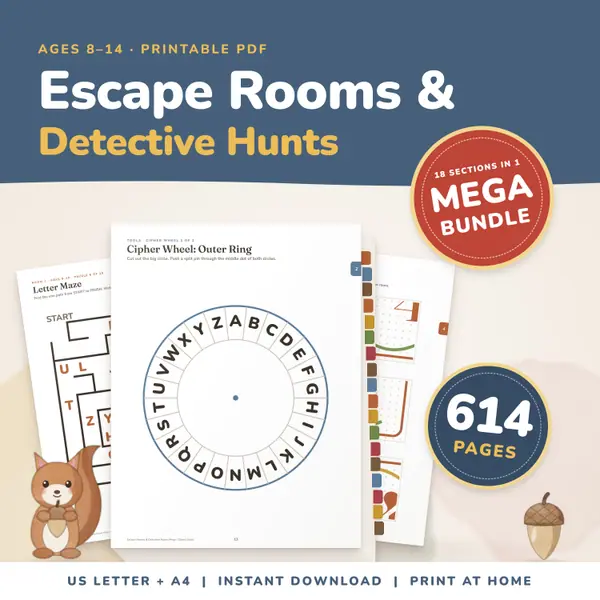
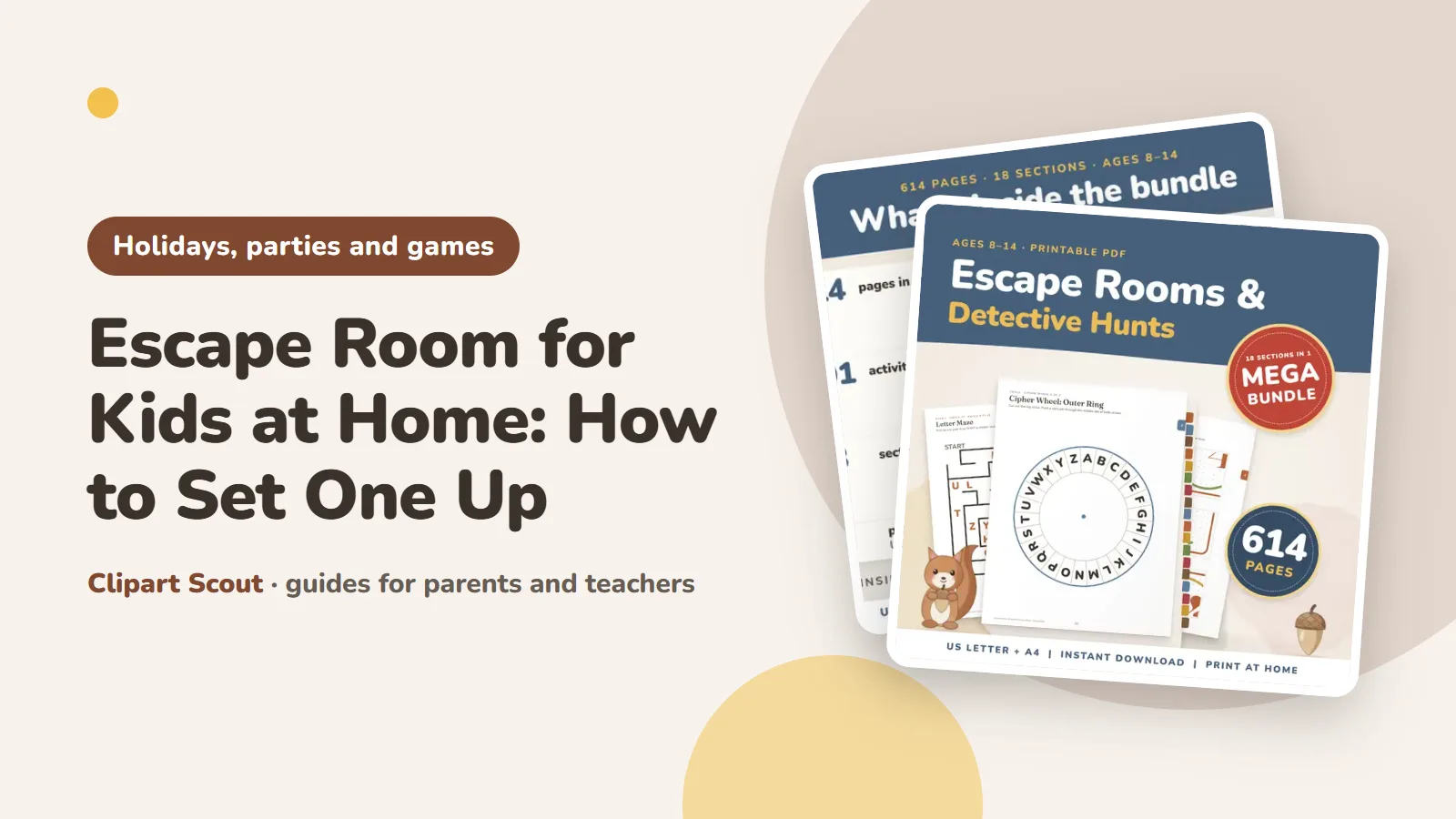
If you want ready-made rooms, the Printable Escape Room for Kids Bundle has 614 pages for ages 8 to 14. It has 24 complete rooms with a story, host setup and reset guide, lock sheet, 10 puzzles and a final vault in each. There are also detective tools, a notebook and 10 code-clue scavenger hunts.
For a holiday version, see our guides to Christmas party games for families and Thanksgiving games for family, which both have ideas for a hunt.
What to do next
- Choose a story and prize for the age of your group, and write the answer to the last puzzle first.
- Pick four to six puzzle types from the list and make a chain on one sheet of paper.
- Write or print the clues, number them and hide them, then test the chain.
- Prepare hint cards and decide how you will keep time.
- Look at our printable party games if you would rather print a finished room.