
Christmas Classroom Games: No-Prep Ideas for Ages 4 to 10
By the Clipart Scout team8 min read
Short answer
The best Christmas classroom games need no preparation, no shopping and no elimination. Use whole-class games such as Snowman Says and Pass the Mitten, quiet seat games such as Memory Tray and Mystery Bag, and small-group games for the last stretch. For a class of 20 to 30 and a 45-minute slot, three or four games plus one calm activity is enough.
Key points
- Choose games where every child plays at once, so nobody waits ten minutes for a turn.
- Mix loud and quiet: one active game, one seat game, one station round and one calm finish.
- Most games here need only paper, a pencil or things already in the room.
- Skip elimination. Give every child a job or a point, and keep prizes small or non-food.
- A noise signal, such as a raised hand or a chime, saves your voice.
On this page
- What are the best no-prep Christmas games for a whole class?
- What quiet Christmas games work when the class is wound up?
- What games work for small groups?
- Which games suit ages 4 to 6 and which suit ages 7 to 10?
- How do you run a 45-minute Christmas class party?
- How do you keep a class party calm and fair?
- Where can you find printable classroom games?
- What to do next
A class of 25, a room with desks and about 40 minutes: this is not the same job as a Christmas party at home. You cannot hand out cards to 25 children in a hurry, nobody can leave the room to calm down and the noise has to stay below the level the next classroom can bear.
This guide has sixteen games for ages 4 to 10, sorted by what the class needs: whole-class games with no preparation, quiet games for the seats, and small-group stations. It ends with a 45-minute run sheet and notes on keeping the room calm. For a family or a large group at home, see our guide to Christmas party games for families.
What are the best no-prep Christmas games for a whole class?
The best no-prep games let every child play at once and need only what is already in the room. These five take less than a minute to explain.
1. Snowman Says. Ages 4 to 8, whole class. Play it like a follow-the-leader game: “Snowman says wobble your arms,” “Snowman says touch your toes.” Children move only when you say “Snowman says.” Nobody is out. A child who moves by mistake simply sits for one round and rejoins.
2. Melting Snowmen. Ages 4 to 7, whole class. Children stand tall and still as snowmen. You call “sun” and they melt slowly to the floor, then “snow” and they grow back up. Speed up and slow down. It takes three minutes and burns energy without noise.
3. Pass the Mitten. Ages 5 to 10, circle or rows. Children pass a mitten while you sing, hum or tap a rhythm. When you stop, the child holding it answers a question: name a winter word, a Christmas food, or something that starts with S. If a child does not want to answer, they can pass.
4. Silent line-up. Ages 6 to 10, whole class. Children line up in order of birthday month, without speaking. They can use fingers and gestures. Then check by going down the line. Do it again by height, by the number of letters in their first name or by shoe size.
5. Draw on the back. Ages 6 to 10, pairs or rows. One child traces a simple Christmas picture with a finger on their partner’s back: a tree, a star, a gift. The partner guesses, then draws what they felt on paper. Swap and compare.
What quiet Christmas games work when the class is wound up?
Quiet games hold the class in their seats and give you a way to settle the group after a loud one. They need almost no space and little preparation.
6. Memory Tray. Ages 5 to 10, whole class or groups. Put ten small items on a tray: a bell, a pine cone, a ribbon, a mitten, a candle shape in paper, a paper star. Let children study the tray for 30 seconds, then cover it. They write or draw as many items as they remember. Uncover and count.
7. Mystery Bag. Ages 4 to 8, small turns. Put one object in a cloth bag, such as a bell or a pine cone. A child feels it without looking and describes it: “It is smooth, it is round, it has a hole.” The class guesses. Use soft items and nothing sharp.
8. Who Am I? Ages 6 to 10, whole class. Write a Christmas or winter word on a sticky note and put it on each child’s back: sleigh, snowman, stocking, candle. Children walk around and ask others yes-or-no questions to guess the word. Sit down when you have guessed.
9. Build-your-own bingo. Ages 5 to 10, seats. Write 20 winter words on the board. Each child draws a 3 by 3 grid and fills it with any nine of the words. You call the words in random order from a list, and children cross them off. The first full line calls “bingo.” Each child makes a different card, so no printing is needed. For a no-reading class, use pictures drawn on the board instead of words. Our bingo card maker is another way to make cards if you would rather not draw grids.
What games work for small groups?
Small-group games split a class of 25 into groups of five or six, so more children are active and fewer are waiting. Give each group its own set of materials, play for about eight minutes and change the game at a chime.
10. Tallest tree. Ages 6 to 10, groups of 5. Give each group ten sheets of scrap paper and a roll of tape. They build a tree that stands on its own, and the tallest wins. Cut the time to five minutes for a challenge.
11. Paper chain race. Ages 5 to 8, groups of 5. Give each group a pile of paper strips and a glue stick or tape. The longest chain after five minutes wins. Cut the strips yourself for younger children, because scissors take longer than you expect with a big class.
12. Snowball target. Ages 4 to 10, groups of 5. Scrunch scrap paper into balls. Mark a line on the floor and place a basket at a distance. Each child throws five snowballs, and the group counts the total. Move the basket back for older children.
13. Word from a word. Ages 7 to 10, groups of 5. Write a long word on the board, such as SNOWMAN, SNOWFLAKE or CHRISTMAS. Groups list as many smaller words as they can using its letters. For a no-reading class, ask for things they can see in the room that start with the letter S.
14. Story pass. Ages 6 to 10, groups of 5. Give each group a sheet of paper and a pencil. The first child writes one sentence about a snowman who finds a gift. They fold the sheet over so only the last line shows and pass it on. Read out the stories at the end.
15. Memory pairs. Ages 4 to 6, groups of 4. Draw eight pairs of simple pictures (a tree, a star, a bell, a sock) on index cards or paper squares. Mix them face down and take turns finding pairs.
16. Silent charades. Ages 5 to 10, teams. Whisper a word to the first member of each team: a gift, a snowman, a reindeer. They act it out with no sound while their team guesses. Rotate every minute.
Which games suit ages 4 to 6 and which suit ages 7 to 10?
Games for ages 4 to 6 should have one step, no reading and a result within a minute. Games for ages 7 to 10 can have rules, writing and a team score.
| Class age | Games to choose | Why |
|---|---|---|
| 4 to 6 | Snowman Says, Melting Snowmen, Mystery Bag, Snowball target, Memory pairs | One-step rules, movement, no reading |
| 7 to 8 | Pass the Mitten, Silent line-up, Memory Tray, Paper chain race, Build-your-own bingo | Simple rules, a little writing |
| 9 to 10 | Who Am I, Word from a word, Story pass, Tallest tree, Silent charades | Reading, spelling and teamwork |
For a mixed-age class, pick games where a younger child can play with a partner: Draw on the back and Mystery Bag both work.
How do you run a 45-minute Christmas class party?
A 45-minute party works best as four blocks with a clear change of pace between them: one active game, one seat game, one station round and one calm finish. Write the plan on the board so children know what comes next.
| Time | Block | Game |
|---|---|---|
| 0 to 5 min | Arrive and settle | Teacher explains the plan and the quiet signal |
| 5 to 13 min | Active whole-class game | Snowman Says or Melting Snowmen |
| 13 to 21 min | Seat game | Build-your-own bingo or Memory Tray |
| 21 to 37 min | Small groups of 5 or 6 | Two rounds of eight minutes, such as Tallest tree and then Snowball target |
| 37 to 45 min | Calm finish | Mystery Bag or Story pass, then tidy up |
For a 30-minute slot, drop the stations and keep the first three blocks. For a class aged 4 to 6, use five or six minutes per game.
How do you keep a class party calm and fair?
Agree on a signal, keep turns short and give every child something to do. These habits matter more than the games.
- Choose a signal first. A raised hand, a chime or a clap pattern. Practice it once before the first game.
- Use teams of five or six. Smaller teams mean fewer children waiting.
- Avoid elimination. A child who is out at minute three has 40 minutes to be bored.
- Give every team a point or a job. Rotate who holds the pencil, the basket and the score.
- Keep prizes small or non-food. A sticker, a pencil or a turn to choose the next game works. Ask families about allergies before any food.
- Offer a winter version for families who do not celebrate Christmas. Snowmen, mittens, snowballs and winter animals work for any class, and you can change the name of the party to a winter party.
- Tell the class where the quiet corner is for anyone who needs a break.
Where can you find printable classroom games?
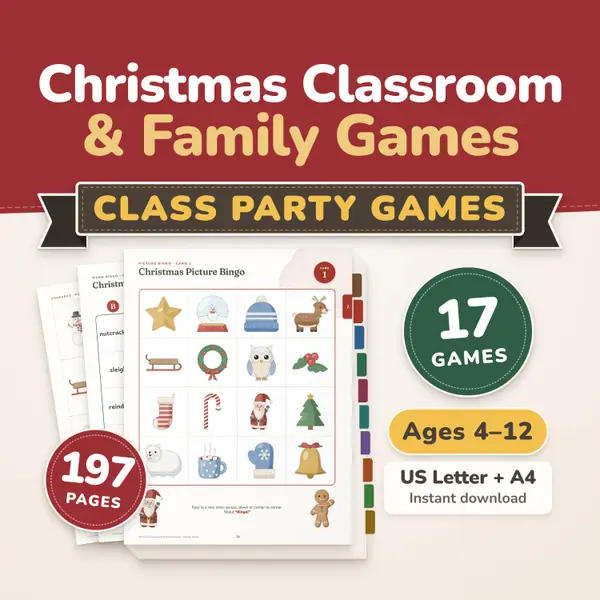
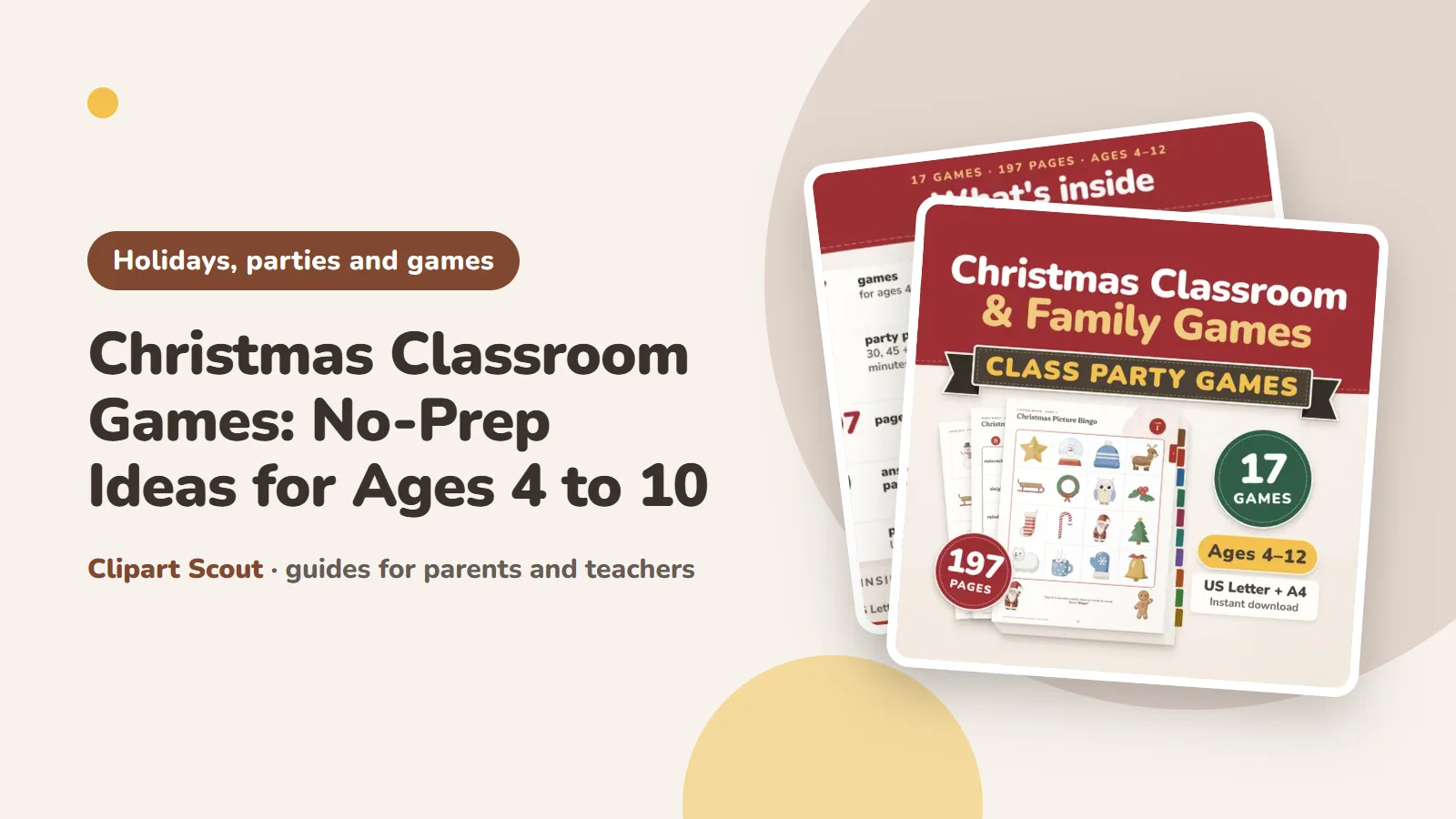
If you would rather have the cards printed, the Christmas Classroom Games for Kids bundle has 197 pages and 17 games, with a party planner that includes 30, 45 and 60-minute plans and a no-reading picture bingo.
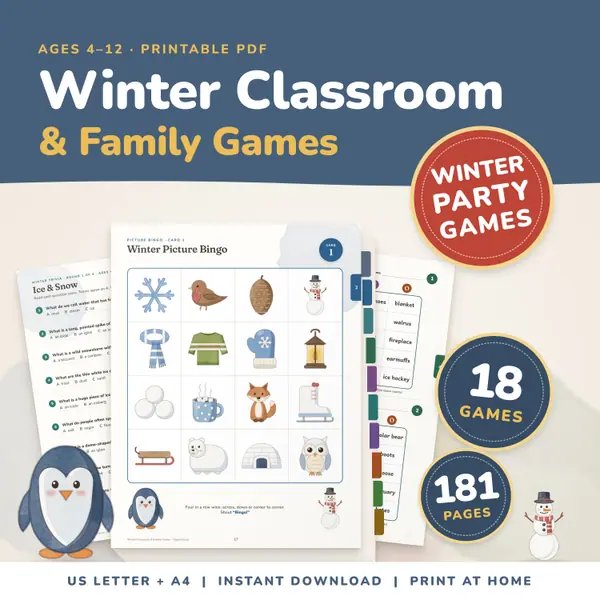
For a winter theme with no Christmas pictures, the Winter Classroom Games for Kids bundle has 181 pages and 18 games, with the same kind of party planner and a whole indoor-day plan.
What to do next
- Choose four games from this guide, one for each block of the run sheet.
- Write the plan on the board before the children arrive.
- Gather the few items you need: a mitten, a bag, ten small objects, a roll of tape and scrap paper.
- Practice the quiet signal with the class once.
- For more ideas see our guides to a Christmas scavenger hunt and winter activities for preschool, or browse the Christmas printables and printable party games.