
Christmas Scavenger Hunt for Kids: Clues, Riddles and Rules
By the Clipart Scout team8 min read
Short answer
To run an indoor Christmas scavenger hunt, decide where the prize will be, then work backwards: write one clue for each stop, number the clues, and hide each one at the place the clue before it points to. Use picture clues for children who cannot read yet and riddles for readers. Four or five clues suit the youngest, eight to ten suit ages 9 and 10.
Key points
- Plan backwards: choose the prize spot first, then write each clue to lead to the next hiding place.
- Draw picture clues for children who cannot read yet and write riddles for readers.
- Four or five clues fit ages 3 to 4, six to eight fit ages 7 to 8, and eight to ten fit ages 9 to 10.
- Number every clue and walk the route yourself before the children start.
- Keep the whole hunt indoors, on one floor, away from hot, wet or breakable places.
On this page
- How do you set up an indoor Christmas scavenger hunt?
- How many clues should a Christmas treasure hunt have?
- What picture clues work for children who cannot read?
- What riddles can you use for readers?
- Where should you hide the clues?
- What does a complete example hunt look like?
- What if there are several children of different ages?
- What to do next
You have an afternoon, a few sheets of paper and a prize: a box of cookies, a book or a new pair of socks. A scavenger hunt turns that prize into 20 minutes of excited searching, and it needs no special equipment.
This guide shows how to build an indoor Christmas hunt step by step. It covers picture clues for children who cannot read yet, riddles for readers, how many clues to use by age and where to hide them. A list of clues you can copy by hand sits in the middle.
How do you set up an indoor Christmas scavenger hunt?
Set up the hunt backwards: pick the prize and its hiding place, then write each clue so it leads to the next hiding place. This way the trail always ends where you want it to.
- Choose the prize and the final spot. A shared prize works well for a group: a plate of cookies, a game, a stack of books.
- Pick the stops. Walk through the house or classroom and choose five to ten places the children can reach without climbing.
- Write the last clue first. It leads to the prize. Then write the clue before it, which leads to the last clue’s hiding place, and so on to clue one.
- Number the clues on the back in a corner, and use a different color for each team if teams will run at once.
- Hide the clues in order, with the first clue in your hand.
- Walk the route once. Read each clue as a child would and check that every hiding place is easy to reach.
- Say the rules before you start: walk, do not push, put each clue back, leave other teams’ clues alone.
Tip: Write the clues on red and green card, fold them once and tape a small star to each. Children learn to spot the star, and the hunt looks like a game rather than a worksheet.
How many clues should a Christmas treasure hunt have?
Use four or five clues for the youngest children and up to ten for ages 9 and 10. Fewer, easier clues beat many hard ones, because a child who gets stuck three times usually stops enjoying it.
The numbers below are our suggestions. Adjust them to the children in front of you.
| Age | Clues | Clue type | Time |
|---|---|---|---|
| 3 to 4 | 4 to 5 | Pictures only, grown-up beside the child | 10 to 15 min |
| 5 to 6 | 5 to 6 | Pictures plus a one-word label | 15 to 20 min |
| 7 to 8 | 6 to 8 | Short riddles | 20 to 25 min |
| 9 to 10 | 8 to 10 | Riddles, a simple code or a two-step puzzle | 25 to 35 min |
For a mixed group, give the youngest child the job of carrying the prize bag or pressing the star on each clue, and let an older child read.
What picture clues work for children who cannot read?
Picture clues are quick line drawings of the hiding place, and they work because children match the drawing to the real object. You do not need to draw well. A few lines and a bold color are enough.
Draw each place on its own card:
- A bed: a rectangle with a pillow.
- A window: a square split into four.
- A shoe: a boot shape with laces.
- The fridge: a tall box with a handle.
- The sofa: a long cushion with arms.
- A plant: a pot with three leaves.
- The front door: a tall rectangle with a round knob.
- The bookshelf: boxes in rows with thin lines for books.
- A table: a flat top with four legs.
For a child who is just starting to recognize words, write the word under the picture in clear capital letters and read it together.
Do not hide a clue where the child will touch anything breakable. A drawing of a bed leads to a clue taped under the pillow, not under a lamp.
What riddles can you use for readers?
Riddles for readers describe an object by what it does, and the answer is the next hiding place. Short riddles of two or three lines work best, and they do not have to rhyme.
Here are ten you can copy. The answer is the place to hide the next clue.
| Riddle | Answer |
|---|---|
| I have a door but I never go out. Open me for milk and for cold things. | The fridge |
| I have four legs and a back, but I never walk. You sit on me to eat. | A chair |
| I have hands but I cannot clap. I tell you when it is time for bed. | A clock |
| You see yourself in me, but I never say a word. | A mirror |
| I hold hundreds of stories, and I stand very still. | The bookshelf |
| I have branches but no birds. I wear lights and a star. | The Christmas tree |
| I live by the door, and I am full of coats, hats and boots. | The coat hooks or shoe rack |
| Warm water and bubbles are my favorite things. Look where you wash your hands. | The bathroom sink |
| Close your eyes on me every night and rest your head. | A bed |
| I am cold and hard, and I melt in your hand. Look where the cold things sleep. | The freezer |
For readers aged 9 and 10, make one clue a simple code. Write the next place with each letter replaced by the next letter of the alphabet, or write it backwards for a mirror. Put the key on the clue before it. Keep the answer to a short word, such as TREE or SOFA, so decoding does not take ten minutes.
Where should you hide the clues?
Hide clues at child height in dry, solid places on one floor: under a cushion, taped to a chair leg, inside a shoe, behind a picture frame low on the wall, or tucked into a book. Choose places where nothing can fall or spill.
- Good places: under a cushion, inside a boot, taped to the fridge door, tucked in a book, under a pillow, behind the plant pot, on the coat hooks.
- Avoid: the kitchen counter near the stove, the bathroom floor, stairs, high shelves, windowsills, the garage and anywhere outdoors after dark.
- For a classroom: use the reading corner, the coat hooks, a drawer of crayons, the class library and the board ledge.
- For a large group: make several copies of the trail in different colors and hide them in separate places so teams do not meet.
Choose a good hiding place for the last clue, since it holds the prize. A shared prize hidden under a tea towel on a table gives everyone a turn to lift it.
What does a complete example hunt look like?
Here is a full hunt for children aged 5 to 8, with six clues and a prize of cookies on the kitchen table. Copy it onto cards, using the picture alongside each clue for the younger ones.
| Clue | What it says | Where you hide it |
|---|---|---|
| 1 | “Look where we keep the milk. I have a door, and I am cold inside.” | Hand it to the children |
| 2 | “I stand on four legs and you sit on me. Look under the seat.” | In the fridge |
| 3 | “I wear lights and a star. Look near my branches.” | Under a kitchen chair |
| 4 | “Your coat and boots wait for you here. Look inside one boot.” | Beside the Christmas tree |
| 5 | “I have pages and stories. Find me on the shelf and open me.” | In a boot by the door |
| 6 | “You have followed five clues. The prize is under the cloth on the table.” | Tucked in a book |
To make it longer, add a task at each stop: sing a line of a carol at the tree, hop three times at the door, name a winter animal at the bookshelf. For a team hunt, give each team its own color of card and its own hiding spot at every stop, such as a different shelf or a different chair, so no team finds another team’s clue.
What if there are several children of different ages?
Pair a reader with a non-reader and give each child one job. The older child reads the riddle aloud, and the younger child finds the clue and carries the prize bag.
Give the smallest children a picture version of each clue, and let older children get the riddle. Both versions can point to the same place, so the trail stays the same. If a younger child gets stuck, show the picture card. If an older child gets stuck, give a hint such as “it is in the kitchen.”
If you do not want to write your own, the Christmas Activity Bundle for Kids has a section with 14 pages of scavenger hunts, including 12 hunts and a 10-card rhyming clue trail.
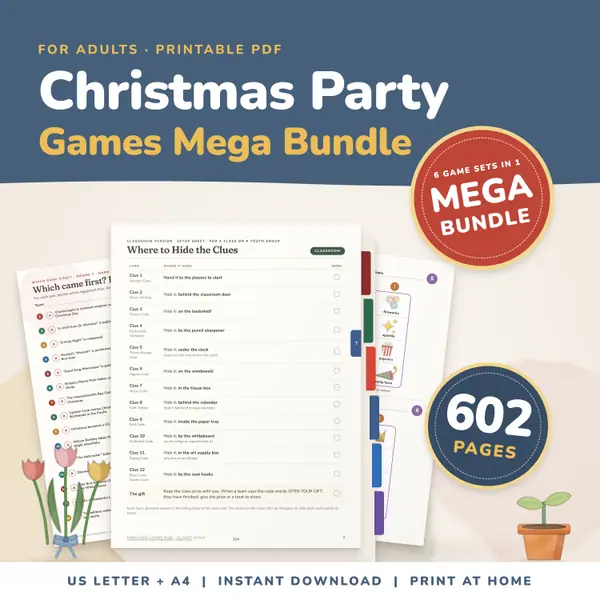
For older children, the Christmas Party Games Mega Bundle includes a 33-page Christmas Cipher Treasure Hunt for ages 9 to 14, with 12 codes from easy to boss level, setup sheets for a house or a classroom and answer keys.
What to do next
- Choose your prize and the final hiding place.
- Pick five to ten stops, write the clues backwards from the prize and number them.
- Draw the picture versions for any child who does not read yet.
- Walk the route once, then hide the clues.
- For a bigger event, see our guides to Christmas party games for families, Christmas classroom games and escape rooms for kids at home, or browse the printable party games.