English Phonics for Beginners: First Sounds and First Words
By the Clipart Scout team6 min read
Short answer
Phonics teaches children the link between letters and the sounds they stand for, so they can read, or decode, written words. England's Department for Education requires systematic synthetic phonics in schools, and its Year 1 check has 40 words. For a child learning English, we suggest teaching what a word means while the child learns to read it, using pictures and word lists.
Key points
- Phonics links letters to sounds so a child can read new words. England's curriculum names more than 40 sounds.
- England's Year 1 phonics screening check has 20 real words and 20 pseudo-words, taken in June, as of 2026.
- US research guidance for English learners rates extensive vocabulary teaching as strong evidence, so meaning matters as well as sounds.
- A suggested order: single letter sounds, blending three-sound words, sh, ch and th, then a few words that cannot be sounded out.
- Ten minutes a day, with pictures, is a simple routine to try.
On this page
Many parents ask whether a child should learn to read English before they can speak it well. The short answer is that phonics, the link between letters and sounds, can start early. Meaning should grow with it.
This guide explains what phonics is, what England and the United States say about it, and a simple sequence of first sounds and first words. The sequence is our suggestion. Our printables are in English.
What is phonics, and why does English need it?
Phonics teaches children which sounds letters stand for, so they can read new words by themselves. In English, the same sound can be spelled in more than one way, and the same letters can have more than one sound. A child needs a clear, step-by-step way to learn this.
Take the word “cat”. It has three sounds: c, a, t. The child says each sound, then blends them into one word. That is decoding. England’s national curriculum asks Year 1 pupils to “apply phonic knowledge and skills as the route to decode words”.
What does England’s Department for Education require?
England’s government requires systematic synthetic phonics in its schools, and it checks Year 1 pupils with a short phonics screening check. This is England’s policy for children learning to read in English-medium schools. It is not a rule for teaching English as a foreign language.
The facts from official documents:
- The national curriculum says Year 1 pupils should “respond speedily with the correct sound to graphemes (letters or groups of letters) for all 40+ phonemes”. So you can say English has more than 40 sounds.
- The screening check is described as “a new, statutory phonics screening check for all children in year 1”.
- It “will be constructed of 20 real words and 20 pseudo-words”, in two sections of 20 items each. That makes 40 words.
- Pseudo-words are made-up words that are shown with a picture of an imaginary creature. The framework says they give the purest assessment of decoding, because they are new to all children.
- Parents’ information from the Standards and Testing Agency says the check takes place in June.
Arrangements are under review, so write “as of 2026” when you describe the check.
What do US research guides say for English learners?
The US Institute of Education Sciences has two practice guides for teaching English learners in elementary school. They were written for US schools, where English learners are taught in English. Here are their recommendations, as worded on the What Works Clearinghouse pages.
| Guide | Recommendation | Evidence level |
|---|---|---|
| 2014 | Teach a set of academic vocabulary words intensively across several days using a variety of instructional activities | Strong |
| 2014 | Integrate oral and written English language instruction into content-area teaching | Strong |
| 2014 | Provide regular, structured opportunities to develop written language skills | Minimal |
| 2014 | Provide small-group instructional intervention to students struggling in areas of literacy and English language development | Moderate |
| 2007 | Provide extensive and varied vocabulary instruction | Strong |
The 2014 guide updates the 2007 guide, so cite the 2014 guide as the current one. We only read the titles and evidence levels of these recommendations. We did not read their full text on phonics, so we do not claim the guides say how to teach phonics.
Colorín Colorado is an educational service of WETA, a public television station in the United States. It describes itself as a leading website for educators and families of English language learners.
How do you teach phonics to a child who is learning English?
Teach the meaning of a word before or while the child learns to read it. This is our suggestion. It builds on the vocabulary recommendations above. A child who can read “dog” but does not know what a dog is has only done half of the job.
Use pictures, real objects and word lists. Our animals page has the words with pictures and listen buttons. The English alphabet page shows each letter with a picture word, and the numbers page has number words.
What is a good order for first sounds and words?
This sequence is our suggestion. Spend as long as your child needs on each step.
- Single letter sounds. Start with a few, such as s, a, t, p, i, n. See how to teach the English alphabet.
- Blending three-sound words. Say each sound, then blend: c, a, t, cat. Our CVC words list has many examples.
- Common two-letter sounds. Add sh, ch and th.
- A few words that cannot be sounded out. Words such as “the” and “you” need to be learned by sight. See sight words by grade.
Here are ten first words to blend. They are all on our vocabulary pages.
| Word | Sounds | Picture idea |
|---|---|---|
| cat | c, a, t | a cat |
| dog | d, o, g | a dog |
| pig | p, i, g | a pig |
| sun | s, u, n | the sun |
| hat | h, a, t | a hat |
| bus | b, u, s | a bus |
| red | r, e, d | a red crayon |
| ten | t, e, n | ten blocks |
| six | s, i, x | six blocks |
| bed | b, e, d | a bed |
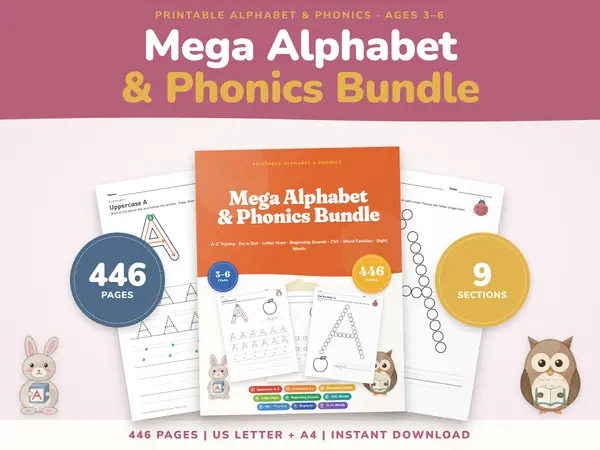
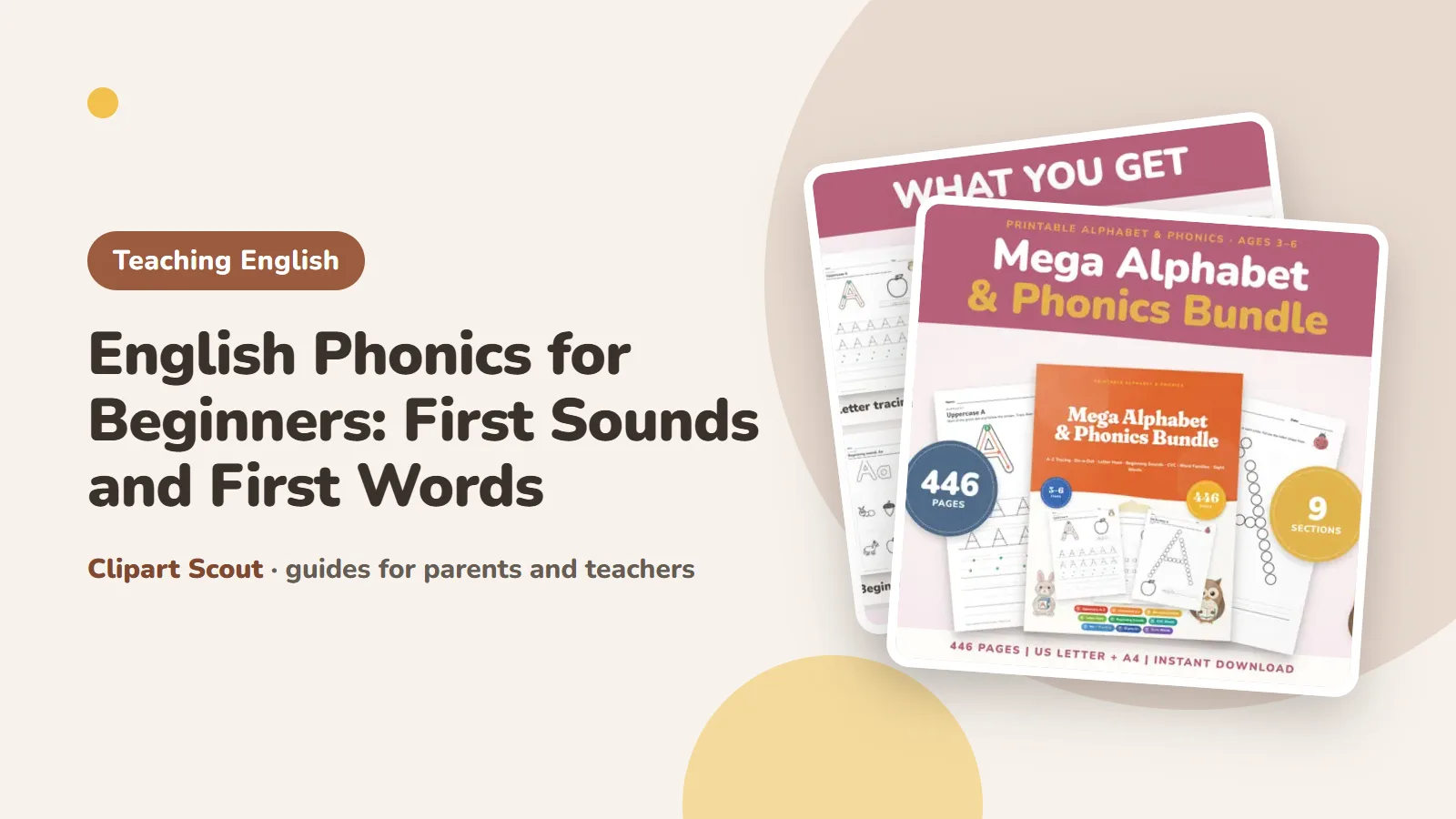
The Alphabet Worksheets and Phonics Bundle has 446 pages, including Beginning Sounds (69 pages), CVC Words (65 pages) and Digraphs (10 pages), with answer keys.
Which sounds can be hard?
Depending on the child’s first language, some English sounds may be new. Some learners find the “th” sound, short and long vowel pairs such as “ship” and “sheep”, or the sounds of “r” and “l” difficult. This is a general suggestion, not a research finding. If a sound is hard, show your mouth, say the word slowly and do not make the child repeat it many times in one session. A British Council article says parents should not force a child to repeat words during a silent period.
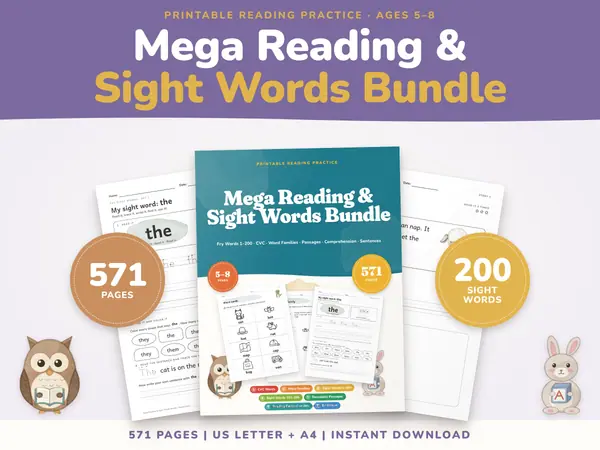
For a child who is ready for sight words and short passages, the Sight Words and Reading Bundle has 571 pages, with CVC words, word families and decodable passages.
What to do next
Try this routine for ten minutes a day:
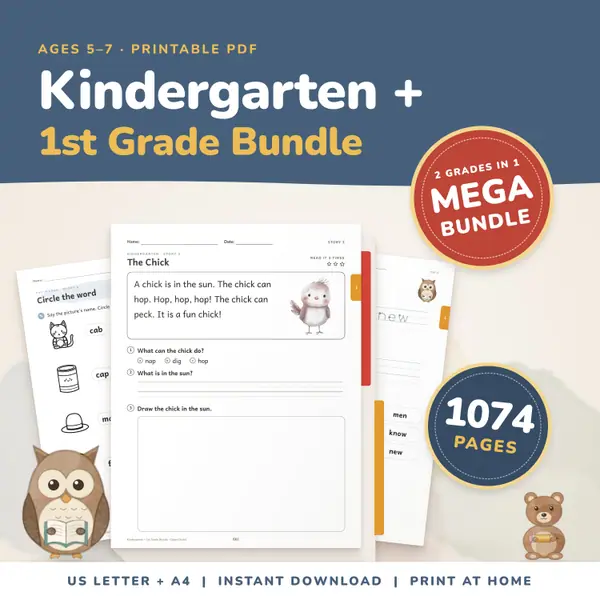
For the bigger plan, read how to teach English to kids at home and how to teach a child to read. If you want one file for two years, the Kindergarten and 1st Grade Worksheets Bundle has 1,074 pages, including 39 pages of Beginning Sounds.
You can also browse our reading and phonics worksheets.
Sources
- National curriculum in England: English programmes of study, Department for Education, GOV.UK.
- Assessment framework for the development of the year 1 phonics screening check, Department for Education and Standards & Testing Agency, GOV.UK.
- Teaching Academic Content and Literacy to English Learners in Elementary and Middle School, What Works Clearinghouse, Institute of Education Sciences, US Department of Education.
- Effective Literacy and English Language Instruction for English Learners in the Elementary Grades, What Works Clearinghouse, Institute of Education Sciences, US Department of Education.
- About Colorín Colorado, Colorín Colorado (WETA).
This guide is general information for parents and teachers. It is not medical, legal or professional advice. Every guide lists its sources at the end. More about our guides is on the About page.