How to Teach the English Alphabet to Beginners
By the Clipart Scout team6 min read
Short answer
The English alphabet has 26 letters, and each letter has a name and one or more sounds. Teach a few letters at a time, say the name and the sound together, and link each letter to a picture word. Show where each letter starts and which way it goes. Begin with the child's own name. Practice a little each day, and use games to keep it light.
Key points
- English has 26 letters, with 5 vowel letters: a, e, i, o and u. Every letter has a name and one or more sounds.
- England's national curriculum asks Year 1 pupils to form letters in the correct direction, starting and finishing in the right place.
- No authoritative guidance was found for teaching Latin letters to children whose first script is different, so our steps are suggestions.
- Two to four new letters a week is a gentle example pace. Change it to suit your child.
- Teach look-alike letters, such as b and d, in separate weeks, and name each letter clearly.
On this page
You have a child who is starting English, and you want to teach the alphabet in a clear order. The short answer is that English has 26 letters, each with a name and one or more sounds, and a few letters at a time is enough for one week.
This guide explains the name and the sound of a letter, what England’s national curriculum expects of young pupils, and a suggested order. It also covers letters that are easy to mix up and some letter games. Our printables are in English.
What does every letter have?
Every letter has a name and at least one sound. The English alphabet has 26 letters. Five of them are vowel letters: a, e, i, o and u. The other 21 are consonant letters. The name is what you say when you spell a word. The sound is what the letter usually does inside a word.
Here are six letters with a common sound and an example word from our English alphabet page.
| Letter | Name (as it is said) | A common sound | Example word |
|---|---|---|---|
| A a | ay | the “a” in apple | apple |
| B b | bee | the “b” in ball | ball |
| C c | see | the “c” in cat | cat |
| D d | dee | the “d” in dog | dog |
| M m | em | the “m” in moon | moon |
| S s | ess | the “s” in sun | sun |
Some letters have more than one sound. The letter c in cat is not the same as the letter c in some other words. You do not need to explain this to a beginner on the first day. Start with one common sound.
What does England’s national curriculum expect?
It expects young pupils to learn letter sounds and to form letters carefully. This is the policy of England’s Department for Education, for children in English-medium schools. It is not a rule for every country.
For Year 1, the national curriculum says pupils should be taught to “respond speedily with the correct sound to graphemes (letters or groups of letters) for all 40+ phonemes”. For handwriting, it says Year 1 pupils should “begin to form lower-case letters in the correct direction, starting and finishing in the right place”. They should also “sit correctly at a table, holding a pencil comfortably and correctly”. The same document asks that pupils “form capital letters” and “form digits 0-9”.
Those words are useful for any beginner: the correct sound, the right direction and the right place to start.
How do you teach a child who writes in another script?
No authoritative guidance was found that is written for teaching Latin letters to children whose first script is different, such as Arabic, Chinese, Hindi, Korean or Thai. So we cannot say that experts recommend a method. The steps below are our suggestions.
- Direction. English is written from left to right. Show this with your finger and an arrow at the start of the line.
- Starting points. Put a dot where each letter starts, and an arrow for the way it goes.
- Tall, short and tail letters. Draw three lines on the page. Show which letters are tall, which are short and which go below the line.
- Capital and small letters side by side. Show A a, B b and so on together.
- The child’s own name first. It has meaning for the child, and it uses real letters.
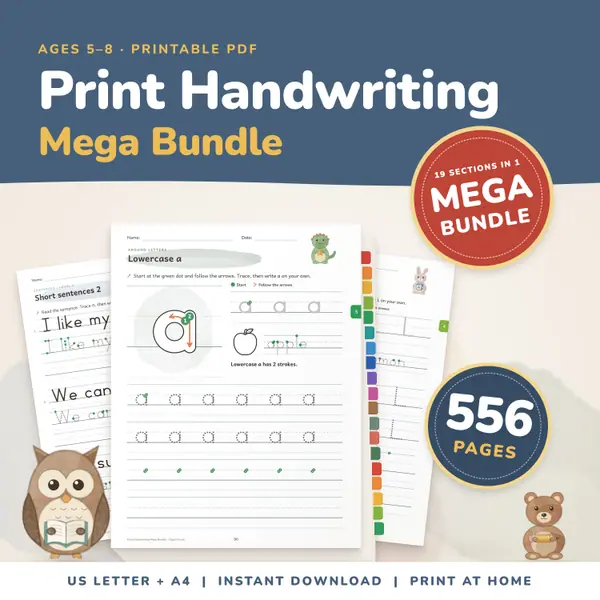
The 52-page Capital Letters A–Z section of our Print Handwriting Practice Bundle gives each capital a big letter page with numbered start dots and stroke arrows. The bundle has 556 pages in all.
In what order can you teach the letters?
Teach a few letters at a time, and review often. The order below is our suggestion. There is no research claim about the best order or pace.
- Week 1: letters in the child’s own name.
- Week 2: a, s, m, t. These make many short words.
- Week 3: c, d, o, p.
- Week 4: b, f, h, n.
- After that: add two to four letters a week, and review.
Each session can be ten minutes. Say the name, say the sound, say the picture word, then trace or write the letter. A song helps: the British Council says songs are a really effective way to learn new words and improve pronunciation.
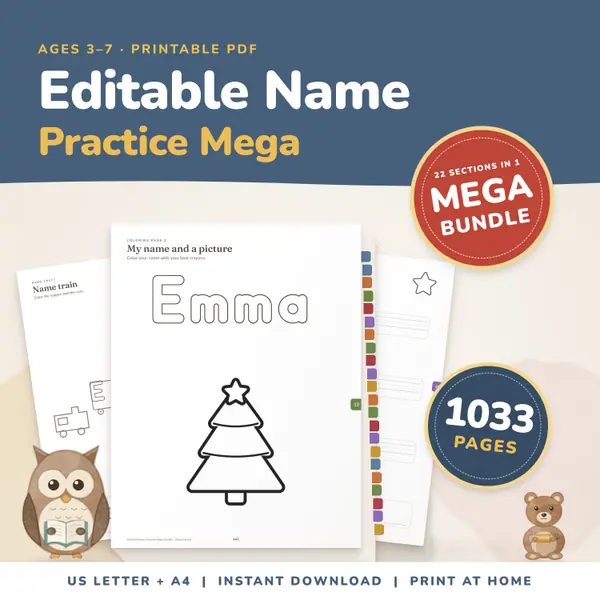
For name practice, the Editable Name Tracing Worksheets has 1,033 pages. You type the name once and it fills the tracing pages.
See also our guide on how to teach a child to write their name.
Which letters do learners mix up?
Some letters look alike, and some names sound alike. Teach the pairs in different weeks.
| Mix-up | Type | What can help |
|---|---|---|
| b and d | shape | b has its belly on the right, d on the left. Draw a bed with b and d at the ends |
| p and q | shape | p has its tail down and its belly on the right |
| n and u | shape | n is like a hump, u is like a cup |
| m and w | shape | m has two humps, w has two cups |
| A, E and I | name | Say them slowly: ay, ee, eye. Use picture words: apple, egg, igloo |
| G and J | name | Say gee and jay, and watch the mouth |
Which games help with letters?
Games keep practice light. Cambridge English says games create opportunities for children to use English in a fun, low-pressure environment. Here are some examples. You can find more in our English games for kids guide.
- Letter hunt. Find a letter on signs, packs and books.
- Draw in the air. Write a big letter with a finger, then on a hand or a back.
- Picture matching. Match each letter to a picture word. Our animals and colors lists are a good source.
- Sound bags. Put three small objects in a bag. The child picks one and says its first letter.
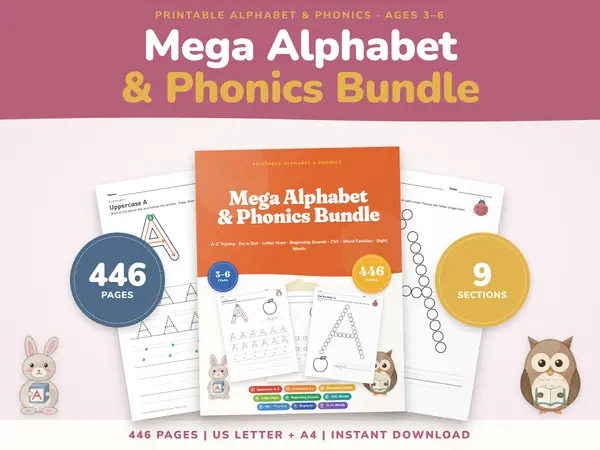
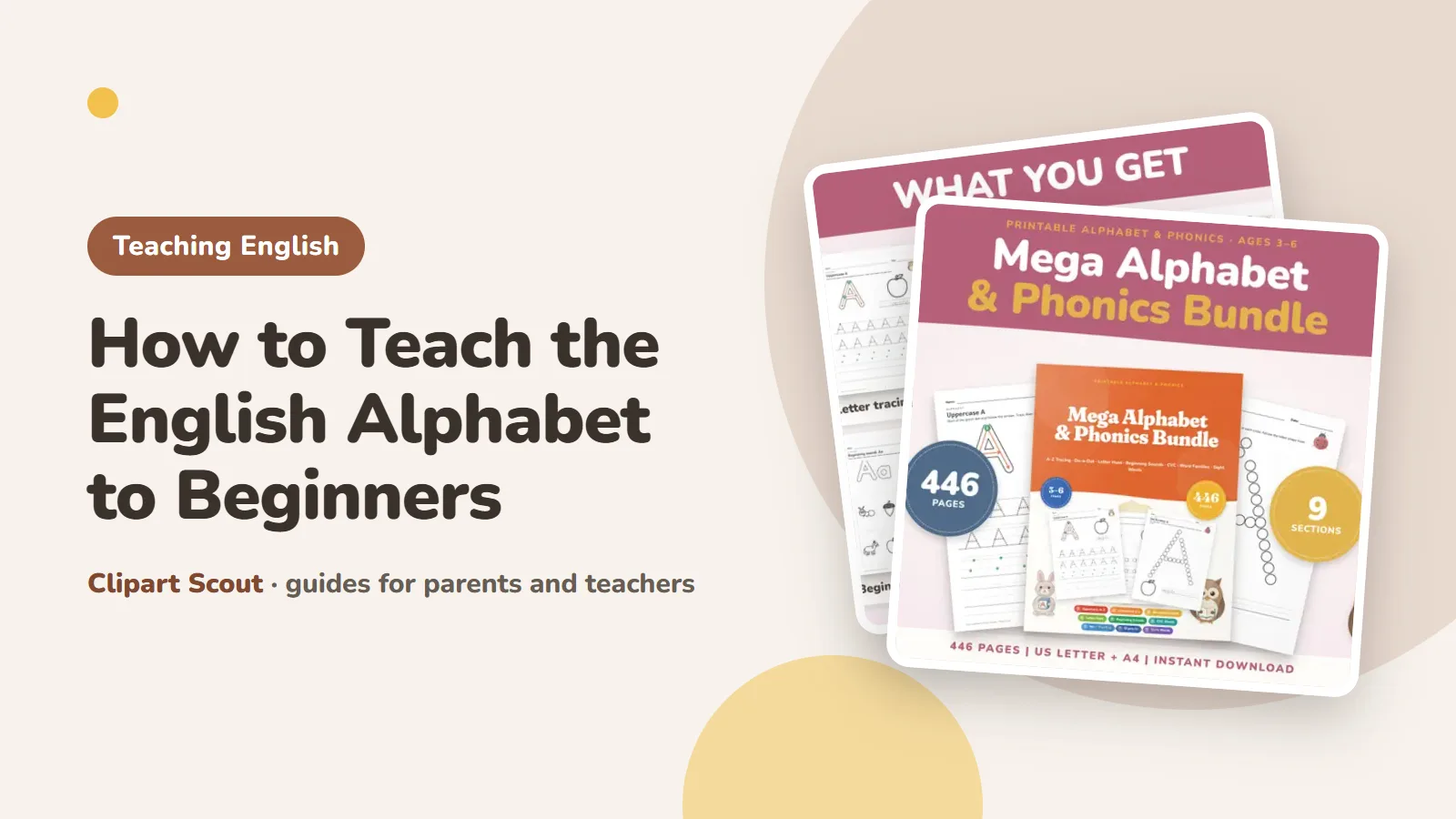
The Alphabet Worksheets and Phonics Bundle has 446 pages, including Uppercase A–Z, Lowercase a–z and Letter Hunt.
What to do next
Use this checklist before moving to the next step, which is sounds and first words. See English phonics for beginners. For the whole plan, read how to teach English to kids at home.
If most lines are ticked, add new letters. If not, stay a little longer. You can also browse our handwriting practice worksheets.
Sources
- National curriculum in England: English programmes of study, Department for Education, GOV.UK.
- How to start teaching kids English at home, British Council, LearnEnglish Kids.
- How to practise English at home, Cambridge English.
This guide is general information for parents and teachers. It is not medical, legal or professional advice. Every guide lists its sources at the end. More about our guides is on the About page.