Animals in English: Names, Pronunciation and Plurals for Kids
By the Clipart Scout teamUpdated 41 words
Short answer
Common animals in English include dog, cat, cow, horse, pig, sheep, chicken, lion, elephant, monkey, fish and butterfly. Most animal names add -s in the plural (dogs, lions), but some change or stay the same: one mouse, two mice; one wolf, two wolves; one sheep, two sheep; one fish, two fish; one deer, two deer. Use "a" before most animals and "an" before elephant, octopus and ant.
This page groups animal names the way children meet them: pets, farm animals, wild animals, sea animals and insects and small animals. Each word has its pronunciation and a short example sentence. Tap the speaker button to hear a word.
Animals are a favorite topic and good for speaking, because children can imitate them and talk about what they eat and where they live. Below you will find a quick practice, teaching ideas and the mistakes learners make most often, especially with plural forms.
Word list
Pets
| Listen | English | Example |
|---|---|---|
| 🐶 | dog/dɔːɡ/a dog · dogs | The dog is brown. |
| 🐱 | cat/kæt/a cat · cats | The cat sleeps on my bed. |
| 🐰 | rabbit/ˈræbət/a rabbit · rabbits | The rabbit eats a carrot. |
| 🐹 | hamster/ˈhæmstər/a hamster · hamsters | My hamster is small. |
| 🦜 | parrot/ˈpærət/a parrot · parrots | The parrot has green wings. |
| 🐢 | turtle/ˈtɜːrtəl/a turtle · turtles | The turtle walks very slowly. |
Farm animals
| Listen | English | Example |
|---|---|---|
| 🐄 | cow/kaʊ/a cow · cows | The cow says moo. |
| 🐴 | horse/hɔːrs/a horse · horses | I like to ride a horse. |
| 🐷 | pig/pɪɡ/a pig · pigs | The pig is pink. |
| 🐑 | sheep/ʃiːp/a sheep · sheep | The sheep has soft wool.Same word for one or many: one sheep, two sheep. |
| 🐔 | chicken/ˈtʃɪkən/a chicken · chickens | The chicken lays eggs. |
| 🦆 | duck/dʌk/a duck · ducks | The duck swims on the pond. |
| 🐐 | goat/ɡoʊt/a goat · goats | The goat eats grass. |
Wild animals
| Listen | English | Example |
|---|---|---|
| 🦁 | lion/ˈlaɪən/a lion · lions | The lion is strong. |
| 🐯 | tiger/ˈtaɪɡər/a tiger · tigers | The tiger has stripes. |
| 🐘 | elephant/ˈeləfənt/an elephant · elephants | The elephant has a long trunk. |
| 🐒 | monkey/ˈmʌŋki/a monkey · monkeys | The monkey climbs the tree. |
| 🦒 | giraffe/dʒəˈræf/a giraffe · giraffes | The giraffe has a long neck. |
| 🦓 | zebra/ˈziːbrə/a zebra · zebras | The zebra has black and white stripes. |
| 🐻 | bear/ber/a bear · bears | The bear likes honey. |
| 🐺 | wolf/wʊlf/a wolf · wolves | The wolf howls at night.Plural: wolves (f changes to v). |
| 🦊 | fox/fɑːks/a fox · foxes | The fox has a bushy tail. |
| 🦌 | deer/dɪr/a deer · deer | The deer runs in the forest.Same word for one or many: one deer, two deer. |
| 🐍 | snake/sneɪk/a snake · snakes | The snake has no legs. |
| 🐧 | penguin/ˈpeŋɡwən/a penguin · penguins | The penguin cannot fly. |
| 🐦 | bird/bɜːrd/a bird · birds | The bird sings in the tree. |
Sea animals
| Listen | English | Example |
|---|---|---|
| 🐟 | fish/fɪʃ/a fish · fish | The fish swims in the water.Usually the same for one or many: one fish, two fish. |
| 🐋 | whale/weɪl/a whale · whales | The whale is very big. |
| 🐬 | dolphin/ˈdɑːlfən/a dolphin · dolphins | The dolphin jumps in the sea. |
| 🦈 | shark/ʃɑːrk/a shark · sharks | The shark has sharp teeth. |
| 🐙 | octopus/ˈɑːktəpʊs/an octopus · octopuses | The octopus has eight arms.The common plural is octopuses. |
| 🦀 | crab/kræb/a crab · crabs | The crab walks sideways. |
Insects and small animals
| Listen | English | Example |
|---|---|---|
| 🐝 | bee/biː/a bee · bees | The bee makes honey. |
| 🦋 | butterfly/ˈbʌtərflaɪ/a butterfly · butterflies | The butterfly has pretty wings.Plural: butterflies (y changes to ie). |
| 🐜 | ant/ænt/an ant · ants | The ant is very small. |
| 🕷️ | spider/ˈspaɪdər/a spider · spiders | The spider makes a web. |
| 🐞 | ladybug (British: ladybird)/ˈleɪdibʌɡ/a ladybug · ladybugs | The ladybug is red with black dots.American English says ladybug. British English says ladybird. |
| 🐌 | snail/sneɪl/a snail · snails | The snail moves slowly. |
| 🪱 | worm/wɜːrm/a worm · worms | The worm lives in the soil. |
| 🐸 | frog/frɑːɡ/a frog · frogs | The frog jumps into the pond. |
| 🐭 | mouse/maʊs/a mouse · mice | The mouse is very quiet.Irregular plural: one mouse, two mice. |
Practice on screen
Look at the picture or number and choose the right English word. Ten questions each round.
How to teach it
1. Animal sounds and movements
Name an animal and let the child move like it and make its sound: hop like a rabbit, stomp like an elephant, buzz like a bee. Then swap: the child chooses and you guess. Movement helps a young child remember the word and the idea.
2. Farm, jungle or ocean sorting
Draw three large areas on paper: farm, jungle and sea. Give the child animal picture cards to place in the right area. As each card is placed, say the name and a short sentence: "The cow lives on the farm."
3. Guess the animal
Give three clues in English: "It is big. It is gray. It has a long nose." The child guesses: "An elephant!" Then the child gives clues for you. This practices describing words and gives a reason to listen carefully.
4. Plurals with toy animals
Put one toy sheep on the table, then two, then three, and say each time: "One sheep. Two sheep." Do the same with a mouse and mice. Seeing the number change next to the word is a clear way to learn irregular plurals.
5. Draw an animal and describe it
Each child draws an animal and writes or says short sentences about it: "It is a frog. It is green. It can jump." Display the pictures and let the others guess before reading the sentences.
6. Animal bingo with sounds
Make bingo cards with animal pictures. Call out names or play the sound and let the children cover the picture. The first with a full row says "Bingo!" and names the animals. Use a small set of animals at first and add more.
Common mistakes
Saying "mouses" instead of mice
The plural of mouse is mice, not "mouses". Some animals change in other ways: one wolf, two wolves; one butterfly, two butterflies. Learn these as they come up and show them with toy animals.
Adding -s to sheep, fish and deer
Sheep and deer are the same in the plural: one sheep, two sheep; one deer, three deer. Fish is also usually the same: two fish. Learners often say "sheeps" and "deers", which are not correct.
Using a instead of an
Use an before a vowel sound: an elephant, an octopus, an ant. Use a before the rest: a dog, a zebra. Say the phrase with the animal each time, so the child hears the pattern.
Writing animal names with a capital letter
Animal names are common nouns, so they use a small letter in the middle of a sentence: "I see a dog." Not "I see a Dog." A pet's own name does take a capital: "My dog is called Max."
Forgetting the verb after the animal
Say "The cat is big", not "The cat big". English needs the verb to be between the animal and the describing word. Practice with a short pattern: "The lion is strong. The mouse is small."
Printables that go with this topic
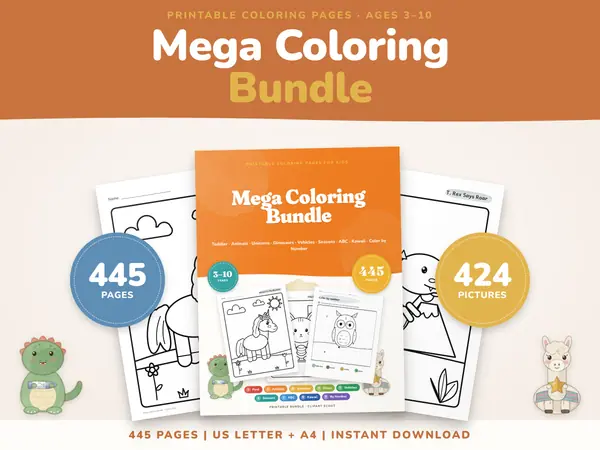
Bold and Easy Coloring Pages for Kids
445 pagesUS Letter + A4Ages 3–10English
See price and buy on Etsy1019 Kids Coloring Pages Super Mega Bundle
1,019 pagesUS Letter + A4Ages 2–14English
See price and buy on Etsy

Questions and answers
What is the plural of mouse?
The plural of mouse is mice. It is irregular, so the -s rule does not apply. One mouse, two mice. Say "mice" for the animal.
Is it one sheep, two sheep or two sheeps?
It is two sheep. Sheep has the same form for one and for many. Deer works the same way, and fish usually does too: one fish, two fish.
What are the farm animals in English?
Common farm animals are cow, horse, pig, sheep, chicken, duck and goat. Many children also learn rooster, turkey and donkey.
Is it a or an before an animal name?
Use an before a vowel sound: an elephant, an ant, an octopus. Use a before a consonant sound: a dog, a lion, a zebra, a frog.
What is the plural of wolf?
The plural of wolf is wolves. The f changes to v and we add -es. One wolf, two wolves. Butterfly also changes: butterflies.
More English vocabulary
- English Alphabet for Kids: Letter Names and Words
- Numbers 1 to 100 in English: Words and Pronunciation
- Colors in English: Names and Pronunciation for Kids
- Shapes in English for Kids: Names and Pronunciation
- Days of the Week in English: Order and Spelling
- Months of the Year and Seasons in English for Kids
- Telling the Time in English: Clock Words for Kids
- Fruits and Vegetables in English for Kids
- Food and Drinks in English for Kids: Word List
- Parts of the Body in English for Kids
- Family Words in English for Kids: Members and Plurals
- Clothes in English: Words and Pronunciation for Kids
- Classroom Objects in English: School Words for Kids
- Rooms and Furniture in English: House Words for Kids
- Transport in English: Vehicle Words for Kids
- Feelings in English: Emotion Words for Kids
- Weather Words in English: Vocabulary for Kids
- Action Verbs for Kids: Common English Verbs
- Opposites in English: Word Pairs for Kids
- Prepositions of Place in English: In, On, Under
- English Greetings and Classroom Phrases for Kids
- Question Words in English: Who, What, Where, Why
Link to this page
Teachers and parents are welcome to link to this page. Copy the address or the ready-made link.