Days of the Week in English: Spelling, Order and Pronunciation
By the Clipart Scout teamUpdated 17 words
Short answer
The days of the week in English are Monday, Tuesday, Wednesday, Thursday, Friday, Saturday and Sunday. Saturday and Sunday make the weekend. Every day name starts with a capital letter: "on Monday", never "on monday". Use the word on before a day ("I have art on Tuesday") and add -s for a habit ("I swim on Fridays").
This page lists the seven days of the week in order, with their short forms and pronunciation, and the time words children use every day: today, tomorrow, yesterday, morning, afternoon, evening and night. Tap the speaker button to hear a word.
Days are easiest to learn when they are part of a routine. Below the list you will find a quick practice, ways to build the days into your week, and the mistakes learners make most often with the spelling and use of the days.
Word list
Days of the week
| Listen | English | Example |
|---|---|---|
| Monday/ˈmʌndeɪ/Mon. | I go to school on Monday. | |
| Tuesday/ˈtuːzdeɪ/Tue. | We have art on Tuesday.Spell it T-u-e-s-d-a-y. Do not drop the e after the u. | |
| Wednesday/ˈwenzdeɪ/Wed. | Wednesday is the middle of the week.Silent d: said "WENZ-day". Spelling trap: Wed-nes-day. | |
| Thursday/ˈθɜːrzdeɪ/Thu. | We swim on Thursday. | |
| Friday/ˈfraɪdeɪ/Fri. | Friday is the last school day. | |
| Saturday/ˈsætərdeɪ/Sat. | I play with friends on Saturday. | |
| Sunday/ˈsʌndeɪ/Sun. | We rest at home on Sunday. |
Time words
| Listen | English | Example |
|---|---|---|
| today/təˈdeɪ/ | Today we go to school. | |
| tomorrow/təˈmɑːroʊ/ | Tomorrow I will see my friend. | |
| yesterday/ˈjestərdeɪ/ | Yesterday I played outside. | |
| week/wiːk/a week · weeks | A week has seven days. | |
| weekend/ˈwiːkend/a weekend · weekends | The weekend is fun.American: "on the weekend". British: "at the weekend". | |
| day/deɪ/a day · days | Every day I brush my teeth. | |
| 🌅 | morning/ˈmɔːrnɪŋ/a morning · mornings | I eat breakfast in the morning.Say "in the morning", "in the afternoon", "in the evening", but "at night". |
| afternoon/ˌæftərˈnuːn/an afternoon · afternoons | I play outside in the afternoon. | |
| 🌇 | evening/ˈiːvnɪŋ/an evening · evenings | We eat dinner in the evening. |
| 🌃 | night/naɪt/a night · nights | The stars come out at night. |
How to teach it
1. A weekly chart on the wall
Draw seven boxes, one for each day, and put one picture in each: school, swimming, a visit to grandma. Every morning, point to the box and say the sentence together: "Today is Tuesday. We go swimming." Move a marker along the row as the week goes by.
2. Say the days with a rhythm
Chant the days with a steady beat, clapping once for each syllable stress: MON-day, TUES-day, WEDNES-day. A rhythm helps the order stick. Then say the days backwards, or start from Thursday and see whether the child can carry on.
3. Days on cards in a line
Write each day on a card and mix them up. Ask the child to put them in the right order on the floor. When it is easy, take one card away and ask: "What day is missing?" The child names it and puts it back.
4. What day is it?
Ask the same question at the same time each day: "What day is it today?" The child answers: "It is Wednesday." After a few days, ask about yesterday and tomorrow too, using the days on your wall chart as a clue.
5. My favorite day
Each child chooses a favorite day and draws what they do on that day. They share the picture with a sentence: "My favorite day is Saturday. I play at the park." This practices the day names and a full sentence.
6. Weekday or weekend
Show the child the cards and ask: "Is Saturday a weekday or a weekend day?" Sort the cards into two piles, five weekdays and two weekend days. Talk about what you usually do on each pile.
Common mistakes
Writing days without a capital letter
In English the days always start with a capital letter: Monday, Friday. Write "I go to school on Monday", not "on monday". The same is true for the months.
Using the wrong word before a day
Use on with days: on Monday, on Saturday. Learners often say "in Monday" or "at Monday". Practice the phrases "on Monday" to "on Sunday" as a chant, then add the activity: "on Tuesday I swim".
Spelling Wednesday and Tuesday
Wednesday has a silent d and is spelled Wed-nes-day. Tuesday is Tues-day, with the e before s. Say the word slowly, one part at a time, as you write it, and write it a few times from memory.
Using the wrong verb with today and yesterday
Today is Monday, yesterday was Sunday, tomorrow will be Tuesday. Learners often say "yesterday is Sunday". Use is for today and was for yesterday, and practice the two sentences together.
Leaving out the -s for habits
For something that happens every week, add -s to the day: "I swim on Fridays" means every Friday. "I swim on Friday" is one Friday. Both are right, but they mean different things.
Printables that go with this topic
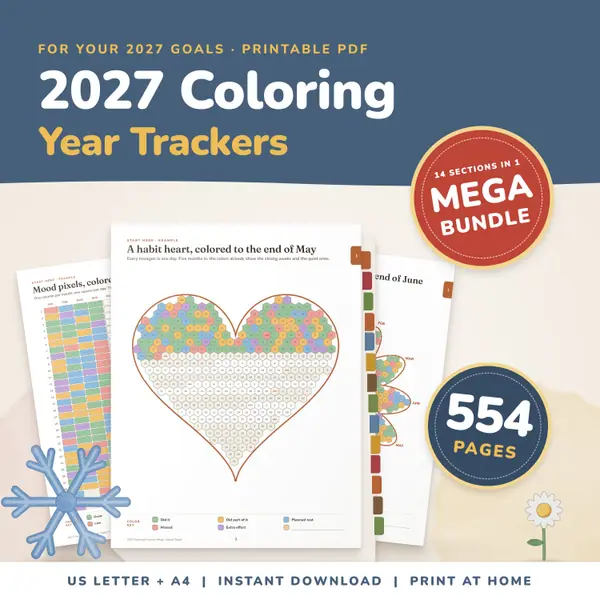
2027 Coloring Habit Tracker Bundle
554 pagesUS Letter + A4Teens & adultsEnglish
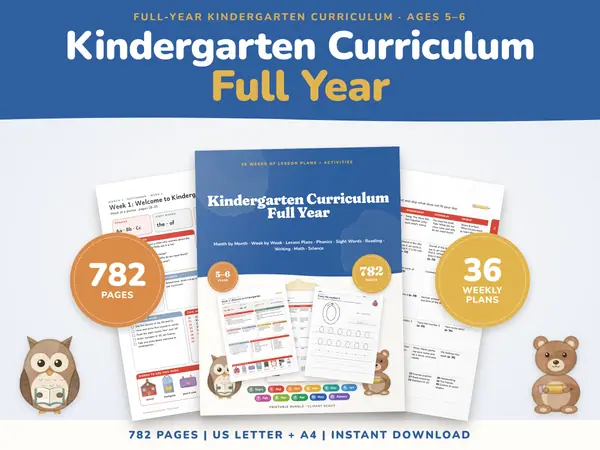
See price and buy on EtsyKindergarten Curriculum Full Year
782 pagesUS Letter + A4KindergartenEnglish
See price and buy on Etsy
Questions and answers
What are the days of the week in English?
Monday, Tuesday, Wednesday, Thursday, Friday, Saturday and Sunday. Saturday and Sunday are the weekend. In many countries the week starts on Monday, and in others it starts on Sunday.
Do the days of the week have a capital letter in English?
Yes. Every day name starts with a capital letter, in the middle of a sentence too: "We have a test on Friday." The months also start with a capital letter.
Is it on Monday or in Monday?
It is on Monday. Use on with days of the week: on Tuesday, on Saturday. Use in with months and seasons, and at with clock times.
How do you spell Wednesday?
W-e-d-n-e-s-d-a-y. The first d is silent, so the word is said "WENZ-day". Breaking it into three parts when writing helps: Wed, nes, day.
What is the difference between a weekday and the weekend?
Weekdays are Monday to Friday, the days of the week when many people work and go to school. The weekend is Saturday and Sunday.
More English vocabulary
- English Alphabet for Kids: Letter Names and Words
- Numbers 1 to 100 in English: Words and Pronunciation
- Colors in English: Names and Pronunciation for Kids
- Shapes in English for Kids: Names and Pronunciation
- Months of the Year and Seasons in English for Kids
- Telling the Time in English: Clock Words for Kids
- Animals in English for Kids: Names and Plurals
- Fruits and Vegetables in English for Kids
- Food and Drinks in English for Kids: Word List
- Parts of the Body in English for Kids
- Family Words in English for Kids: Members and Plurals
- Clothes in English: Words and Pronunciation for Kids
- Classroom Objects in English: School Words for Kids
- Rooms and Furniture in English: House Words for Kids
- Transport in English: Vehicle Words for Kids
- Feelings in English: Emotion Words for Kids
- Weather Words in English: Vocabulary for Kids
- Action Verbs for Kids: Common English Verbs
- Opposites in English: Word Pairs for Kids
- Prepositions of Place in English: In, On, Under
- English Greetings and Classroom Phrases for Kids
- Question Words in English: Who, What, Where, Why
Link to this page
Teachers and parents are welcome to link to this page. Copy the address or the ready-made link.