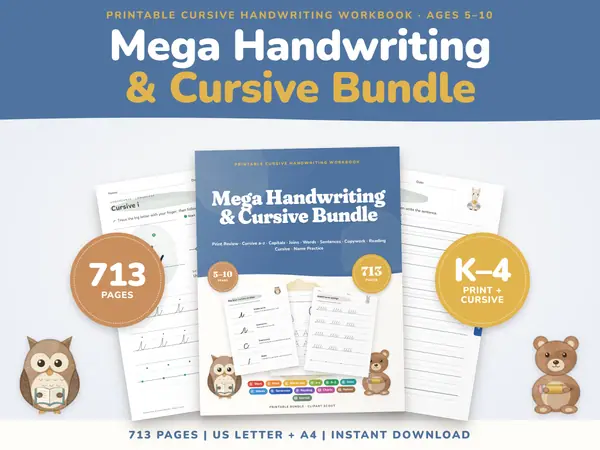
Cursive Handwriting Practice Bundle
713 pagesUS Letter + A4Kindergarten to 4th gradeEnglish
See price and buy on EtsyBy the Clipart Scout teamUpdated 20 words
Short answer
Opposites are words with the opposite meaning: big and small, hot and cold, tall and short, fast and slow, old and young, full and empty, loud and quiet. Teach them in pairs, in one sentence: An elephant is big. A mouse is small. Some words have more than one opposite: the opposite of old is young for people and new for things.
This page lists twenty pairs of opposites that children meet early, each with the pronunciation of the first word and an example sentence that uses both words. Tap the speaker button to hear it.
Below the list you will find a quick practice, ideas for teaching opposites at home or in class, and the mistakes learners make most often, such as old and new, the two meanings of right, light and hard, and early and late.
| Listen | English | Example |
|---|---|---|
| big ↔ small/bɪɡ/ ↔ /smɔːl/ | An elephant is big. A mouse is small. | |
| hot ↔ cold/hɑːt/ ↔ /koʊld/ | The soup is hot. The ice is cold. | |
| tall ↔ short/tɔːl/ ↔ /ʃɔːrt/ | A giraffe is tall. A cat is short.For things, the opposite of short can also be long. | |
| fast ↔ slow/fæst/ ↔ /sloʊ/ | A rabbit is fast. A turtle is slow. | |
| old ↔ young/oʊld/ ↔ /jʌŋ/ | My grandfather is old. The baby is young.For things, the opposite of old is new. | |
| heavy ↔ light/ˈhevi/ ↔ /laɪt/ | A rock is heavy. A feather is light.Light also means not dark. | |
| hard ↔ soft/hɑːrd/ ↔ /sɔːft/ | A stone is hard. A pillow is soft.Hard also means difficult. | |
| wet ↔ dry/wet/ ↔ /draɪ/ | The dog is wet. The towel is dry. | |
| clean ↔ dirty/kliːn/ ↔ /ˈdɜːrti/ | The plate is clean. The sock is dirty. | |
| full ↔ empty/fʊl/ ↔ /ˈempti/ | The glass is full. The box is empty. | |
| bright ↔ dark/braɪt/ ↔ /dɑːrk/ | The sun is bright. The night is dark. | |
| loud ↔ quiet/laʊd/ ↔ /ˈkwaɪət/ | The drum is loud. The mouse is quiet. | |
| easy ↔ difficult/ˈiːzi/ ↔ /ˈdɪfəkəlt/ | The game is easy. The test is difficult. | |
| right ↔ left/raɪt/ ↔ /left/ | I raise my right hand. I raise my left hand.Right also means correct. | |
| thick ↔ thin/θɪk/ ↔ /θɪn/ | The book is thick. The paper is thin. | |
| early ↔ late/ˈɜːrli/ ↔ /leɪt/ | I get up early. I go to bed late.Late is not the same as lately. | |
| up ↔ down/ʌp/ ↔ /daʊn/ | The kite goes up. The ball goes down. | |
| wide ↔ narrow/waɪd/ ↔ /ˈnæroʊ/ | The road is wide. The path is narrow. | |
| sweet ↔ sour/swiːt/ ↔ /ˈsaʊər/ | The honey is sweet. The lemon is sour. | |
| strong ↔ weak/strɔːŋ/ ↔ /wiːk/ | A bear is strong. A butterfly is weak. |
Act out each pair: arms wide for big, arms close for small, stand tall and crouch down for tall and short. Say the word as you do it. The child copies and then gives the instruction: "Be fast. Now be slow." Movement makes the meaning clear.
Ask the child to find two things that are opposites: a heavy book and a light feather, a wet cloth and a dry cloth. Hold them up and say a sentence with both words. Let the child choose the next pair.
Say one word of a pair and the child answers with the other, faster and faster: "Hot." "Cold." "Up." "Down." Start with pairs the child knows well. When the child gets it, give a sentence to finish: "The elephant is big, but the mouse is ..."
Make two cards for every pair, a picture on each: a sun and a moon for bright and dark. Turn all cards face down and find the matching opposites. Each time a pair is found, the child says both words.
Choose a day or a short time when everything is backwards. If you say "Stand up," the child sits down, and if you say "Open the door," the child closes it. The child must also say the opposite word out loud, which makes it a listening and speaking game.
Fold a paper in two. On one side the child draws something big, on the other something small, and writes or says the two words. Do one fold for each pair and join them into a little book of opposites.
For people and animals, old and young are opposites: an old man, a young girl. For things, the opposite of old is new: an old car, a new car. Wrong: "a young book." Right: "a new book."
Tall and short are used for people and trees: a tall girl, a short boy. For a rope, a road or a pencil we also say long and short. Wrong: "a tall rope." Right: "a long rope."
Right is the opposite of left, but also means correct. Light is the opposite of heavy, but also of dark. Hard is the opposite of soft, but also of easy. A sentence shows the meaning: "The test is hard."
Some opposites use un-, such as happy and unhappy, but not all. The opposite of big is small, not "unbig." The opposite of hot is cold, not "unhot." Learn the pairs as two separate words.
Late is the opposite of early: "I go to bed late." Lately means recently and is a different word. Wrong: "I get up lately." Right: "I get up late." Early is both an adjective and an adverb: "I get up early."
713 pagesUS Letter + A4Kindergarten to 4th gradeEnglish
See price and buy on Etsy446 pagesUS Letter + A4KindergartenEnglish
See price and buy on EtsyOpposites, also called antonyms, are words with the opposite meaning, such as hot and cold, big and small, up and down. Children learn them in pairs because each word makes the other easier to remember.
It depends. For people and animals, the opposite of old is young. For things, such as a house or a toy, the opposite of old is new. English does not use young for things.
For height, the opposite of short is tall: a short boy, a tall boy. For length, the opposite of short is long: a short rope, a long rope. The same word has two opposites.
When you talk about direction, the opposite of right is left. When right means correct, the opposite is wrong. A sentence helps to show the meaning: "Raise your right hand" or "That answer is right."
Teach them in pairs and with objects: a heavy book and a light feather, a wet cloth and a dry one. Then use actions and games. Start with pairs the child can see or feel, and move to the more abstract ones later.
Teachers and parents are welcome to link to this page. Copy the address or the ready-made link.