Reading Comprehension and Grammar Bundle
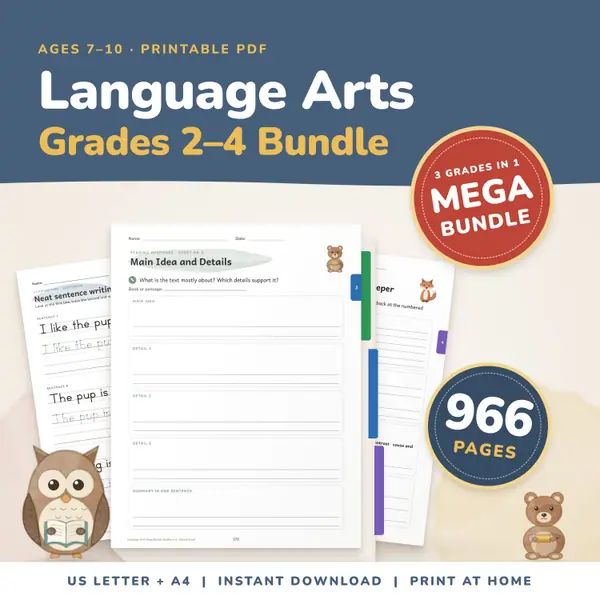
966 pagesUS Letter + A42nd grade to 4th gradeEnglish
See price and buy on EtsyBy the Clipart Scout teamUpdated 12 words
Short answer
Prepositions of place tell us where something is. The main ones are in, on, under, next to, behind, in front of, between, above, below, near, inside and outside. A simple pattern is: The ball is in the box. Use in for inside something, on for touching a surface, and under for lower than something. Between needs two things.
This page lists twelve prepositions of place, each with its pronunciation and a short example sentence about a ball and a box. Tap the speaker button to hear it. A real ball and a real box make the lesson much easier.
Below the list you will find a quick practice, ideas for teaching prepositions at home or in class, and the mistakes learners make most often, such as in front of, next to, between and the difference between in, on and at.
| Listen | English | Example |
|---|---|---|
| in/ɪn/ | The ball is in the box. | |
| on/ɑːn/ | The ball is on the box. | |
| under/ˈʌndər/ | The ball is under the box. | |
| next to/nekst tə/ | The ball is next to the box.Two words: next to. Do not leave out to. | |
| behind/bɪˈhaɪnd/ | The ball is behind the box. | |
| in front of/ɪn frʌnt əv/ | The ball is in front of the box.Three words: in front of. Do not leave out of. | |
| between/bɪˈtwiːn/ | The ball is between two boxes.Use it with two things: between the two boxes. | |
| above/əˈbʌv/ | The ball is above the box.Above is higher and does not touch. On touches. | |
| below/bɪˈloʊ/ | The ball is below the box.Below is lower and does not touch. Under is right beneath. | |
| near/nɪr/ | The ball is near the box. | |
| inside/ˌɪnˈsaɪd/ | The ball is inside the box. | |
| outside/ˌaʊtˈsaɪd/ | The ball is outside the box. |
Use a ball and a box. Say, "Put the ball in the box," and the child does it. Then on, under, behind, next to and so on. Let the child change the position and say a sentence: "The ball is under the box." Real objects make the meaning clear.
Hide a teddy bear in the room and give a clue with a preposition: "It is behind the sofa." The child looks and answers: "Here it is. It is behind the sofa." Swap roles and let the child hide the toy and give the clue.
Use a chair and ask the child to stand in different places: "Stand behind the chair. Stand next to the chair. Sit on the chair. Go under the table." The whole body learns the words, and the game is fun for active children.
Give the child a blank sheet and a pencil. Say, "Draw a house. Draw a tree next to the house. Draw a sun above the house. Draw a cat in front of the house." Then compare the picture with the instructions and talk about it.
Look at a picture book scene with many things. Ask, "Where is the dog? Where is the bird?" The child answers with a full sentence: "The dog is next to the tree." Take turns, so the child also asks the questions.
Put three cups upside down on a table and hide a small object under one. The child asks, "Is it under the red cup?" You answer yes or no. Move the cups and play again. The game practices the question and the preposition together.
In front of has three words. Wrong: "The dog is in front the house." Right: "The dog is in front of the house." The opposite is behind, which is one word and needs no of.
Say next to: "I sit next to Mia." Wrong: "I sit next of Mia." Wrong: "I sit next Mia." Near is a good short alternative: "I sit near Mia."
Between needs two things or places: "The ball is between the two boxes." Wrong: "The ball is between the box." For one thing, use next to, near or in.
Use in for inside something (in the box), on for touching a surface (on the table, on the wall) and at for a point (at the door, at the table). Wrong: "The picture is in the wall." Right: "The picture is on the wall."
Under is directly beneath: the ball under the box. Below is lower, often not touching. On touches the surface, and above is higher with space between. Children can start with on and under and add the others later.
966 pagesUS Letter + A42nd grade to 4th gradeEnglish
See price and buy on EtsyPrepositions of place are small words that tell where something is: in, on, under, next to, behind, in front of, between, above and near. They come before a noun: on the table, under the bed.
In means inside: in the box, in the room. On means touching a surface: on the table, on the wall. At means a point or a place: at the door, at school. For time, use at for clock times, on for days and in for months.
Under means directly beneath something: the ball is under the table. Below means lower than something, and can be further away: the sixth floor is below the seventh. Children can use under first.
Behind is the standard word. In back of is used in some American speech, but behind is understood everywhere and easier for children. Use behind in your lessons.
Use real objects and the child's body: a ball and a box, a chair to go under or behind. Say the preposition while the child moves the object, and later let the child give the instructions.
Teachers and parents are welcome to link to this page. Copy the address or the ready-made link.