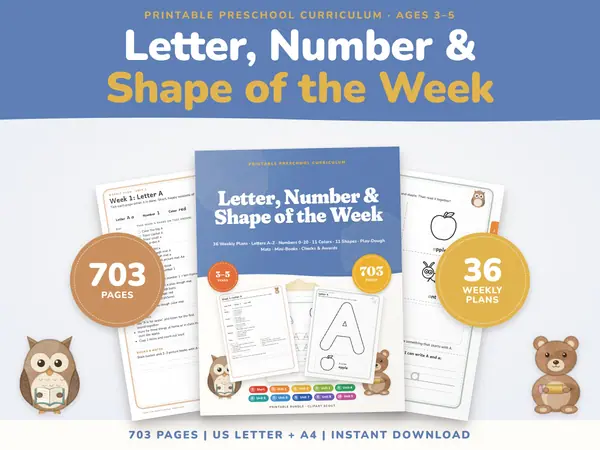
Letter of the Week Preschool Curriculum
703 pagesUS Letter + A4Ages 3–5English
See price and buy on EtsyBy the Clipart Scout teamUpdated 17 words
Short answer
The basic shapes in English are circle, square, triangle, rectangle, oval, star and heart. Learners then add diamond, pentagon, hexagon and octagon, and the solid shapes cube, sphere, cone, cylinder and pyramid. A triangle has three sides, a square and a rectangle have four, a pentagon five, a hexagon six and an octagon eight. Use "a" before most shape names, but "an" before oval and octagon.
This page lists the shape words children meet first, each with its pronunciation and a short example sentence. Tap the speaker button to hear a word. The flat shapes come first and the solid shapes follow, so you can teach them in two steps.
Below the list you will find a quick practice, ideas for teaching shapes with things found at home or in class, and the mistakes learners make most often with shape words, including which shapes take a and which take an.
| Listen | English | Example |
|---|---|---|
| circle/ˈsɜːrkəl/a circle · circles | A circle is round. | |
| square/skwer/a square · squares | A square has four equal sides. | |
| triangle/ˈtraɪæŋɡəl/a triangle · triangles | A triangle has three sides. | |
| rectangle/ˈrektæŋɡəl/a rectangle · rectangles | A rectangle has four sides. | |
| oval/ˈoʊvəl/an oval · ovals | An oval looks like an egg.Say "an oval", because oval starts with a vowel sound. | |
| star/stɑːr/a star · stars | A star shines in the night sky. | |
| heart/hɑːrt/a heart · hearts | I draw a heart. | |
| diamond/ˈdaɪmənd/a diamond · diamonds | A diamond has four sides.A diamond is a shape with four equal sides, standing on one point. | |
| pentagon/ˈpentɪɡɑːn/a pentagon · pentagons | A pentagon has five sides. | |
| hexagon/ˈheksəɡɑːn/a hexagon · hexagons | A hexagon has six sides. | |
| octagon/ˈɑːktəɡɑːn/an octagon · octagons | A stop sign is an octagon.Say "an octagon". An octagon has eight sides. | |
| crescent/ˈkresənt/a crescent · crescents | The moon can look like a crescent. |
| Listen | English | Example |
|---|---|---|
| cube/kjuːb/a cube · cubes | A cube has six flat faces.A cube is a solid shape. A square is flat. | |
| sphere/sfɪr/a sphere · spheres | A sphere is round like a ball. | |
| cone/koʊn/a cone · cones | A cone looks like a party hat. | |
| cylinder/ˈsɪləndər/a cylinder · cylinders | A can is a cylinder. | |
| pyramid/ˈpɪrəmɪd/a pyramid · pyramids | A pyramid has a point at the top. |
Look at the picture or number and choose the right English word. Ten questions each round.
Name a shape and ask the child to find and touch something with that shape: a round clock, a square window, a rectangle door. Then swap roles. Looking for shapes in real objects gives each word a meaning the child can see and touch.
Give the child sticks, straws or pasta pieces and some play dough. Make a triangle with three sticks and a square with four, counting the sides aloud: "One, two, three. A triangle has three sides." Building the shape shows why each one has its name.
Cut paper into circles, squares, triangles and rectangles in different colors and sizes. Ask the child to sort them into piles by shape, not by color. Say the name each time a piece goes onto a pile, then count how many are in each pile.
Ask the child to make a house, a robot or a boat using only shapes. Then ask questions: "What shape is the roof? How many circles are there?" The child practices the shape names and the question words together.
Put solid objects in a cloth bag: a ball, a box, a can, a party hat. The child reaches in, feels one and guesses: sphere, cube, cylinder, cone. Say the shape word and the object together, then let the child take out the object to check.
Make bingo cards with a grid of shapes. Call out the shape names one by one and have the children cover the matching shapes with small counters. The first to cover a row says "Bingo!" and reads the shapes back.
Use "an" before words that start with a vowel sound: an oval, an octagon. All the other shape words on this page take "a": a circle, a square, a triangle, a cube.
A square has four equal sides. A rectangle has four sides too, but two are longer than the other two. Show a book next to a sticky note and say: "This is a rectangle. This is a square."
A pentagon has five sides, a hexagon has six and an octagon has eight. Learners often swap them. Count the sides aloud with the child each time and point to a stop sign as an example of an octagon.
Say one triangle but three triangles, one circle but two circles. Learners sometimes say "two circle". Hold up cards and ask "How many?" to practice the plural with the numbers.
A square and a circle are flat. A cube and a sphere are solid. Learners may call a ball "a circle". Say: "A ball is a sphere. A box is a cube." Show the flat and solid versions side by side.
703 pagesUS Letter + A4Ages 3–5English
See price and buy on Etsy1,043 pagesUS Letter + A4KindergartenEnglish
See price and buy on EtsyThe basic shapes are circle, square, triangle, rectangle, oval, star and heart. After these, children usually learn diamond, pentagon, hexagon and octagon.
A triangle has three sides, a square and a rectangle have four, a pentagon has five, a hexagon has six and an octagon has eight. A circle has no sides and no corners.
The common solid shapes are cube, sphere, cone, cylinder and pyramid. They are also called 3D shapes. A ball is a sphere, a box is a cube and a can is a cylinder.
Both have four sides and four corners. In a square all four sides are the same length. In a rectangle the opposite sides are equal, but two sides are longer than the other two.
Use "an" before a vowel sound: an oval, an octagon. Use "a" before the others: a circle, a square, a triangle, a rectangle, a star.
Teachers and parents are welcome to link to this page. Copy the address or the ready-made link.