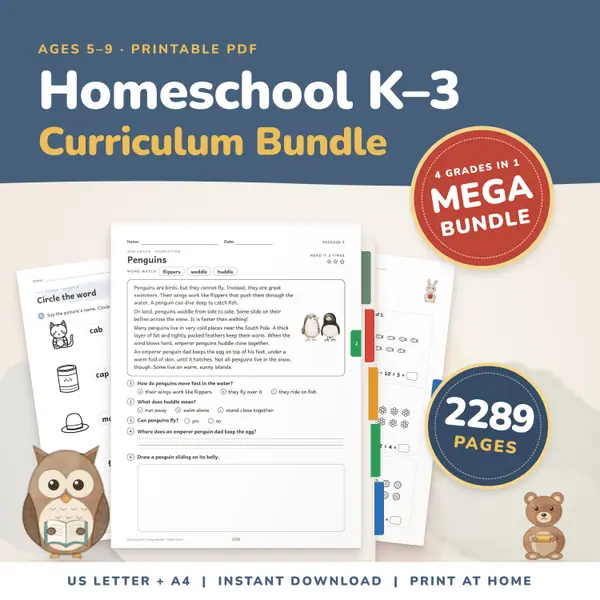
Homeschool Curriculum Bundle K-3
2,289 pagesUS Letter + A4Kindergarten to 3rd gradeEnglish
See price and buy on EtsyBy the Clipart Scout teamUpdated 30 words
Short answer
Common school words in English are pencil, pen, book, notebook, eraser, ruler, scissors, backpack, desk, chair, board, teacher, student and classroom. Some words have no plural or only a plural form: homework and paper are not counted with -s, and scissors always has one. Say a pair of scissors and a piece of homework.
This page lists the words children need in a classroom: things on the desk, things in the room, and the people and places of a school. Each word has its pronunciation and a short example sentence. Tap the speaker button to hear it.
Below the list you will find a quick practice, ideas for teaching school words at home or in class, and the mistakes learners make most often with them, such as homework, scissors and the American and British words.
| Listen | English | Example |
|---|---|---|
| ✏️ | pencil/ˈpensəl/a pencil · pencils | I write with a pencil. |
| 🖊️ | pen/pen/a pen · pens | My pen is blue. |
| 📖 | book/bʊk/a book · books | I read a book. |
| 📓 | notebook/ˈnoʊtbʊk/a notebook · notebooks | I write in my notebook. |
| eraser (British: rubber)/ɪˈreɪsər/an eraser · erasers | I use an eraser.American English. British English says rubber. | |
| 📏 | ruler/ˈruːlər/a ruler · rulers | I draw a line with a ruler. |
| ✂️ | scissors/ˈsɪzərz/ | I cut paper with scissors.Always plural: a pair of scissors. |
| glue/ɡluː/ | Glue is sticky. | |
| 🖍️ | crayon/ˈkreɪɑːn/a crayon · crayons | I draw with a red crayon. |
| marker/ˈmɑːrkər/a marker · markers | The marker is black. | |
| 🎒 | backpack/ˈbækpæk/a backpack · backpacks | My backpack is heavy. |
| 📄 | paper/ˈpeɪpər/ | I draw on paper.Not counted: say a sheet of paper. |
| pencil case/ˈpensəl keɪs/a pencil case · pencil cases | My pencil case is blue. | |
| homework/ˈhoʊmwɜːrk/ | I do my homework at home.Not counted: no homeworks. Say a piece of homework. |
| Listen | English | Example |
|---|---|---|
| desk/desk/a desk · desks | My desk is clean. | |
| 🪑 | chair/tʃer/a chair · chairs | I sit on a chair. |
| board/bɔːrd/a board · boards | Look at the board. | |
| 🚪 | door/dɔːr/a door · doors | Please close the door. |
| 🪟 | window/ˈwɪndoʊ/a window · windows | I look out of the window. |
| 🕐 | clock/klɑːk/a clock · clocks | The clock says three. |
| 💻 | computer/kəmˈpjuːtər/a computer · computers | I use the computer in class. |
| 🗺️ | map/mæp/a map · maps | The map shows the world. |
| Listen | English | Example |
|---|---|---|
| teacher/ˈtiːtʃər/a teacher · teachers | My teacher is kind. | |
| student/ˈstuːdənt/a student · students | The student is reading. | |
| classmate/ˈklæsmeɪt/a classmate · classmates | My classmate sits next to me. | |
| classroom/ˈklæsruːm/a classroom · classrooms | Our classroom is big. | |
| 🏫 | school/skuːl/a school · schools | I walk to school. |
| playground/ˈpleɪɡraʊnd/a playground · playgrounds | We play on the playground. | |
| library/ˈlaɪbreri/a library · libraries | I borrow a book at the library. | |
| principal (British: head teacher)/ˈprɪnsəpəl/a principal · principals | The principal says hello.American English. British English says head teacher. |
Look at the picture or number and choose the right English word. Ten questions each round.
Put five or six school objects in a pencil case or a bag. The child reaches in without looking, feels one thing and guesses: "It is a ruler." Then pull it out to check. Add more objects over several days as the child learns new words.
Write the English words on sticky notes or small cards: desk, door, window, board, clock. The child sticks each note on the right object and reads it aloud. Leave the labels up for a week and point to them whenever you pass.
Give short commands with school objects: "Touch the desk. Pick up the pencil. Put the book on the chair." The child acts them out. After a few rounds the child becomes the teacher and gives the commands, which gives practice in speaking.
Name a school day and ask, "What do you need today?" The child puts the right things into a backpack and says each word: "a notebook, a pencil, a ruler." Repeat with a different day, such as an art lesson.
One person draws a school object on paper or on a small board, a little at a time. The other guesses in English: "Is it a clock?" Keep the drawings simple. Guessing wrong is fine, because every guess is another chance to say a word.
Set up chairs as a classroom. One child is the teacher and one is the student. Use greetings, an attendance call and a short question about a school object: "Where is my pen?" Swap roles after a few minutes.
Homework is not counted in English. Say "I have a lot of homework" or "I have two pieces of homework." Wrong: "I have three homeworks." Paper and furniture work the same way.
Scissors is always plural because it has two blades. Say "The scissors are on the desk" and "I need a pair of scissors." For two, say two pairs of scissors.
In English you do homework, not make it: "I do my homework after school." Wrong: "I make my homework." You also do an exercise, and you make a mistake.
Borrow means to take something for a short time: "I borrow a book from the library." Lend means to give it for a short time: "The library lends books." Wrong: "Can you borrow me a pen?" Right: "Can you lend me a pen?"
American schools have an eraser and a principal. British schools have a rubber and a head teacher. In the same way, American classroom words may differ from British ones, so choose one set and keep to it.
2,289 pagesUS Letter + A4Kindergarten to 3rd gradeEnglish
See price and buy on EtsyClassroom objects are the things you find in a classroom, such as a desk, a chair, a board, a book, a pencil, a ruler and a backpack. Children usually learn them in the first lessons of English.
It is a pair of scissors. Scissors is always plural in English, like pants and glasses. You can also say the scissors without a pair of: "Where are the scissors?"
Both mean a person who learns at school. Student is the common word in American English, for all ages. In British English, pupil is often used for younger children. A child can safely learn student first.
A book has printed pages that you read. A notebook has empty pages that you write in. The word notebook is one word, and pencil case is two words.
Start with the things the child touches every day: pencil, pen, book, notebook, bag, desk and chair. Add teacher, classroom and board, then the rest of the list when the first words feel easy.
Teachers and parents are welcome to link to this page. Copy the address or the ready-made link.