Fruits and Vegetables in English: Names and Pronunciation
By the Clipart Scout teamUpdated 32 words
Short answer
Common fruits in English are apple, banana, orange, grapes, strawberry, lemon and pear. Common vegetables are carrot, potato, tomato, cucumber, onion, broccoli and peas. Count most of them with a or an (an apple, a carrot) and add -s for more than one. Some plurals change: tomatoes, potatoes, cherries, strawberries. Some words are not counted: broccoli, garlic and lettuce.
This page lists the fruits and vegetables children see at home and in the shop, with pronunciation and a short example sentence. Tap the speaker button to hear a word. Where American and British English use different words, such as eggplant and aubergine, both are shown.
Fruit and vegetables are easy to teach with real food, which makes the lesson short and real. Below you will find a quick practice, teaching ideas and the mistakes learners make most often with plurals and with words that are not counted.
Word list
Fruits
| Listen | English | Example |
|---|---|---|
| 🍎 | apple/ˈæpəl/an apple · apples | The apple is red and sweet. |
| 🍌 | banana/bəˈnænə/a banana · bananas | The banana is yellow. |
| 🍊 | orange/ˈɔːrəndʒ/an orange · oranges | The orange is round and juicy.Orange is a fruit and a color: "an orange", "orange". |
| 🍇 | grapes/ɡreɪps/ | The grapes are sweet.Usually plural: "a bunch of grapes". |
| 🍓 | strawberry/ˈstrɔːberi/a strawberry · strawberries | The strawberry is red and sweet. |
| 🍉 | watermelon/ˈwɔːtərmelən/a watermelon · watermelons | The watermelon is big and green. |
| 🍍 | pineapple/ˈpaɪnæpəl/a pineapple · pineapples | The pineapple has a spiky top. |
| 🍋 | lemon/ˈlemən/a lemon · lemons | The lemon is sour. |
| 🍒 | cherry/ˈtʃeri/a cherry · cherries | The cherry is small and red. |
| 🍑 | peach/piːtʃ/a peach · peaches | The peach is soft. |
| 🍐 | pear/per/a pear · pears | I eat a pear at lunch. |
| 🥭 | mango/ˈmæŋɡoʊ/a mango · mangoes | The mango is sweet.Plural: mangoes (also mangos). |
| 🥝 | kiwi/ˈkiːwi/a kiwi · kiwis | The kiwi is green inside. |
| 🥥 | coconut/ˈkoʊkənʌt/a coconut · coconuts | The coconut is hard outside. |
| 🫐 | blueberry/ˈbluːberi/a blueberry · blueberries | The blueberry is small and blue. |
| 🍈 | melon/ˈmelən/a melon · melons | I eat a slice of melon. |
Vegetables
| Listen | English | Example |
|---|---|---|
| 🥕 | carrot/ˈkærət/a carrot · carrots | The carrot is orange. |
| 🥔 | potato/pəˈteɪtoʊ/a potato · potatoes | The potato grows in the ground. |
| 🍅 | tomato/təˈmeɪtoʊ/a tomato · tomatoes | The tomato is red and round.Plural: tomatoes, with -es. |
| 🥒 | cucumber/ˈkjuːkəmbər/a cucumber · cucumbers | The cucumber is long and green. |
| 🌽 | corn (British: sweetcorn)/kɔːrn/ | The corn is yellow.American English says corn. British English says sweetcorn. |
| 🥦 | broccoli/ˈbrɑːkəli/ | Broccoli looks like a little tree.Not counted: "some broccoli", not "a broccoli". |
| 🧅 | onion/ˈʌnjən/an onion · onions | The onion makes me cry. |
| 🧄 | garlic/ˈɡɑːrlɪk/ | Garlic has a strong smell. |
| 🫑 | bell pepper/bel ˈpepər/a bell pepper · bell peppers | The bell pepper is red. |
| 🥬 | lettuce/ˈletəs/ | I put lettuce in my sandwich. |
| 🍄 | mushroom/ˈmʌʃrum/a mushroom · mushrooms | The mushroom grows in the dark. |
| pumpkin/ˈpʌmpkɪn/a pumpkin · pumpkins | The pumpkin is big and orange. | |
| eggplant (British: aubergine)/ˈeɡplænt/an eggplant · eggplants | The eggplant is purple.American: eggplant. British: aubergine. | |
| zucchini (British: courgette)/zuˈkiːni/a zucchini · zucchini | The zucchini is long and green.American: zucchini. British: courgette. | |
| peas/piːz/ | Peas are small and green.Usually plural: "The peas are green". | |
| cabbage/ˈkæbədʒ/a cabbage · cabbages | The cabbage is round and green. |
Practice on screen
Look at the picture or number and choose the right English word. Ten questions each round.
How to teach it
1. Taste and name
Bring a few safe, familiar fruits and vegetables to the table. Let the child look, smell, touch and taste, then say the name and one word: "Apple. Sweet." Real food gives the word a strong memory. Check for allergies first.
2. Shopping game
Set up a pretend shop with picture cards or toy food. One child is the shopper and asks: "Can I have two apples, please?" The other puts them in a basket. Swap roles. This practices the words, numbers and plurals in a useful sentence.
3. Fruit or vegetable?
Make two big circles on paper, one for fruit and one for vegetables. The child places each picture card in a circle and says the name. Discuss borderline cases only if the child is ready; for now, sort by what people usually call them.
4. Color the produce
Draw outlines of a banana, a tomato, a carrot and a pear, and ask the child to color each correctly. Say a color for each: "The carrot is orange." This links the topic to the colors the child already knows.
5. What is in the bag?
Put a fruit or vegetable in a cloth bag. The child reaches in and feels it, then guesses in English: "It is a pear." Give hints with words the child knows: "It is round. It is green."
6. Make a fruit salad
Cook or prepare a simple fruit salad together and give simple instructions: "Wash the grapes. Cut the banana." The child hears the fruit names in real sentences and sees what they mean.
Common mistakes
Writing tomatos and potatos
Tomato and potato add -es in the plural: tomatoes, potatoes. Mango can be mangoes or mangos. Say the plural aloud when you write it and show the extra e.
Changing -y to -ies
When a word ends in a consonant plus y, the y changes to ies: strawberry becomes strawberries, cherry becomes cherries. Learners often write "strawberrys". Compare with banana, which only adds -s.
Using a with broccoli, garlic and lettuce
These are not counted, so do not say "a broccoli". Say "some broccoli", "some lettuce" or "a head of lettuce". Say "a clove of garlic" for one piece.
Using a instead of an
Use an before a vowel sound: an apple, an orange, an onion, an eggplant. Use a before the rest: a banana, a pear, a carrot.
Saying "a grapes" or "a peas"
Grapes and peas are plural words, so they do not take a. Say "grapes", "some grapes", "a bunch of grapes" and "some peas". One piece is a grape or a pea.
Questions and answers
What are the names of fruits in English?
Common fruits are apple, banana, orange, grapes, strawberry, watermelon, pineapple, lemon, cherry, peach, pear and mango. Kiwi, coconut, blueberry and melon are also common.
What are the names of vegetables in English?
Common vegetables are carrot, potato, tomato, cucumber, corn, broccoli, onion, garlic, lettuce, mushroom, pumpkin and peas. Cabbage and bell pepper are also very common.
What is the plural of tomato and potato?
The plural of tomato is tomatoes and the plural of potato is potatoes. Both add -es. Most other fruit and vegetable names simply add -s: apples, carrots.
What is the difference between eggplant and aubergine?
They are the same vegetable. Eggplant is the American English word and aubergine is the British English word. Zucchini and courgette are another pair.
Is a tomato a fruit or a vegetable?
People usually call it a vegetable in cooking and shops, even though in science it is a fruit. For a child learning English, you can place it with the vegetables, as in most books.
More English vocabulary
- English Alphabet for Kids: Letter Names and Words
- Numbers 1 to 100 in English: Words and Pronunciation
- Colors in English: Names and Pronunciation for Kids
- Shapes in English for Kids: Names and Pronunciation
- Days of the Week in English: Order and Spelling
- Months of the Year and Seasons in English for Kids
- Telling the Time in English: Clock Words for Kids
- Animals in English for Kids: Names and Plurals
- Food and Drinks in English for Kids: Word List
- Parts of the Body in English for Kids
- Family Words in English for Kids: Members and Plurals
- Clothes in English: Words and Pronunciation for Kids
- Classroom Objects in English: School Words for Kids
- Rooms and Furniture in English: House Words for Kids
- Transport in English: Vehicle Words for Kids
- Feelings in English: Emotion Words for Kids
- Weather Words in English: Vocabulary for Kids
- Action Verbs for Kids: Common English Verbs
- Opposites in English: Word Pairs for Kids
- Prepositions of Place in English: In, On, Under
- English Greetings and Classroom Phrases for Kids
- Question Words in English: Who, What, Where, Why
Link to this page
Teachers and parents are welcome to link to this page. Copy the address or the ready-made link.
Printables from our shop
Ready-made worksheets and activity packs. You buy and download them in our Etsy shop.
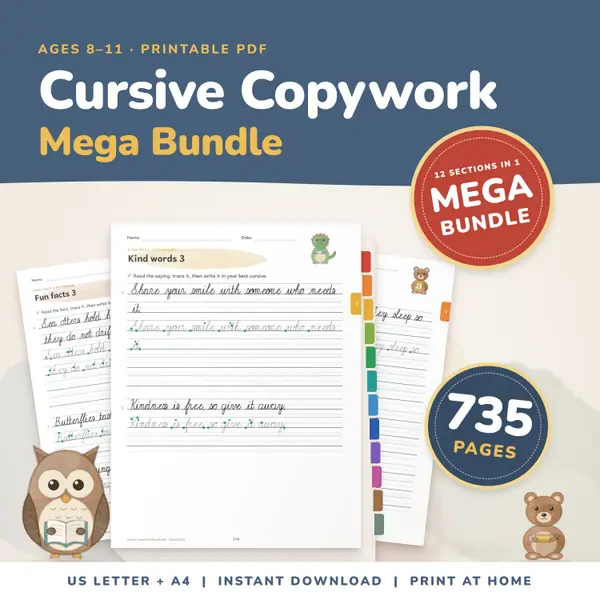
Cursive Copywork Bundle
735 pagesUS Letter + A43rd grade to 5th gradeEnglish
See price and buy on Etsy