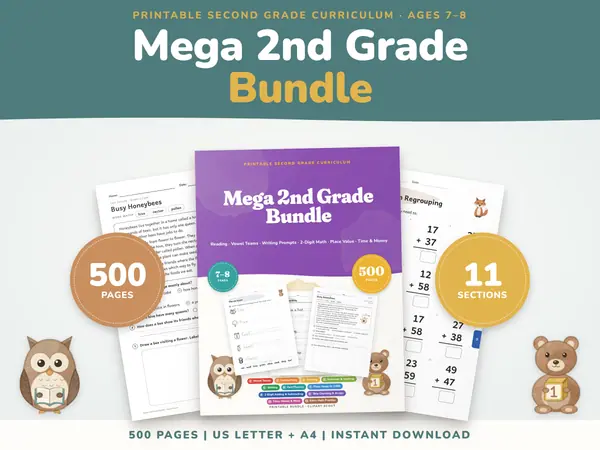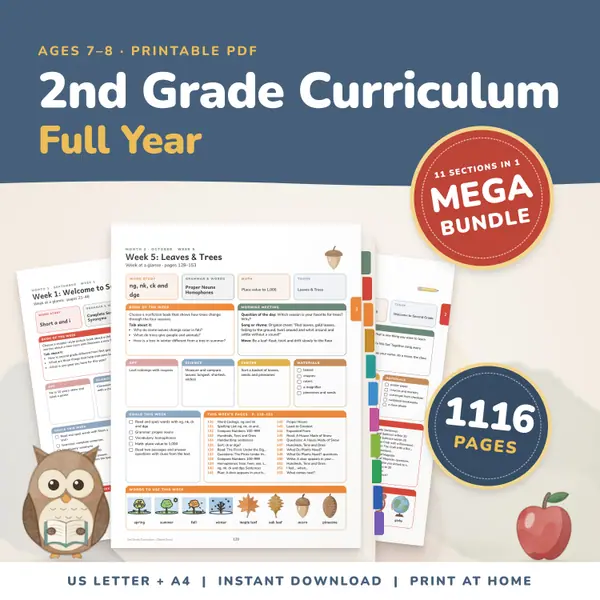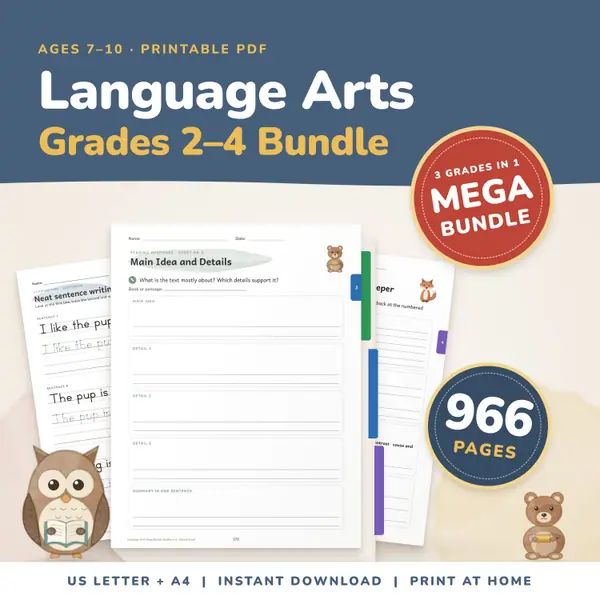
Reading Comprehension and Grammar Bundle
966 pagesUS Letter + A42nd grade to 4th gradeEnglish
See price and buy on EtsyBy the Clipart Scout teamUpdated 32 words
Short answer
Action verbs are words for things we do: run, jump, walk, swim, eat, drink, sleep, read, write, draw, play and sing. After I, you, we and they, the verb stays the same: I run. After he, she and it, add -s: he runs, she eats. After can, use the plain verb: I can swim. Many past forms are irregular: go becomes went, run becomes ran.
This page lists thirty-two action verbs that children use every day, grouped by movement, daily life, school and play. Each verb comes with its pronunciation and a short example sentence. Tap the speaker button to hear it.
Below the list you will find a quick practice, ideas for teaching verbs at home or in class, and the mistakes learners make most often, such as the -s in he runs, the verb after can, irregular past forms and -ing spelling.
| Listen | English | Example |
|---|---|---|
| go/ɡoʊ/going · went | I go to school.Irregular past: went. | |
| 🏃 | run/rʌn/running · ran | I can run fast.Irregular past: ran. The -ing form is running. |
| 🚶 | walk/wɔːk/walking · walked | We walk to the park. |
| jump/dʒʌmp/jumping · jumped | I can jump high. | |
| 🏊 | swim/swɪm/swimming · swam | I can swim. |
| 🧗 | climb/klaɪm/climbing · climbed | I can climb a tree. |
| fly/flaɪ/flying · flew | Birds can fly. | |
| sit/sɪt/sitting · sat | I sit at my desk. | |
| stand/stænd/standing · stood | We stand in a line. |
| Listen | English | Example |
|---|---|---|
| eat/iːt/eating · ate | We eat lunch together. | |
| drink/drɪŋk/drinking · drank | I drink water. | |
| 💤 | sleep/sliːp/sleeping · slept | I sleep at night. |
| wash/wɑːʃ/washing · washed | I wash my hands. | |
| 🍳 | cook/kʊk/cooking · cooked | We cook dinner together. |
| open/ˈoʊpən/opening · opened | I open the door. | |
| close/kloʊz/closing · closed | Please close the window. | |
| give/ɡɪv/giving · gave | I give my friend a pencil. |
| Listen | English | Example |
|---|---|---|
| read/riːd/reading · read | We read books.The past form is also read, but it sounds like red. | |
| ✍️ | write/raɪt/writing · wrote | I write my name. |
| draw/drɔː/drawing · drew | I draw a picture. | |
| listen/ˈlɪsən/listening · listened | We listen to the teacher. | |
| ask/æsk/asking · asked | I ask a question. | |
| answer/ˈænsər/answering · answered | I answer the question. | |
| 🤔 | think/θɪŋk/thinking · thought | I think about my dog. |
| Listen | English | Example |
|---|---|---|
| play/pleɪ/playing · played | We play in the park. | |
| 🎤 | sing/sɪŋ/singing · sang | We sing a song. |
| 💃 | dance/dæns/dancing · danced | I like to dance. |
| kick/kɪk/kicking · kicked | I kick the ball. | |
| throw/θroʊ/throwing · threw | I throw the ball. | |
| catch/kætʃ/catching · caught | I can catch the ball. | |
| ride/raɪd/riding · rode | I ride my bike. | |
| 🎨 | paint/peɪnt/painting · painted | I paint a picture. |
Look at the picture or number and choose the right English word. Ten questions each round.
Give commands with action verbs: "Simon says jump. Simon says swim." The child acts out each one only when you say Simon says. This is a classic game for a reason, because it gives clear listening practice and plenty of movement in a small space.
One person acts out a verb without speaking and the other guesses: "You are eating!" Then say the full sentence together: "I eat." Use the simple verbs first, such as run, jump and sleep, and add harder ones such as climb or catch later.
Choose one verb each day and use it many times: "Let us jump to the door. Can you jump on one leg?" The child hears the same word in different sentences and begins to use it too. Put the verb on a card that you keep on the table.
Make a short list of verbs on paper. For each, the child says "I can" or "I cannot" and acts it out: "I can swim. I can fly" (with a laugh). Funny sentences are easy to remember, and the plain verb after can becomes a habit.
Cut paper into cards. On one set the child draws what the verb means, and on the other set you write the verb. Mix and match them as a memory game. For older children, write a sentence under each picture.
Ask the child to tell about a normal day using verbs only: wake up, wash, eat, walk, read, play, sleep. Show a picture for each. Next, change to full sentences: "I eat breakfast. I walk to school." This builds the habit of using verbs in order.
In the simple present, add -s after he, she and it: "He runs," "She eats," "The dog sleeps." Wrong: "He run." Some verbs add -es: go becomes goes, wash becomes washes, watch becomes watches.
After can, use the plain verb: "I can swim," "She can swim." Wrong: "I can to swim." Wrong: "She can swims." The same rule works for do: "She does not run," not "She does not runs."
Many common verbs do not take -ed: go goes to went, run to ran, swim to swam, eat to ate, drink to drank, sleep to slept, give to gave, write to wrote, sing to sang, catch to caught, throw to threw. Wrong: "I goed." Right: "I went."
Double the last letter after a short vowel in run, swim and sit: running, swimming, sitting. Drop the e in dance, ride and write: dancing, riding, writing. Verbs such as play and jump just add -ing: playing, jumping.
Say listen to, not listen alone with a thing: "We listen to the teacher." Wrong: "We listen the teacher." In the same way, you ask a question, you do not make one: "I ask a question."
966 pagesUS Letter + A42nd grade to 4th gradeEnglish
See price and buy on EtsyAction verbs are words that show something a person, animal or thing does, such as run, jump, eat, read and sing. Children usually learn them early because they can act them out.
In the simple present, the verb takes an -s after he, she, it or a single name: "He runs. Mia sings." After I, you, we and they, the verb stays plain: "I run. They sing."
Go becomes went, run becomes ran, swim becomes swam, eat becomes ate, drink becomes drank, sleep becomes slept, write becomes wrote. These do not take -ed and must be learned one by one.
Double the final consonant when the verb is short and ends in one vowel plus one consonant: run, running; swim, swimming; sit, sitting. Verbs that end in e drop it: dance, dancing.
Start with verbs the child can act out: run, jump, walk, sit, stand, eat, drink and sleep. Then add school verbs such as read, write and draw, and play verbs such as sing, dance and kick.
Teachers and parents are welcome to link to this page. Copy the address or the ready-made link.