Feelings in English: Emotions Vocabulary for Kids
By the Clipart Scout teamUpdated 16 words
Short answer
Common feelings words in English are happy, sad, angry, scared, tired, hungry, thirsty, excited, surprised, shy, proud, bored and worried. To say how you feel, use I am plus the feeling: I am happy, I am hungry. Do not say I have hunger. To ask, say How are you? or How do you feel? A feeling ends in -ed (bored); a thing that causes it ends in -ing (boring).
This page lists sixteen feelings and body states that children use every day, such as happy, sad, hungry and sleepy. Each word comes with its pronunciation and a short example sentence. Tap the speaker button to hear it.
Below the list you will find a quick practice, ideas for teaching feelings at home or in class, and the mistakes learners make most often with them, such as I have hunger, bored and boring, and very and much.
Word list
Feelings
| Listen | English | Example |
|---|---|---|
| 😊 | happy/ˈhæpi/ | I am happy. |
| 😢 | sad/sæd/ | I am sad. |
| 😠 | angry/ˈæŋɡri/ | I am angry. |
| 😨 | scared/skerd/ | I am scared. |
| 🥱 | tired/ˈtaɪərd/ | I am tired. |
| hungry/ˈhʌŋɡri/ | I am hungry. | |
| thirsty/ˈθɜːrsti/ | I am thirsty. | |
| 🤩 | excited/ɪkˈsaɪtəd/ | I am excited.Feeling excited. The thing that causes it is exciting. |
| 😮 | surprised/sərˈpraɪzd/ | I am surprised.Feeling surprised. The thing that causes it is surprising. |
| 🤒 | sick/sɪk/ | I am sick.American English. British English often says ill. |
| shy/ʃaɪ/ | I am shy. | |
| proud/praʊd/ | I am proud. | |
| bored/bɔːrd/ | I am bored.Feeling bored. The thing that causes it is boring. | |
| 😟 | worried/ˈwɜːrid/ | I am worried. |
| 😌 | calm/kɑːm/ | I am calm. |
| 😴 | sleepy/ˈsliːpi/ | I am sleepy. |
Practice on screen
Look at the picture or number and choose the right English word. Ten questions each round.
How to teach it
1. Feelings faces
Draw faces on paper plates, or make them with a marker on your hands. Hold up one face and ask, "How does he feel?" The child answers, "He is sad." Then the child makes faces and you guess. Show the face with the body too.
2. Act it out
Whisper a feeling to the child, who shows it with the face and body without a word: slumped shoulders for tired, a big jump for excited. You guess in a full sentence: "You are tired." Then change roles.
3. Feelings check-in
At a regular time of day, such as before dinner or at the start of a lesson, ask, "How are you today?" Put a set of feelings cards on the table and let the child point to one and say the sentence. Daily repetition makes the words natural.
4. Story pictures
Look at a picture book with expressive faces and stop on a page. Ask, "How does the bear feel? Why?" The child answers in one word first ("Sad"), then you model the full sentence: "He is sad because he lost his ball."
5. Feelings weather report
Make a simple chart with the days of the week. Each day the child draws or sticks a face to show how they feel and says one sentence: "On Monday I am happy." At the end of the week, look back at the chart together.
6. Match feeling to situation
Say a short situation and let the child choose the right feeling card: "It is your birthday." "You lose your toy." "You hear a loud noise." This teaches words together with the moments in which they are used.
Common mistakes
Saying "I have hunger" or "I have thirst"
In English we use the verb to be with feelings and body states: "I am hungry," "I am thirsty," "I am tired." Wrong: "I have hunger." Wrong: "I have fear." Right: "I am scared."
Mixing up bored and boring
Bored describes how a person feels: "I am bored." Boring describes the thing or person that causes the feeling: "The movie is boring." Wrong: "I am boring" when you mean you feel bored. The same is true for excited and exciting.
Saying "I am much happy"
To make a feeling stronger, use very: "I am very happy." Much is not used before an adjective in this way. Wrong: "I am much happy." Right: "I am very happy" or "I am so happy."
Using the wrong small word after angry and scared
People are angry with someone or about something, and scared of something: "I am scared of dogs." Wrong: "I am scared from dogs." Right: "I am scared of dogs." Learn the pair as one phrase.
Answering "How are you?" with "How are you?"
To the question How are you? answer with a feeling and then ask back: "I am fine, thank you. And you?" Wrong answer: repeating "How are you?" as the whole reply. Practice both parts together.
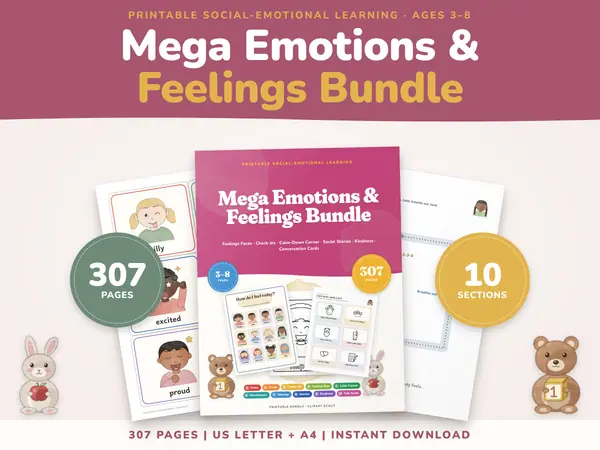
Printables that go with this topic
Questions and answers
What are feelings in English?
Feelings, or emotions, are words such as happy, sad, angry, scared, excited and tired. We usually say them after I am: "I am happy." Body states such as hungry and thirsty use the same pattern.
How do you ask about someone's feelings in English?
Ask "How are you?" or "How do you feel?" A child can answer with I am and a feeling word: "I am happy." For a specific moment, ask "Are you OK?" or "Are you sad?"
What is the difference between bored and boring?
Bored is how you feel: "I am bored." Boring is what causes it: "This game is boring." The same difference applies to excited and exciting, tired and tiring, and surprised and surprising.
Is it I am hungry or I have hunger?
It is I am hungry. English uses to be with hungry, thirsty, tired, cold and scared. Saying I have hunger is a common mistake that comes from other languages.
Which feelings should children learn first?
Start with happy, sad, angry, scared and tired, because children feel them every day. Then add hungry and thirsty, and later words such as shy, proud, worried and calm.
More English vocabulary
- English Alphabet for Kids: Letter Names and Words
- Numbers 1 to 100 in English: Words and Pronunciation
- Colors in English: Names and Pronunciation for Kids
- Shapes in English for Kids: Names and Pronunciation
- Days of the Week in English: Order and Spelling
- Months of the Year and Seasons in English for Kids
- Telling the Time in English: Clock Words for Kids
- Animals in English for Kids: Names and Plurals
- Fruits and Vegetables in English for Kids
- Food and Drinks in English for Kids: Word List
- Parts of the Body in English for Kids
- Family Words in English for Kids: Members and Plurals
- Clothes in English: Words and Pronunciation for Kids
- Classroom Objects in English: School Words for Kids
- Rooms and Furniture in English: House Words for Kids
- Transport in English: Vehicle Words for Kids
- Weather Words in English: Vocabulary for Kids
- Action Verbs for Kids: Common English Verbs
- Opposites in English: Word Pairs for Kids
- Prepositions of Place in English: In, On, Under
- English Greetings and Classroom Phrases for Kids
- Question Words in English: Who, What, Where, Why
Link to this page
Teachers and parents are welcome to link to this page. Copy the address or the ready-made link.