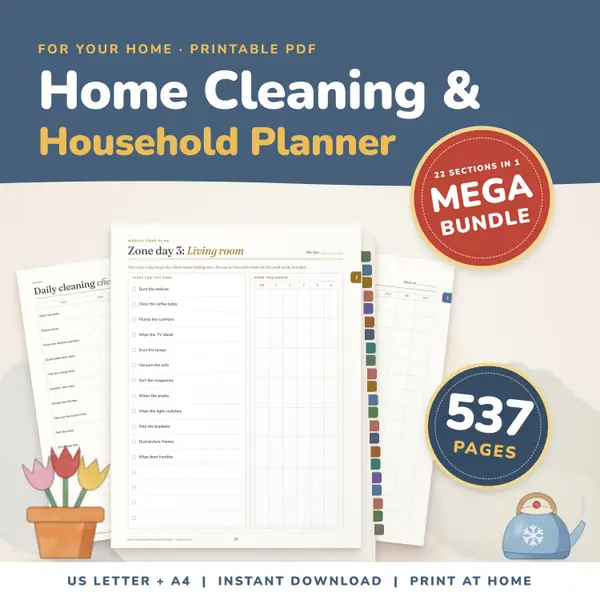
Home Cleaning and Household Planner Mega Bundle
537 pagesUS Letter + A4Teens & adultsEnglish
See price and buy on EtsyBy the Clipart Scout teamUpdated 28 words
Short answer
The main rooms of a house in English are the kitchen, bedroom, bathroom, living room, dining room, garage and garden. Common furniture words are bed, table, chair, sofa, shelf, closet and lamp. Use in for rooms (in the kitchen), on for surfaces (on the sofa, on the wall) and at for a place you stop (at the table). Say go home, not go to home.
This page lists the words for the rooms of a house, the furniture inside it and the things you find at home, such as a key, stairs and a fridge. Each word has its pronunciation and an example sentence. Tap the speaker button to hear it.
Below the list you will find a quick practice, ideas for teaching house words at home or in class, and the mistakes learners make most often, such as house and home, stairs and the small words in, on and at.
| Listen | English | Example |
|---|---|---|
| 🏠 | house/haʊs/a house · houses | I live in a big house. |
| kitchen/ˈkɪtʃən/a kitchen · kitchens | We cook in the kitchen. | |
| bedroom/ˈbedruːm/a bedroom · bedrooms | I sleep in my bedroom. | |
| bathroom/ˈbæθruːm/a bathroom · bathrooms | I brush my teeth in the bathroom. | |
| living room/ˈlɪvɪŋ ruːm/a living room · living rooms | We play in the living room. | |
| dining room/ˈdaɪnɪŋ ruːm/a dining room · dining rooms | We eat in the dining room. | |
| garage/ɡəˈrɑːʒ/a garage · garages | The car is in the garage. | |
| garden/ˈɡɑːrdən/a garden · gardens | Flowers grow in the garden. |
| Listen | English | Example |
|---|---|---|
| 🛏️ | bed/bed/a bed · beds | I sleep in my bed. |
| table/ˈteɪbəl/a table · tables | We eat at the table. | |
| 🪑 | chair/tʃer/a chair · chairs | The chair is soft. |
| 🛋️ | sofa/ˈsoʊfə/a sofa · sofas | We sit on the sofa. |
| shelf/ʃelf/a shelf · shelves | The books are on the shelf. | |
| closet (British: wardrobe)/ˈklɑːzət/a closet · closets | My clothes are in the closet.American English. British English says wardrobe. | |
| lamp/læmp/a lamp · lamps | The lamp is on my desk. | |
| 🪞 | mirror/ˈmɪrər/a mirror · mirrors | I see my face in the mirror. |
| Listen | English | Example |
|---|---|---|
| 🚪 | door/dɔːr/a door · doors | The door is open. |
| 🪟 | window/ˈwɪndoʊ/a window · windows | The window is closed. |
| 🔑 | key/kiː/a key · keys | I open the door with a key. |
| stairs/sterz/ | I walk up the stairs.Always plural: the stairs are steep. | |
| roof/ruːf/a roof · roofs | The roof is red. | |
| wall/wɔːl/a wall · walls | The wall is white. | |
| floor/flɔːr/a floor · floors | The floor is clean. | |
| 🛁 | bathtub (British: bath)/ˈbæθtʌb/a bathtub · bathtubs | I wash in the bathtub.American English. British English says bath. |
| 📺 | TV/ˌtiːˈviː/a TV · TVs | I watch TV after school.Say it as two letters: T, V. |
| fridge/frɪdʒ/a fridge · fridges | The milk is in the fridge. | |
| 🪥 | toothbrush/ˈtuːθbrʌʃ/a toothbrush · toothbrushes | I use my toothbrush every day. |
| stove (British: cooker)/stoʊv/a stove · stoves | The pot is on the stove.American English. British English says cooker. |
Look at the picture or number and choose the right English word. Ten questions each round.
Take the child from room to room and name each one: "This is the kitchen." In each room, name two or three things. The real room gives a reason to say the word, and the child can touch the objects while repeating them.
Use a shoe box with cut paper rooms, or a toy house. Ask the child to put furniture in the right place: "Put the bed in the bedroom." Names of rooms and furniture are practiced together, and the child can use real sentences.
Hide a small toy somewhere in a room and give clues in English: "It is in the kitchen. It is near the fridge." The child searches. Then swap, so the child hides the toy and describes where it is.
On a big sheet of paper, the child draws the rooms and labels each one. Next, add the furniture. Ask, "What is in the living room?" and let the child answer. A finished plan makes a good reference for later lessons.
Make cards with pictures or words: toothbrush, lamp, bed, stove, car. Lay out cards with the room names and let the child place each object where it belongs, saying a full sentence: "The toothbrush is in the bathroom."
Give clues about a room without naming it: "We sleep here. There is a bed." The child guesses: "The bedroom." Start with easy clues and, as the child improves, make them shorter and harder.
With home as a place you go, English uses no to: "I go home" and "She is at home." Wrong: "I go to home." With other places, to is needed: "I go to school." Learn go home as a fixed phrase.
A house is a building: "They have a big house." Home is the place where you live and feel you belong: "I am at home." Wrong: "I am at house." Right: "I am at home."
Use in for rooms (in the kitchen), on for surfaces (on the sofa, on the wall, on the floor) and at for a point such as at the table or at the door. Wrong: "The picture is in the wall." Right: "The picture is on the wall."
Stairs is a plural word, so we say "The stairs are steep" and "I walk up the stairs." Wrong: "The stair is steep." You can say a stair for one step, but children mostly need the plural.
American English says closet, stove and bathtub. British English says wardrobe, cooker and bath. A bathroom is the room, and a bathtub is the thing you wash in. Choose one set of words and keep to it.
537 pagesUS Letter + A4Teens & adultsEnglish
See price and buy on Etsy2,289 pagesUS Letter + A4Kindergarten to 3rd gradeEnglish
See price and buy on Etsy614 pagesUS Letter + A4Ages 8–14English
See price and buy on EtsyThe main rooms are the kitchen, bedroom, bathroom, living room, dining room, garage and garden. A garden is not a room, but children learn it with the house words because it belongs to the home.
A house is a building you can see. Home is where you live. We say "I live in a house" and "I am at home." We also say go home, not go to home.
Both exist. Living room is the common word in American English and the one children usually learn. Sitting room is used in some places in British English. Choose one and keep to it.
Use a short sentence with is and a place word: "The bed is in the bedroom. The lamp is on the table. The milk is in the fridge." The word fridge is short for refrigerator.
Start with the rooms the child uses every day: kitchen, bedroom and bathroom. Then add furniture the child sees there, such as bed, table and chair, and later the smaller things, such as key, lamp and mirror.
Teachers and parents are welcome to link to this page. Copy the address or the ready-made link.