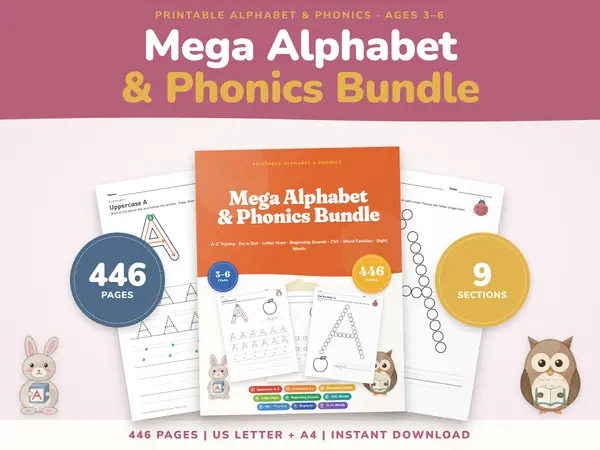
Alphabet Worksheets and Phonics Bundle
446 pagesUS Letter + A4KindergartenEnglish
See price and buy on EtsyBy the Clipart Scout teamUpdated 26 words
Short answer
The English alphabet has 26 letters: 5 vowels (A, E, I, O, U) and 21 consonants. Each letter has a capital form (A) and a small form (a), and each has a name that is different from its sound: the letter C is named "see" but sounds like /k/ in cat. Learn the names first, then link each letter to a picture word such as A for apple.
This page shows all 26 letters, each with a picture word, its pronunciation and a short example sentence. Tap the speaker button to hear a letter or its word. Below the list you will find ways to teach the alphabet, a quick practice and the letter mix-ups that come up most often.
A letter has two things to learn: its name and its sound. Start with the names, because they are used for spelling and for the ABC song, and add the sounds a few letters at a time, always with a word the child already knows.
| Listen | Letter and word | Example |
|---|---|---|
| Aa | apple 🍎/eɪ/ · /ˈæpəl/ | A is for apple. |
| Bb | ball ⚽/biː/ · /bɔːl/ | B is for ball. |
| Cc | cat 🐱/siː/ · /kæt/ | C is for cat. |
| Dd | dog 🐶/diː/ · /dɔːɡ/ | D is for dog. |
| Ee | egg 🥚/iː/ · /eɡ/ | E is for egg. |
| Ff | fish 🐟/ef/ · /fɪʃ/ | F is for fish. |
| Gg | goat 🐐/dʒiː/ · /ɡoʊt/ | G is for goat. |
| Hh | hat 👒/eɪtʃ/ · /hæt/ | H is for hat. |
| Ii | igloo/aɪ/ · /ˈɪɡluː/ | I is for igloo.The letter I is named "eye". As a word, I is always a capital. |
| Jj | juice 🧃/dʒeɪ/ · /dʒuːs/ | J is for juice. |
| Kk | kite 🪁/keɪ/ · /kaɪt/ | K is for kite. |
| Ll | lion 🦁/el/ · /ˈlaɪən/ | L is for lion. |
| Mm | moon 🌙/em/ · /muːn/ | M is for moon. |
| Nn | nose 👃/en/ · /noʊz/ | N is for nose. |
| Oo | octopus 🐙/oʊ/ · /ˈɑːktəpʊs/ | O is for octopus. |
| Pp | pig 🐷/piː/ · /pɪɡ/ | P is for pig. |
| queen/kjuː/ · /kwiːn/ | Q is for queen. | |
| Rr | rabbit 🐰/ɑːr/ · /ˈræbət/ | R is for rabbit. |
| Ss | sun ☀️/es/ · /sʌn/ | S is for sun. |
| Tt | tiger 🐯/tiː/ · /ˈtaɪɡər/ | T is for tiger. |
| Uu | umbrella ☂️/juː/ · /ʌmˈbrelə/ | U is for umbrella. |
| Vv | van 🚐/viː/ · /væn/ | V is for van. |
| Ww | water 💧/ˈdʌbəljuː/ · /ˈwɔːtər/ | W is for water.The name of W is "double-u", two words, not "we-we". |
| Xx | box 📦/eks/ · /bɑːks/ | Box ends with X.X is at the end of the word in box, not at the start. |
| Yy | yo-yo 🪀/waɪ/ · /ˈjoʊ joʊ/ | Y is for yo-yo. |
| Zz | zebra 🦓/ziː/ · /ˈziːbrə/ | Z is for zebra.American English says "zee"; British English says "zed". |
Look at the picture or number and choose the right English word. Ten questions each round.
Sing the alphabet song together at a slow pace and point to each letter on a wall chart as it is sung. The tune gives the child the order of the letters. Later, stop at a random letter and ask the child to say what comes next.
Roll play dough snakes and bend them into letters, or lie on the floor and make an L or a T with arms and legs. Making the shape with the whole body helps young children notice how each letter is built, and the name is said every time.
Choose one letter each day. Say its name and sound, then look for it on cereal boxes, signs and book covers, and find three objects at home that start with it. Keep the game short and stop while the child is still interested.
Write the capital letters on one set of cards and the small letters on another. Lay them face up and ask the child to pair A with a, B with b. Start with six letters and add more once the pairs come easily.
Pour a thin layer of sand, salt or dry rice into a tray. Say a letter, then let the child draw it with a finger while you both say its name. Shake the tray to start again. It is a quiet activity that practices the hand movements of writing.
Hide picture cards for the words on this page (apple, ball, cat) around the room. When the child finds one, they say the word and then the first letter: "Ball. B." This links the letter to a real word and a sound.
A is said "ay", E is said "ee" and I is said "eye". Learners often say E as "eh" or I as "ee". Say all five vowels together (ay, ee, eye, oh, you) and have the child repeat them.
G is "gee" and J is "jay". They look different but the names are easy to mix up when spelling aloud. Practice with a short word the child knows, such as the letters in "goat" and "juice", saying each letter name slowly.
The name of W is "double-u", spoken as two short parts. The letter is not named "we". Say it with the child a few times and point out that it looks like two Vs joined together.
American English says "zee" for Z and British English says "zed". Both are correct. Pick the one used in your books and songs.
The name of a letter is not always its sound. C is named "see" but sounds like /k/ in cat; Y is named "why" but sounds like /y/ in yo-yo. Teach both, and tell the child which one you mean: "This letter's name is C. Its sound is /k/."
446 pagesUS Letter + A4KindergartenEnglish
See price and buy on Etsy703 pagesUS Letter + A4Ages 3–5English
See price and buy on Etsy713 pagesUS Letter + A4Kindergarten to 4th gradeEnglish
See price and buy on EtsyThere are 26 letters. Five are vowels (A, E, I, O, U) and the other 21 are consonants. Each letter can be written as a capital (A) or a small letter (a).
The vowels are A, E, I, O and U. All the other letters are consonants. The letter Y can sound like a vowel in words such as gym, but it is counted as a consonant in the list of 26 letters.
Both. American English says "zee" and British English says "zed". The letter is the same. Teach the one used in the books, songs and videos your child already hears, and keep to it.
Start with the letter names in alphabetical order, using the ABC song, so the child learns the order. Then add sounds a few letters at a time with picture words. A short session each day works better than one long one.
Many teachers introduce both together because the child sees both in books. Begin with the capital letters or with the small ones, whichever your materials use, and match the pairs once the child knows about ten letters.
Teachers and parents are welcome to link to this page. Copy the address or the ready-made link.